
Just a dream
I first really heard about North American Wall in the fall of 2019. I had just climbed the Nose and Lurking Fear with Jon (One of my primary climbing partners and best friends). While on The Nose, we met a pair of Kiwi’s (folks from New Zealand) whom we befriended, James and Tanja. After The Nose, the Kiwis went for a clean ascent of North American Wall, for their second wall ever. Now having done NA Wall, I think that is one of the most bad ass things any of my friends have done.
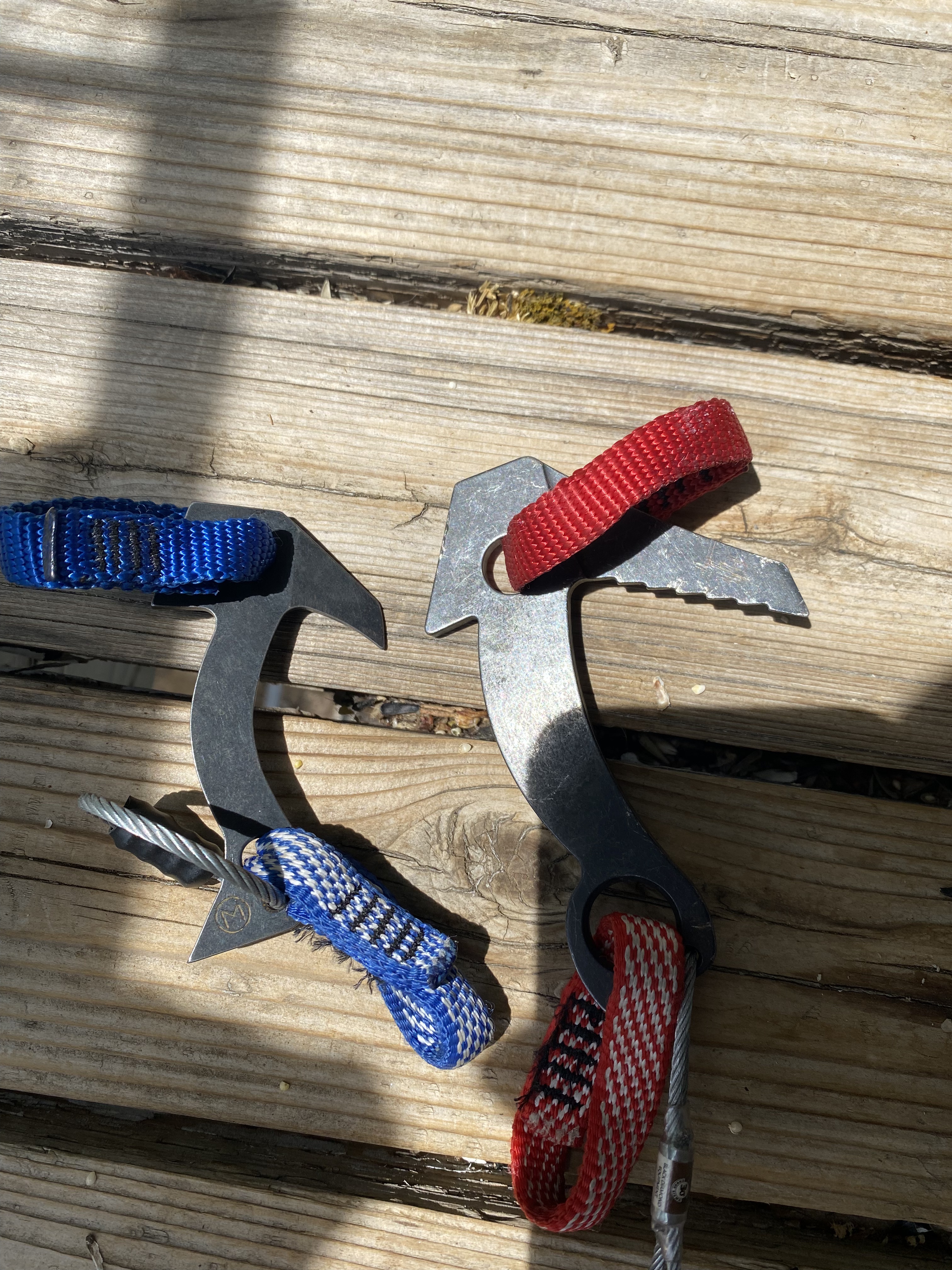
Once we were down from Lurking Fear we met up with them and exchanged stories in their van while they made us brownies. Side note: we also got harassed by the rangers that night, but that’s another story. James had said that he thought I would love NA Wall because I had told him how much I loved the sky hooking on Lurking Fear. Sky hooks are pointed pieces of metal that you place on divets and irregularities in the rock to make upward progress. Generally speaking, you can’t leave hooks as protection if you fall, and they are less secure than camming devices in a crack. I took a look at the Topo (a map of the route) and chuckled. I had no idea how to nail (using a hammer to place pitons) and C4 (the hardest aid grade in the world without the use of a hammer aka ‘clean aid’) was a pipe dream. Maybe one day.
Spring 2022
Fast forward to the end of March, 2022 and I was preparing to leave for The Valley with no real plans. I had a couple of friends who may come later in the trip, but my first 2 weeks were free. Perry was coming for a good chunk of time, but El Cap was off the table. Perry was waiting to climb El Cap for his first time with his fiancé, Camryn. I consider Perry and Camryn my direct family, as if they were my brother and sister. Last year Camryn and Perry were supposed to climb Lurking Fear, but there was an accident and she broke her leg on the approach. We are hoping to try again (Triple Direct this time) as a team this upcoming fall (2022). Jon was planning to come, but for too short of a window to do a proper wall. Ultimately, Jon got a new job and ended up not being able to make it.
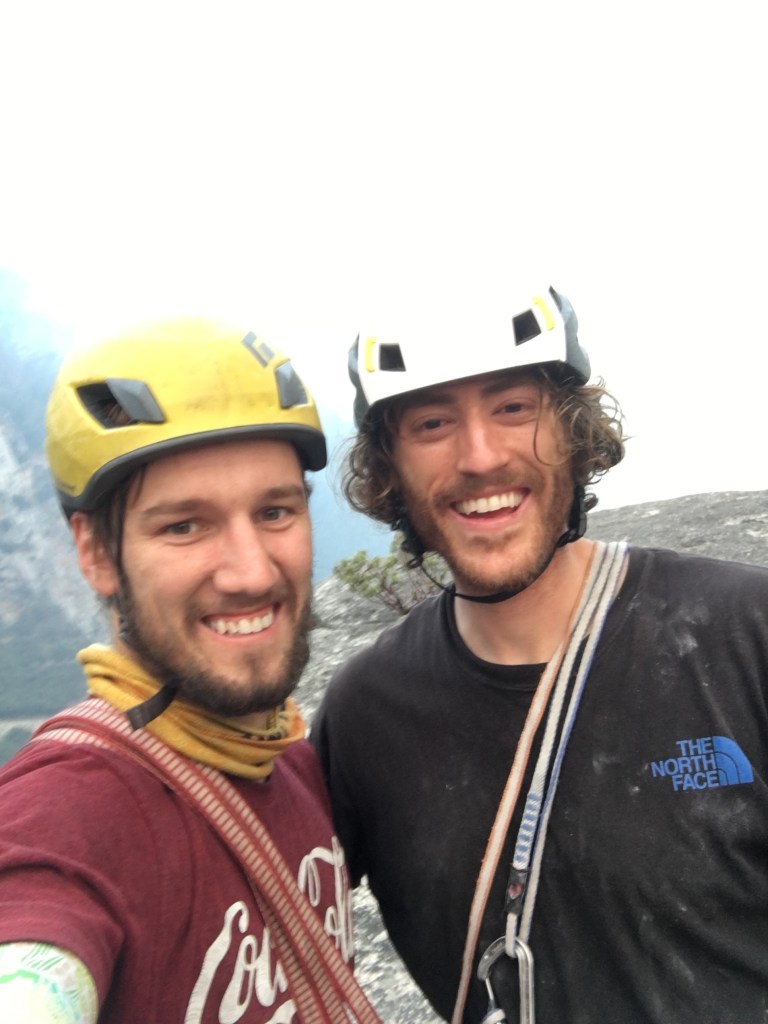
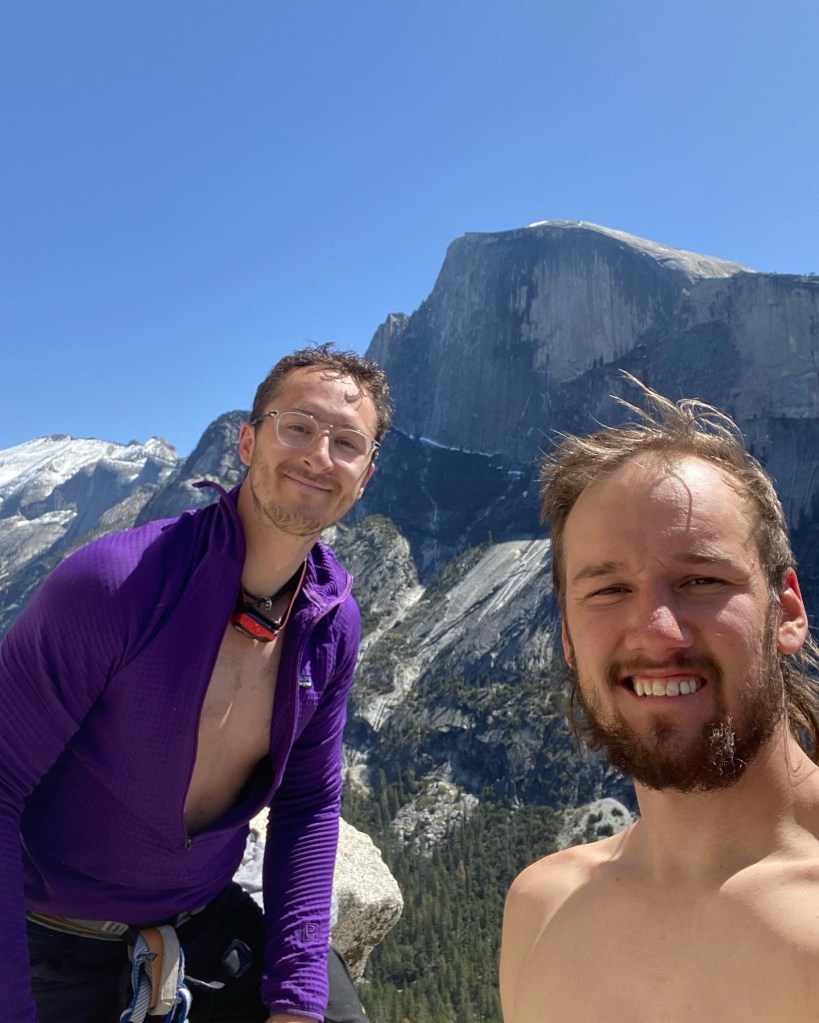
I wound up in Yosemite on April 1 and made plans to climb with a random person named Ben who I knew not at all. He made a post on a Facebook group looking for a partner for the weekend and was offering a spot at his Pines Campground. It was the perfect start to the trip for me. I could get a little free climbing (using ropes and gear to protect you in case you fall, but only using your hands and feet to progress up the rock) in and I got established in the park and had 2 days to get myself a spot in Camp 4, a first come first serve campground in The Valley. That first day Ben and I climbed Serenity Sons and we had a blast. I really enjoyed climbing with Ben and we got along quite nicely. Long story short, I invited Ben back out to climb his first wall.

Ben was super stoked on the idea, but we had a hard time finding a route that suited both of us. Initially, I agreed to the Nose, the most sought after route on El Capitan. My thought was I had only led half the route, having jugged the other half(When you wall climb, usually one person climbs a pitch, and the other climbs the rope with a rope ascending device). This time I could lead the pitches that I hadn’t yet climbed. Later that week I climbed the Salathe with another new partner, and while things went quite well, I found the entire thing rather underwhelming. Whenever anyone asked me how The Salathe went, the only thing that came to mind was “casual.” While that isn’t entirely true or fair, and I did have a blast on it, I didn’t feel satisfied. I needed to do something harder.
The more I looked at it, North American Wall seemed perfect. There were 26 pitches in total, 9 that were C1 or relatively easy free climbing, 8 at C2, 8 at C3, and 1 C4. I told Ben I would take all of the pitches harder than C2 and he could have everything below C2. He could also decide which C2 pitches he wanted to do, and I would take whatever he didn’t want to do.

Aid climbing is when one uses the gear they place in the rock, to assist with upward progress. A free climber generally thinks of aid climbing as cheating. If a pitch is done ‘clean’ that means a hammer was not used. If a hammer was used, then the pitch gets an ‘A’ grade. If not, then a ‘C’ grade is given. Aid grades are either A0-A5 or C1-C4. The lower the number, the safer and easier (usually) the pitch is. So a C1 means just about every piece you place can take a fall and hold, whereas C4 means that there will be a long section where the gear you place cannot hold a fall. Often times it means that the falls will be particularly gnarly and will likely result in significant injury. A5 is the hardest aid grade in the world and someone has proposed that there is a section in the pitch that if you were to fall, death is likely.

Ben was confident in his ability to haul (bringing all the gear up), clean (taking all the gear out of the cracks), and lower out (a rope trick where the second has to move sideways to get back below the gear that has been placed.) I was beyond confident in our ability to get it done. I had never failed on El Capitan before, and I wasn’t planning on starting now. With a very tiny small amount of prodding I had convinced Ben we could do it, and he was in.
In the weeks leading up to Ben’s arrival for what would be my last week in the valley, I talked to a few people I met along the way about my plans. The first was Greg, a climbing guide in Yosemite, whom I met on the South Face of Washington Column. Greg had some wisdom to share and relayed that he had done NA Wall and found it to be quite the challenge. Furthermore, he said that he wouldn’t bring a first timer on it. One thing Greg said that stuck with me, and that I thought about often on the route, was that he had to use all the tricks and knowledge he had gathered from all of his previous walls to find success on NA Wall. That proved to be true for me as well.
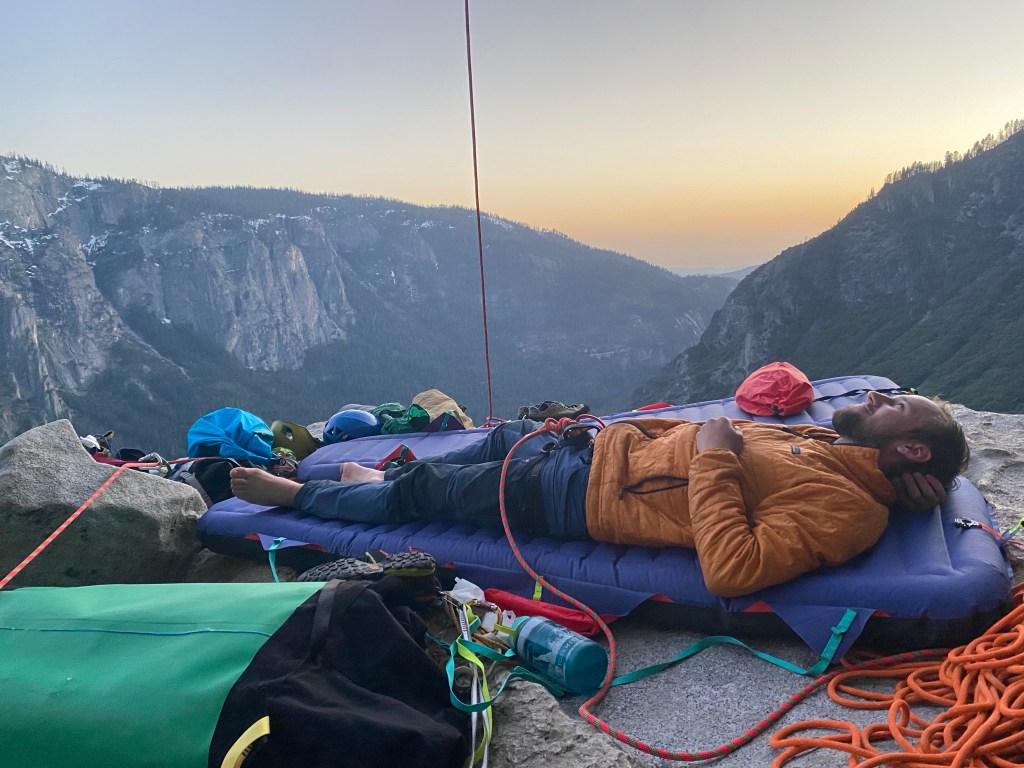
A few days before starting up NA wall I met another climber, Lance. He was going up Zodiac on an NPS project to do research on the Bats in Yosemite. Very cool stuff, and I got to share that I had seen a lot of bats on the Salathe headwall. Lance encouraged me to make sure I kept my partner stoked and we would be fine and get it done. The thing Lance said to me that stuck with me was that to do NA Wall you have to be able to free climb as hard as on the Salathe, while also being able to aid as hard as on Zodiac, and that’s something that a lot of folks just can’t do. This was both encouraging and intimidating. Encouraging because I knew that I had the ability to do that, but also intimidating because I knew that NA Wall was going to be much harder than anything I had done before. NA Wall has a reputation for being a little loose and sketchy in places. The free climbing can be hard to protect and the aid is harder and more sustained than the aid I had done in the past.
Humping, Fixing, and Hauling
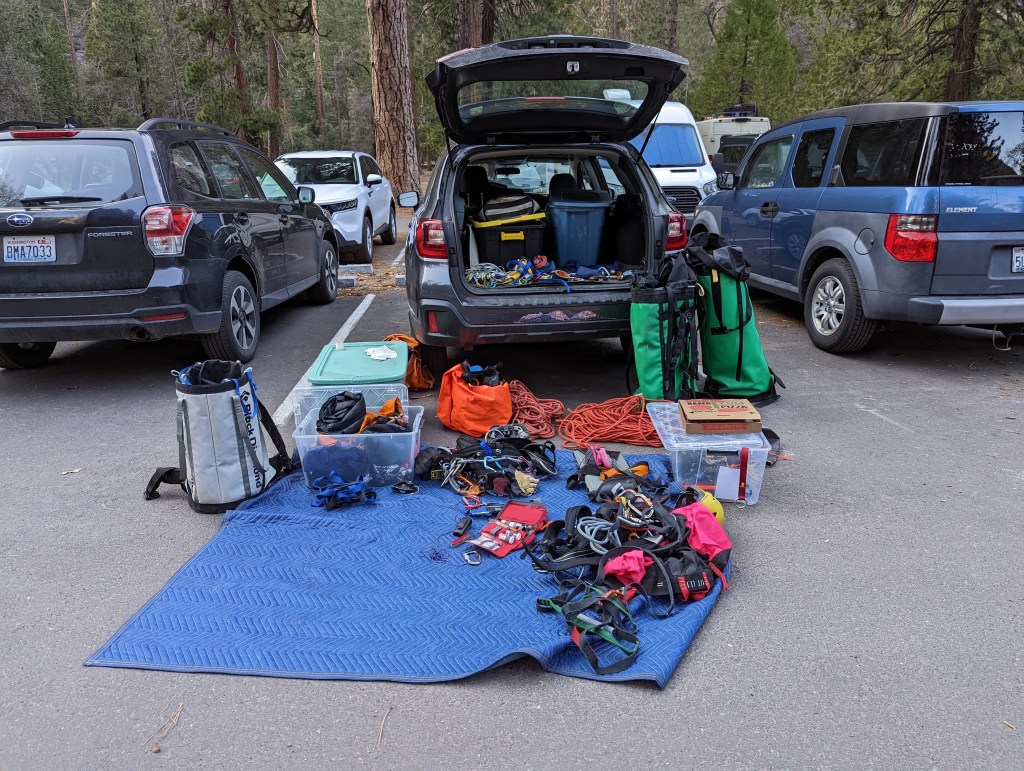
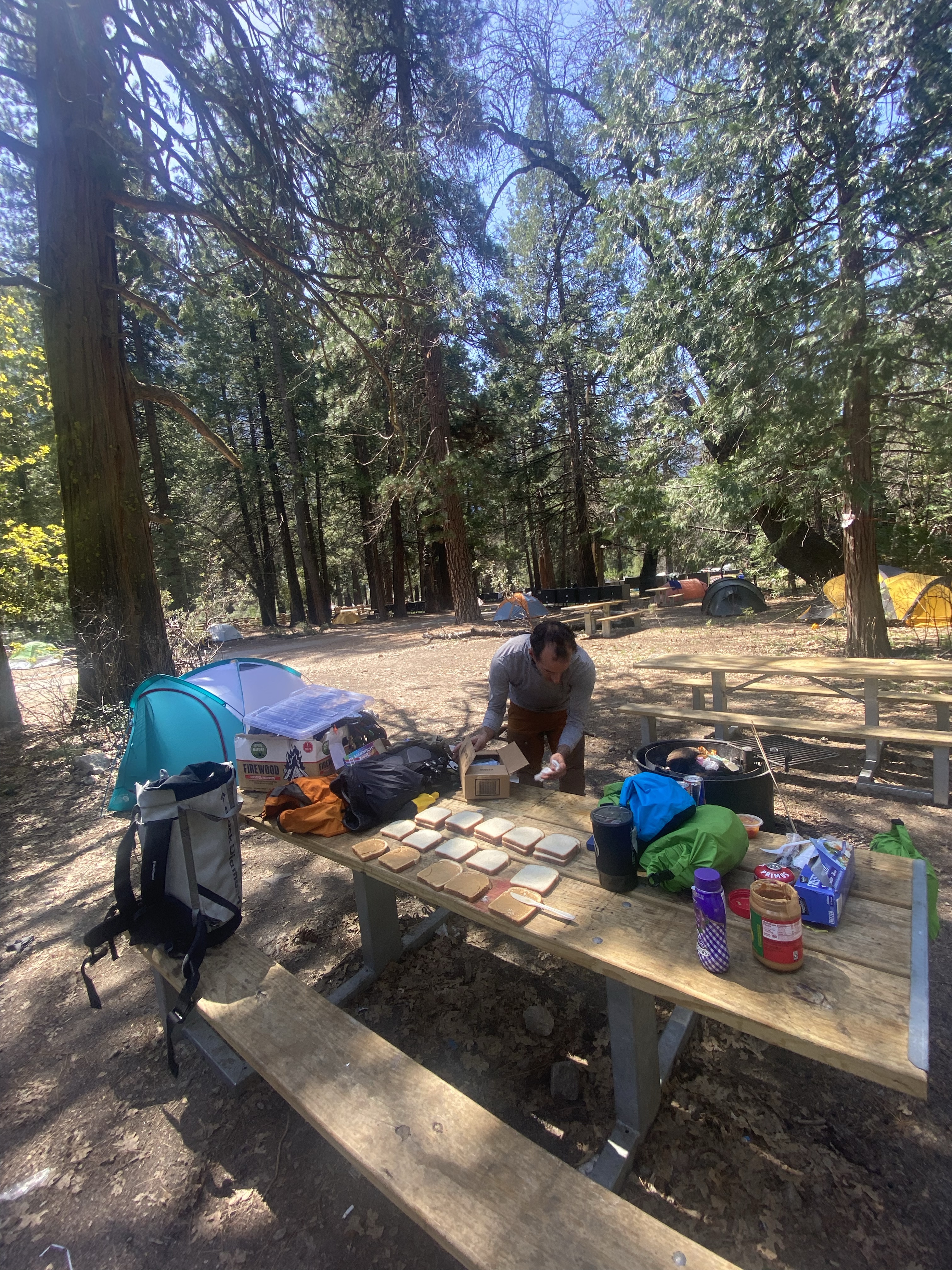
The weather window for the week that Ben was going to be there was absolutely splitter. We couldn’t have asked for a better forecast. Saturday morning I woke up and hiked 3 gallons of water to the base of the route. This served a dual purpose for both finding the start of the route and reducing the load we had to later hike up. Ben got in with enough time that we were able to hike up another 5 gallons of water that afternoon to the base of the route, leaving us with 8 total. Our plan was to hopefully do the route in 4 days, and this gave us the normally prescribed gallon/day per person. I tend to drink quite a bit less water than that as well, so it left us some wiggle room for another day or two if needed.

The next day we got up, had a nice big breakfast at Curry Village, and then went to climb the first 4 pitches of the route. While not the actual crux of the route based on grade, I had heard numerous times that the first 4 pitches were the sustained aid crux of the route. Another stipulation that Ben and I had discussed was that if we didn’t do well on the first 4 pitches, we could always change plans and climb something else. We took our time that morning getting up to the base as we figured we had all day to climb a mere 4 pitches. That being said, we finished in the dark! We felt fairly slow, but it ended up being a good indicator for our pace for the rest of the route.
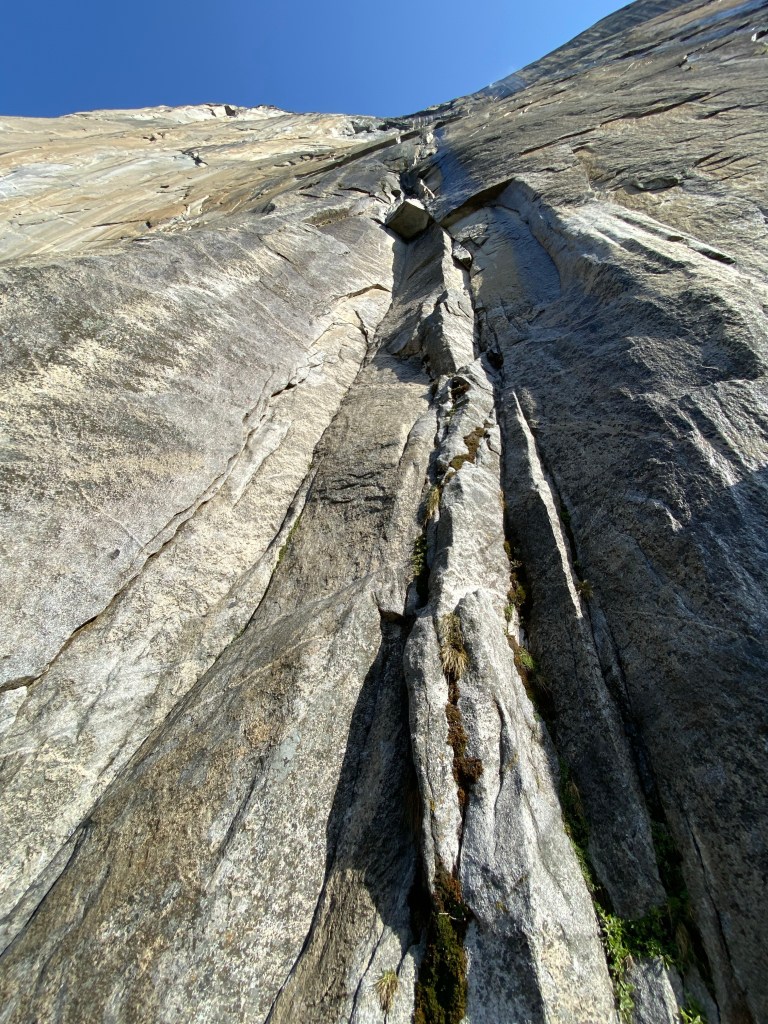
Ben started us off with Pitch 1, his first ever C2 amid a barrage of other firsts. Looking at the first pitch, I thought starting on the right would be the way to go. Ben thought the left looked better, and that ended up being a great read on his part. Ben absolutely crushed it, placing his first ever cam hooks, sky hook, and beak (hand placed behind a broken nut stuck in the crack). By then end of the first pitch Ben had pretty much used all of the tools that would be required on the route. We were off to a great start.


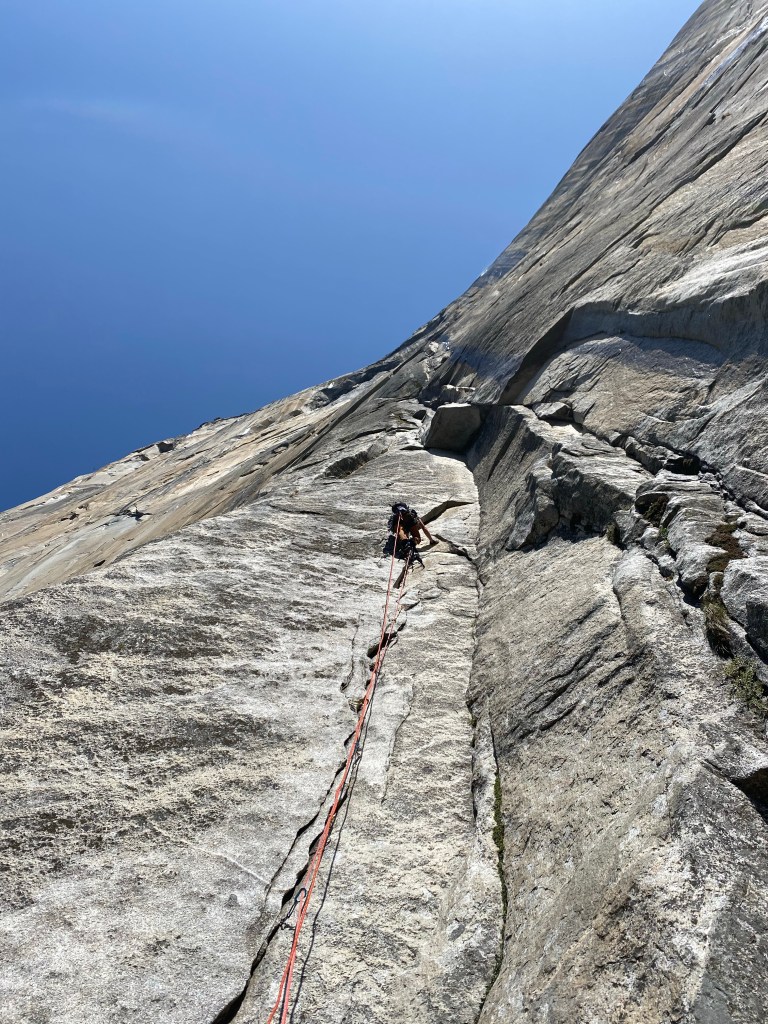
I took pitch 2 and 3. While I don’t remember pitch 2 very well, I will never forget pitch 3. I have always typically tried to avoid fixed copperheads (bits of aluminum or copper smashed into the rock with a hammer,) trying to place around them and not use them. On this particular pitch there were large sections of rock that had nothing but fixed copperheads. I tried skipping them for a bit, even using hand placed beaks to “hook” on top of them, but eventually I relented and just treated them like the fragile bolt ladder they were. Initially, I clipped my rope into all of them, but somewhere along the way I started thinking that if I ripped one, and fell on the ones I had clipped, I may rip those too. If I ripped those as well, I would then be forced to put in new ones, something I wasn’t super stoked on doing if it could be avoided. At that point I stopped clipping into them, and just risked a big whipper onto the bolt far below if one ripped out.
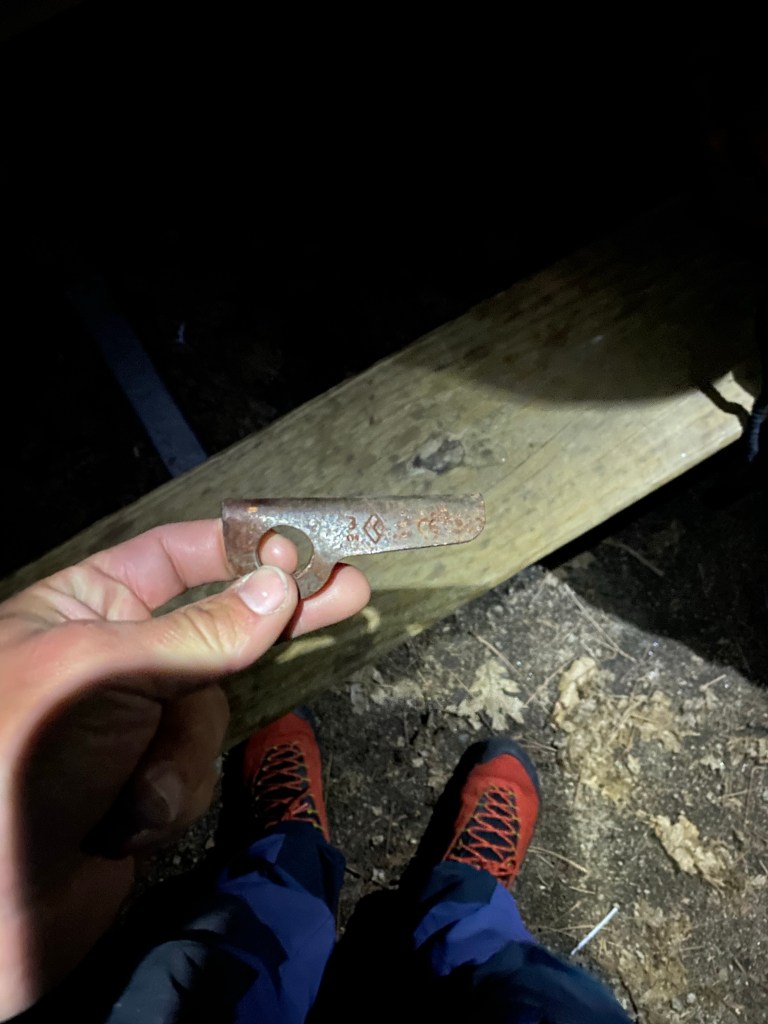
Pitch 4 was one that I figured I may have to do when first reviewing the topo. But when we got up there, Ben was stoked to get after it. It had a C2 crack to start and C2+ hooks to finish. Ben performed beautifully, absolutely crushing it. Ben encountered his first rivet (a smaller and more fragile version of a bolt) which he initially didn’t see. Ben quite enjoyed the rightward hook traverse high up the pitch, and found it to be a bit reachy. It was very obvious to me at this point that I had made a wise decision in my choice of partner, and that we were in fact going to get this thing done. We arrived at Mazatlan Ledge, the top of pitch 4, under the cover of darkness. We fixed our two ropes to the ground and rapelled down, approximately 400 feet, intending to haul the remainder of our equipment up the following day. Once we touched the ground, Ben looks at me and tells me he can’t find his keys. We search for a bit, but soon realize there are two options: they are either in the car down at El Cap Bridge, a 45 minute hike away, or they are 400 feet above us, on Mazatlan ledge. We took a gamble and hiked down to the car, thinking we would find them casually sitting in the ignition. We were mistaken.
We asked one fellow climber for a ride back to Camp 4, but he told us he was going to bed. This left Ben a little annoyed, but I wasn’t terribly surprised. The 2 mile walk back to camp 4 did suck quite a bit, especially knowing that my keys were locked in ben’s car along with both of our wallets. So much for a nice big breakfast first thing in the morning.
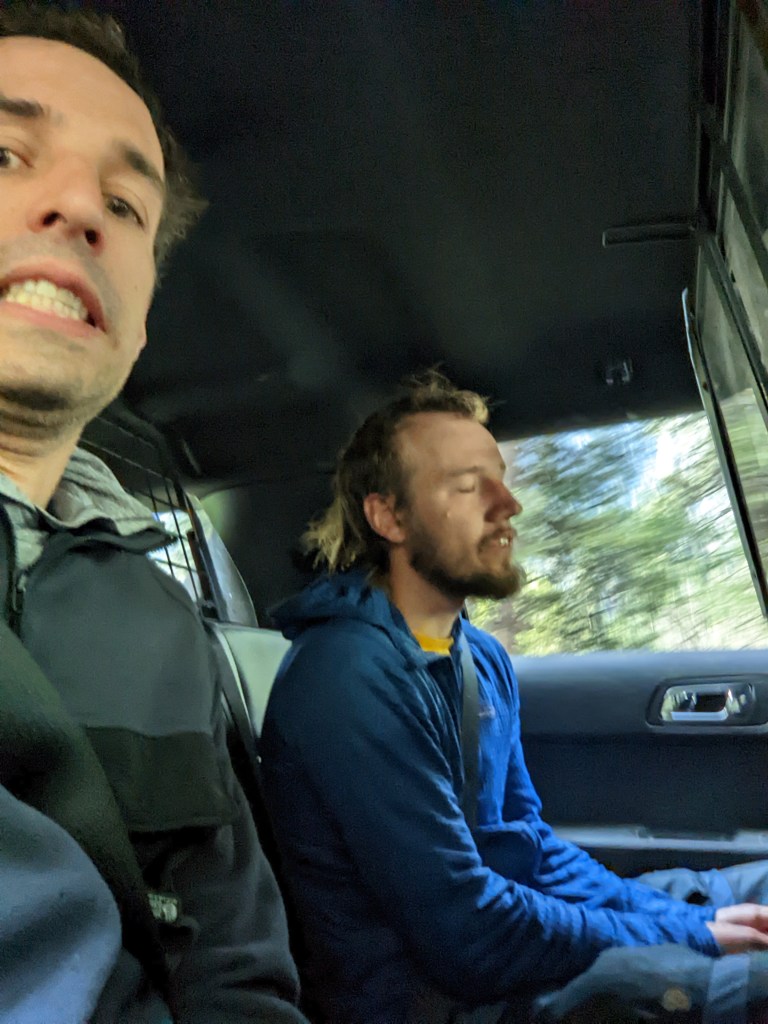
The next day went about as smoothly as one could have hoped for. Some very nice rangers got Ben’s car unlocked in no time at all, and even gave me a ride back to camp 4 to retrieve my vehicle. Bonus: we were able to grab breakfast at Curry before they closed. With access to my vehicle now, we headed back to camp 4 and packed up our haul bags for our adventure. We timed our hike to hopefully put us at the base right around the time the route went into the shade. That went to plan and worked out quite nicely. We began jugging, and the first 200 feet was overhanging. We immediately regretted our plan, wishing we had instead planned to sleep on Mazatlan ledge that night, as the jugging was quite strenuous. In hindsight though, we both think that getting dinner on the ground that night was nice. After getting back to Mazatlan ledge we did find Ben’s car keys, which came down with us this time. We hiked out, drove back to Camp 4, and got to bed early. While we had considered waiting until after a delicious breakfast to start the next morning, ultimately we had a big agenda for the day (the top of Pitch 11) and opted to start earlier in the morning so that we could get a head start on the day.
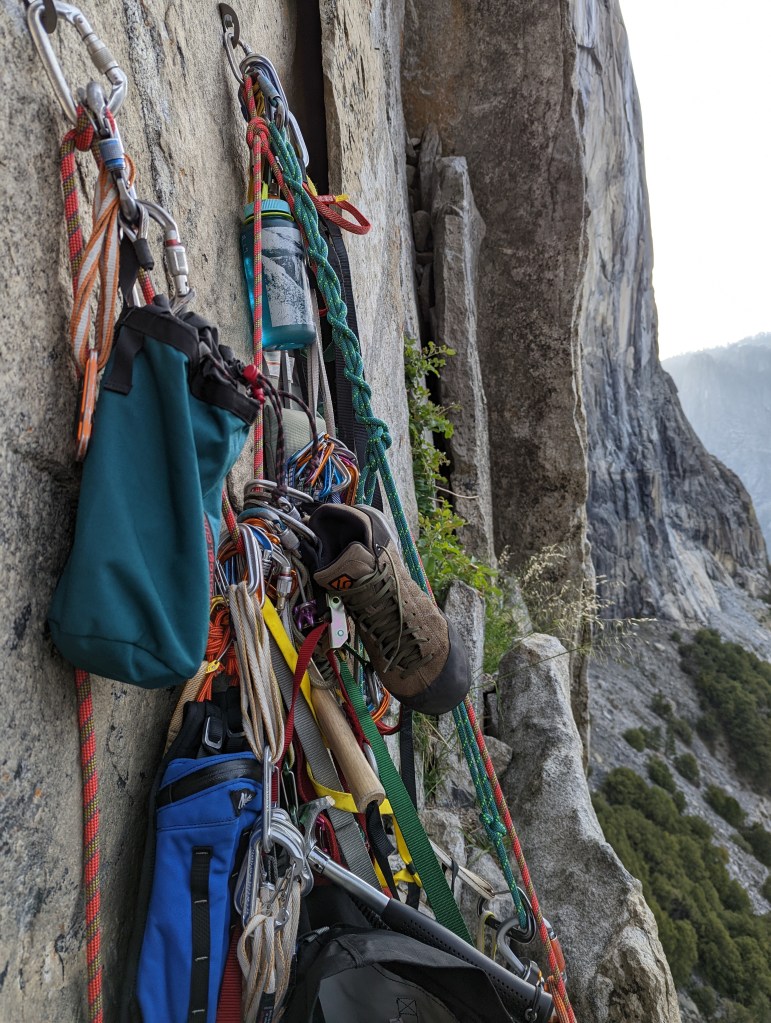
Day 1- Pitch 5-11


Monday morning we hiked back up for what was my 5th time and Ben’s 4th to the base of the route. For some reason I find the hike up the east side of El Cap a lot more pleasant than the west side. We jugged our way back up to Mazatlan ledge and Ben took the sharp end for what ended up being his favorite pitch of the route. Ben found the burly chimney a touch harder than the advertised 5.8 and loved the exposure of exiting out the roof to the C1 crack above. Ben placed an inverted nut to keep the rope out of the crack after pulling the roof, and that worked really well.
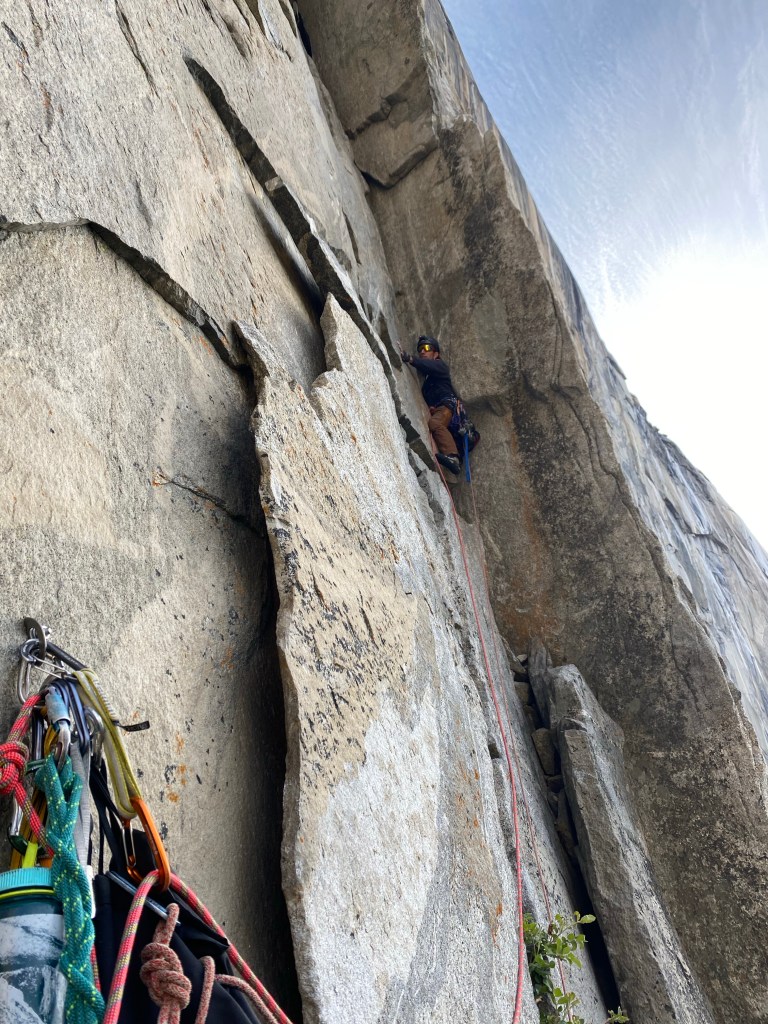
Ben took Pitch 6 and did a tension traverse to reach Easy Street which was agonizingly close at the last bolt. The last little bit to the awesome belay stance was easy, but again, a bit harder than the advertised 5.6. Ben passed up on placing some protection at the bottom of this section which he later regretted as there wasn’t much pro to be had higher up.
I took back the sharp end for the first C3 of the day. My memory of this pitch is a bit hazy, but I do recall it being rather easy in comparison to the other C3 pitches on the route.
Pitch 8 may have been my favorite of the route and is a moment in time I will look back on and smile for the rest of my days. Lance had told me that it was a wild pitch that I should make sure I took. At the top of the C1 crack, one has 2 options on the topo. You can either do a C2+ hook variation straight right, or you can pendulum down and right to a set of bolts, to a section labelled on the topo as 5.10 ‘weird’. I had thought about doing the hook variation in the days leading up to the climb, but figured I may just opt for the penji when I actually got there. At the top of the crack I scoped out both ways and I simply didn’t want to give up any ground to do the pendulum. The more I looked at it, the hook variation looked free climbable, even for a mere mortal such as myself. I fifi’d (a small hook on your waist that you use to attach yourself to your closest piece)into my top piece, put away the aiders, took a deep breath, and set off free climbing. As I worked across the traverse, I entered a trance of sorts and was able to block out everything that wasn’t the very next move. With no chance of placing any protection, I had to be absolutely locked in, and I was. I don’t know what the grade of the climbing was. My ego wants to say 5.10, but it was probably more along the lines of 5.8 or 5.9. In any case, I was at the end of the traverse and now entered a 5.10 A/C3 section that would be followed by 5.7R to the end of the pitch.
I was so thrilled after having just freed the last section, I decided to just go for it. There was a brief section that was slightly harder than the rest, and I was able to throw in a #1 cam to protect that move, but I immediately removed it to ensure Ben was able to clean the pitch without issue. If you leave protection along traverses it can be very difficult, and sometime impossible, for your second to get them back. I was probably looking at an 80 to 100 foot fall if I blew it before I finally got a piece in that lined back up with the original crack I started in. I stayed in the flow, and cruised through the 5.7 R section until I was nearly at the end. I was so focused on the climbing in front of me that I actually traversed too far to the left before I realized I had gone the wrong way. I needed to reverse a few balancey moves to get to the anchor. Once I reached the anchor I was beyond elated at the moment I had just experienced, nearly 1,000 feet up The Captain, proclaiming it as the greatest pitch of my life. While that is probably not true, it was one of the greater climbing moments of my life, and it is moments like that one that I’m always searching for, and are so hard to actually find.
I handed the rope back to Ben for pitch 9, and while he has no memory of the pitch, I do know that he cruised it. We were on pace to get to pitch 11 and have a good first night on Big Sur Ledge.

The final 2 pitches of the day were mine and I was racing the sun to try and get done before the head lamps had to be turned on. I was still thriving on the feeling from my last pitch and decided to try and free this pitch at 10c rather than aiding it at C2. I’m glad that I did, as I found the pro incredibly spaced out and somewhat non existent. Perhaps it would have been easier if I had been in ladders and looking all over for placements, but it was a 4 star free pitch that catered to my style of climbing perfectly. The majority of the pitch was stemming with some techy edge climbing thrown in. There was one point where I had a pin scar at my face and my last piece of of pro was 10 feet below me. I had the choice of plugging up the scar with a perfect totem, or using the scar as my only hand hold, but not having any pro. I opted to send the pitch and left the cam hanging on my harness. A few power grunts later and I was on top of a pretty nice belay ledge looking up at the 5.7 chimney guarding Big Sur Ledge.
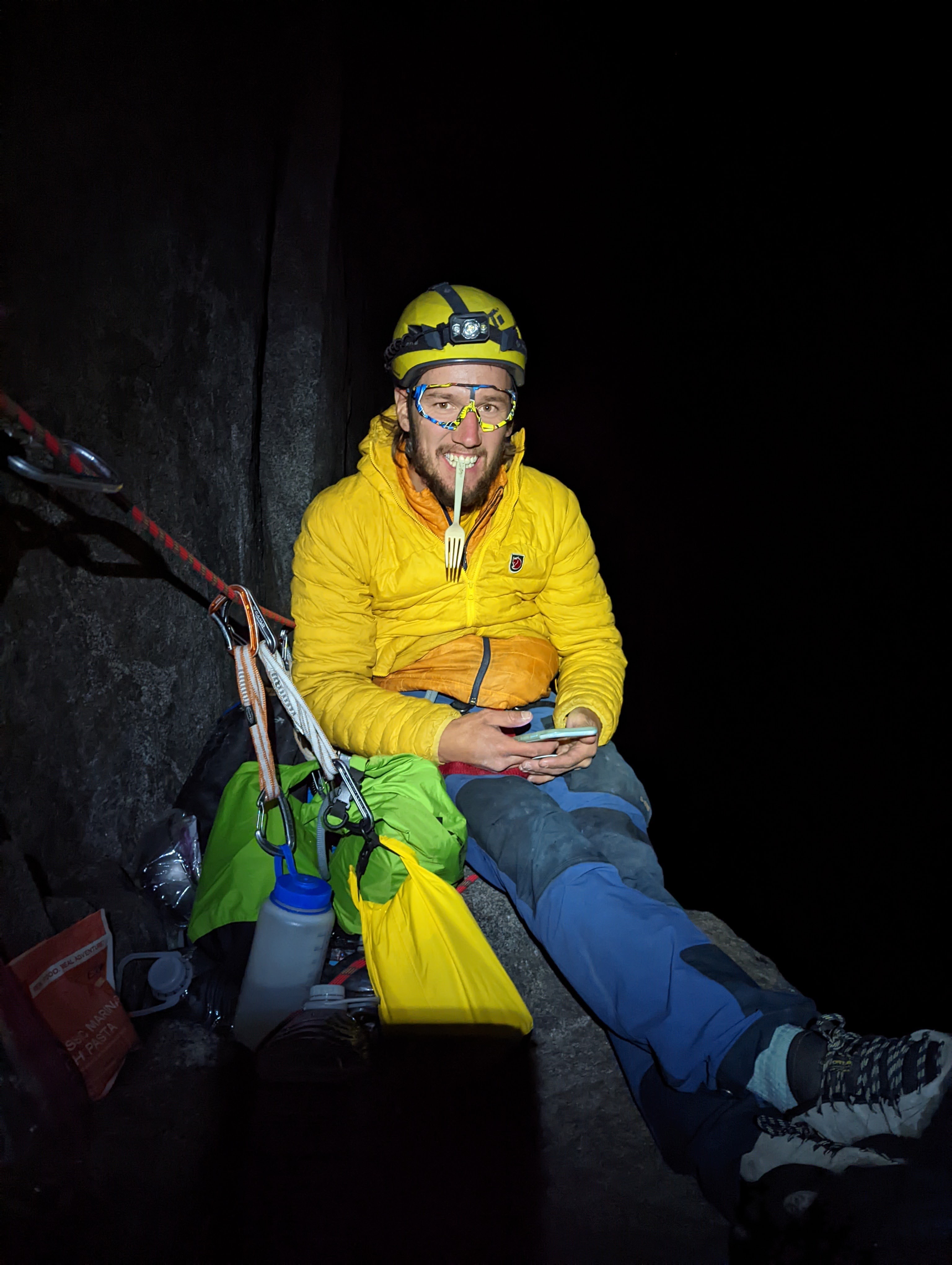
I was excited for the Chimney pitch as I had not done Texas Flake on The Nose when I climbed that route, and this looked a bit similar. I climbed the chimney facing outwards and about halfway up the thing I found a perfect crimp/foot rail to take a rest from the chimney thrutching that had been required up to that point. I placed my foot on the rail, and as I pushed my body upwards, the rock snapped beneath my foot. I began to fall and pushed every limb out as hard as possible arresting my fall and staying wedged in the chimney. From that point on I ignored all other edges for my feet and stuck to the tried and true chimney technique that saw me to the top. After some minor shenanigans figuring out how to get the ropes on the other side a of a chock stone on top, we had reached the infamous Big Sur Ledge right as the sun had gone down. Perfect.
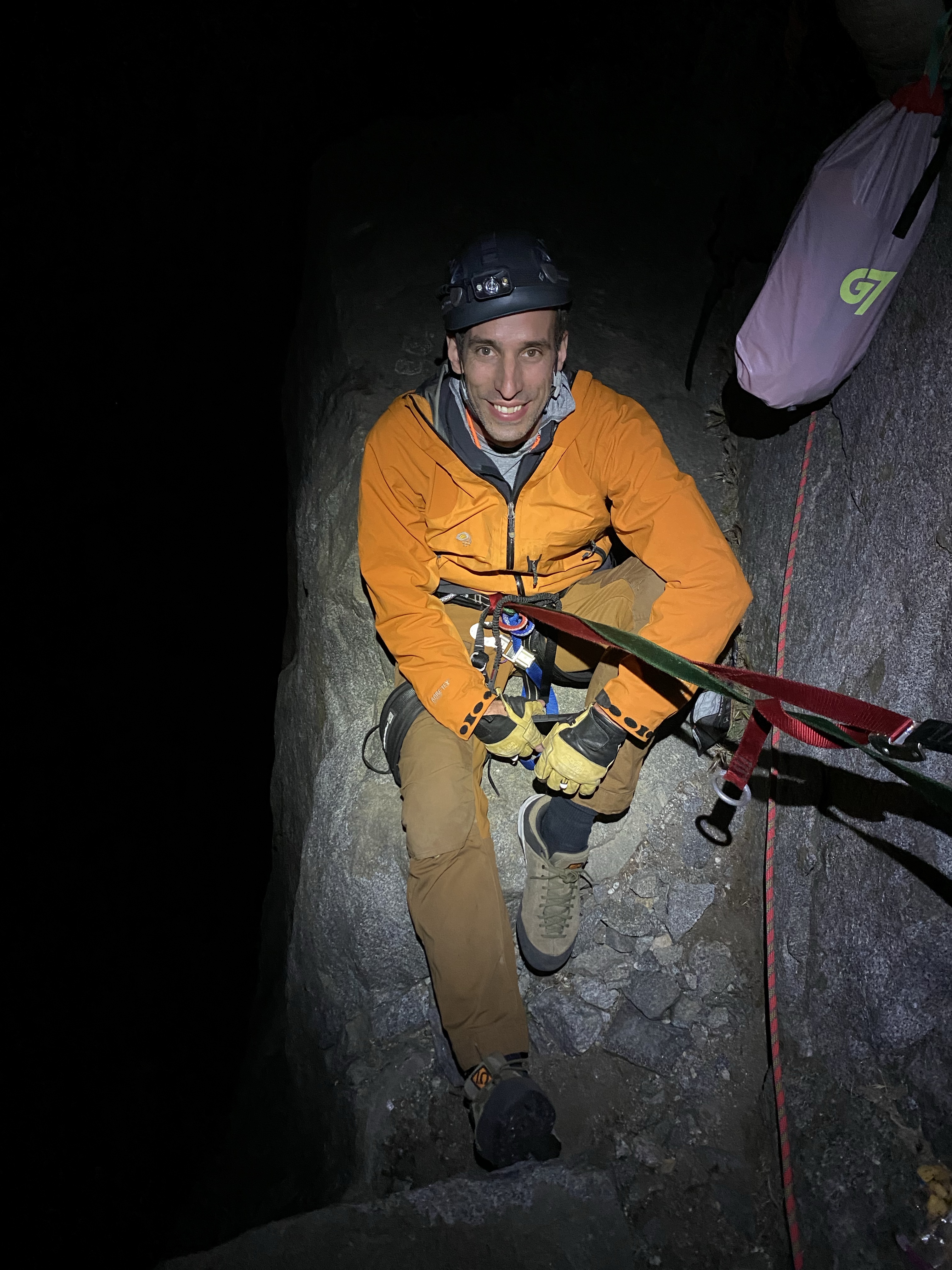
Day 2- Pitch 12-16
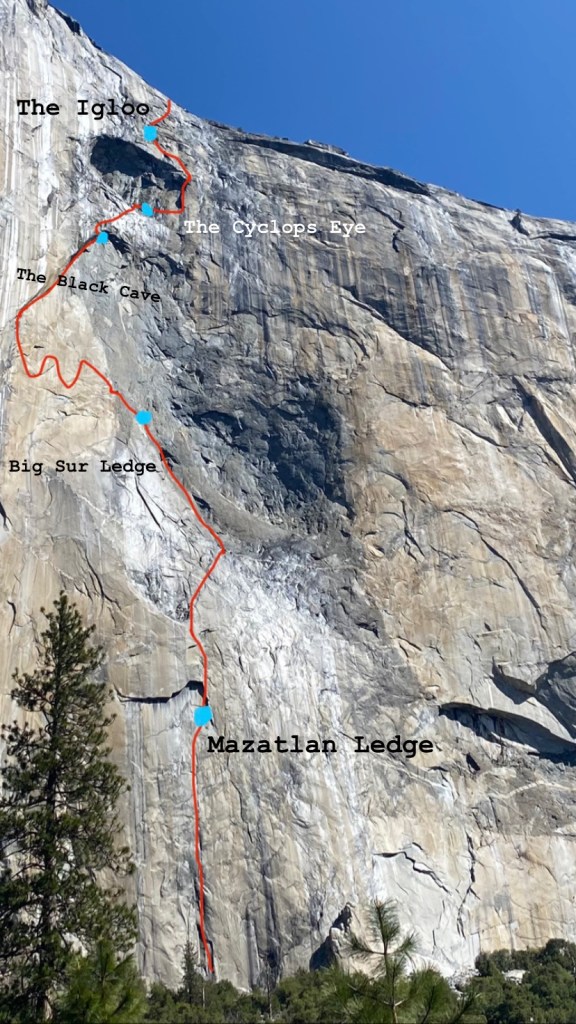
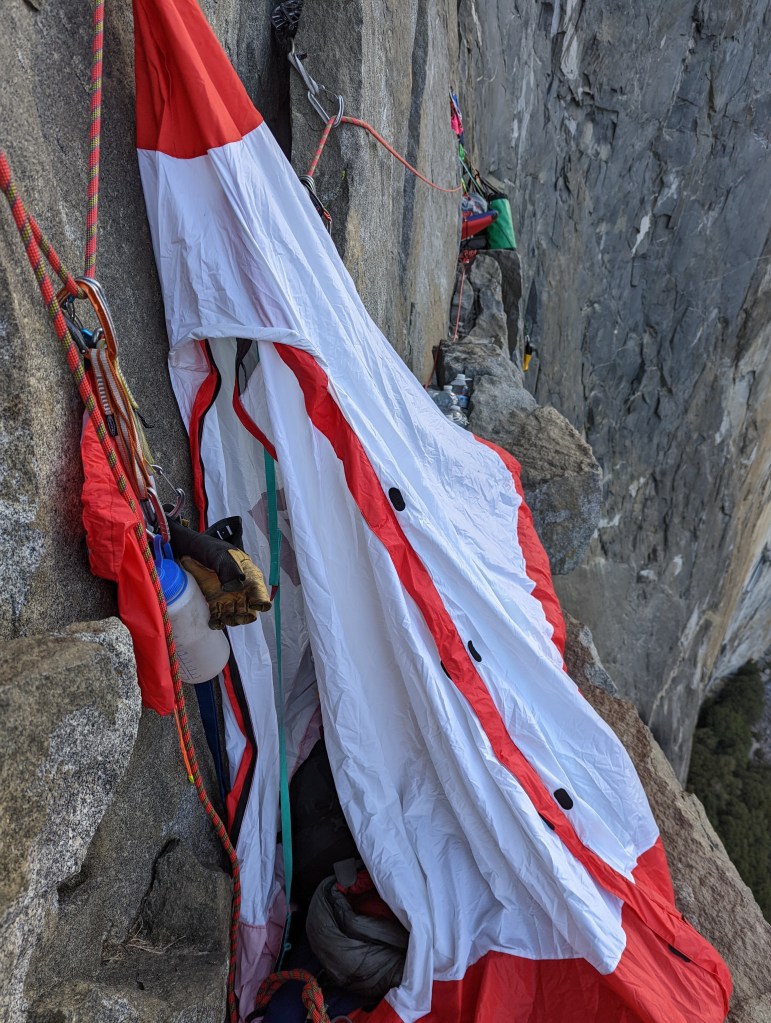
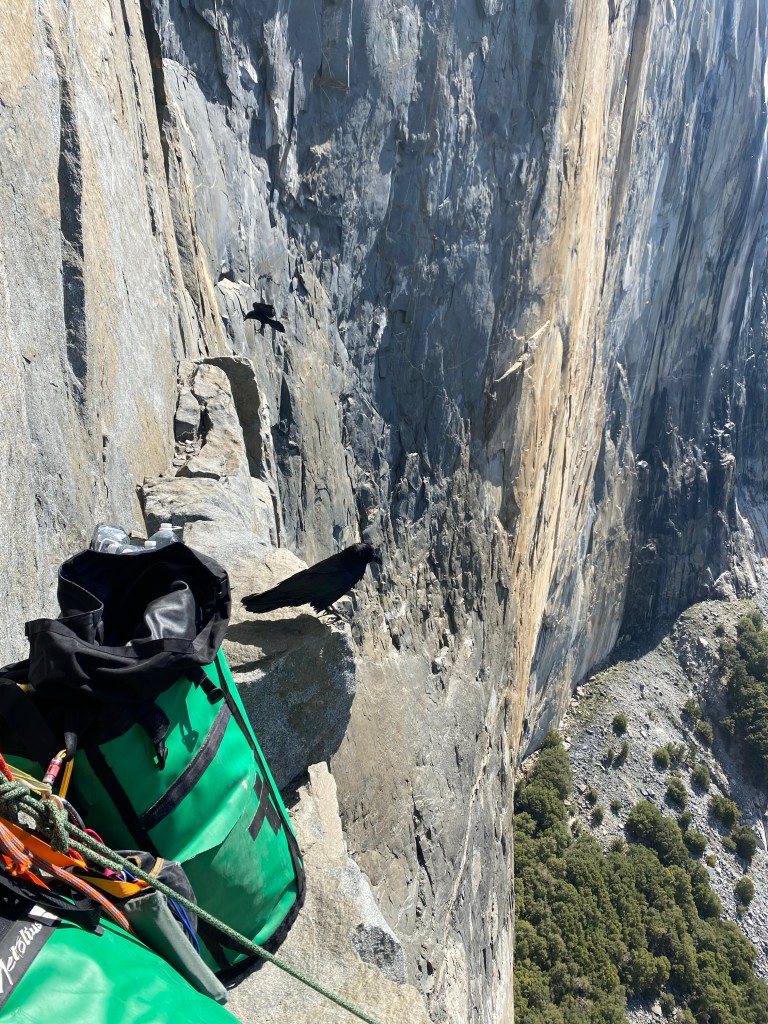
The goal was to reach the next sleepable ledge, which was pitch 18, at the bottom of the Cyclops Eye. Context clues will tell you we did not pull that off. This was the part of the route where things started to get a bit weird. The first ascent team spent a lot of time traversing, swinging, and flat out climbing in circles to avoid putting any bolts into the rock. A truly admirable style of climbing that made use of the natural features when it would have been easier to simply bolt some blank sections to go straight up at times.
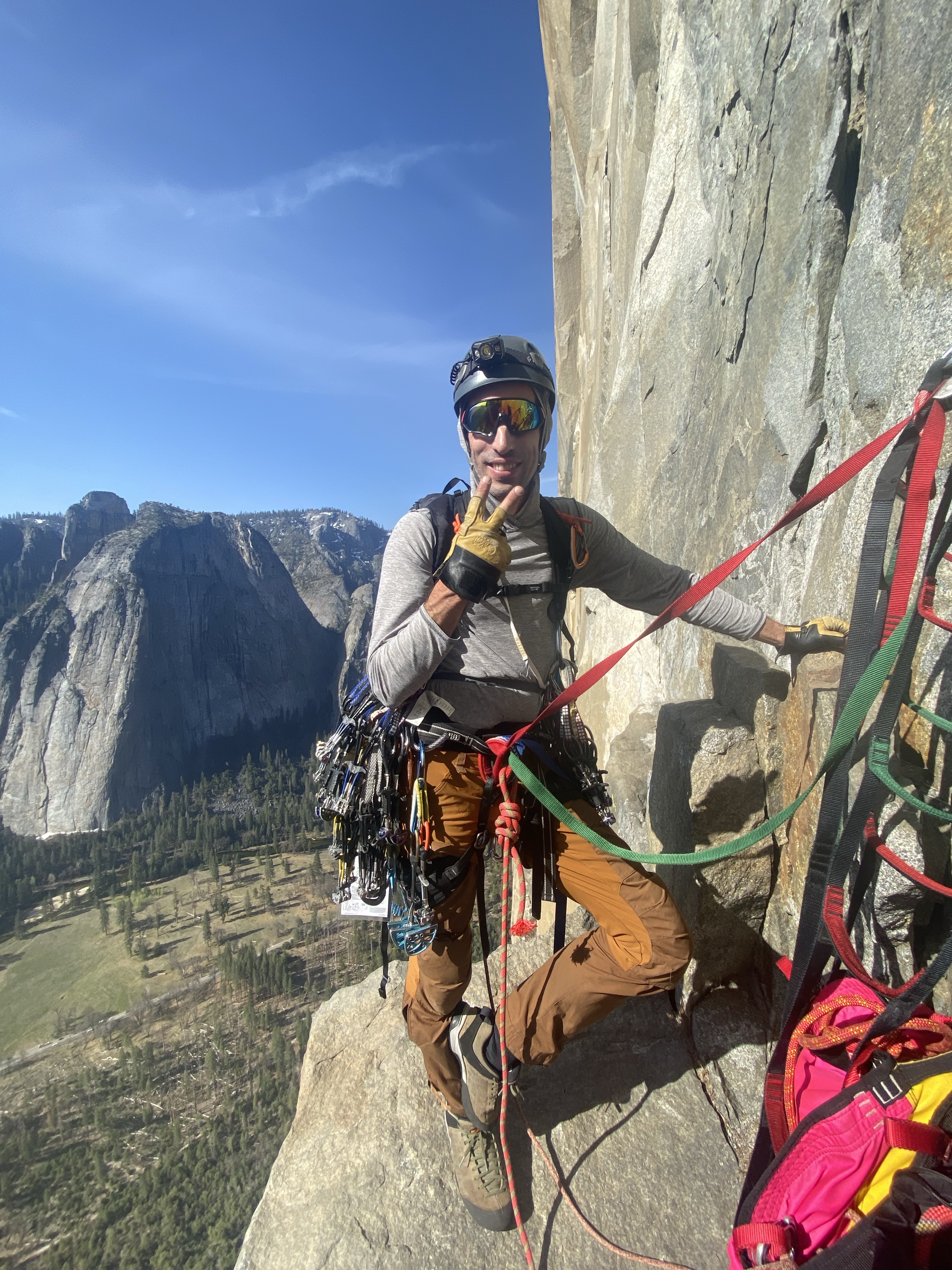
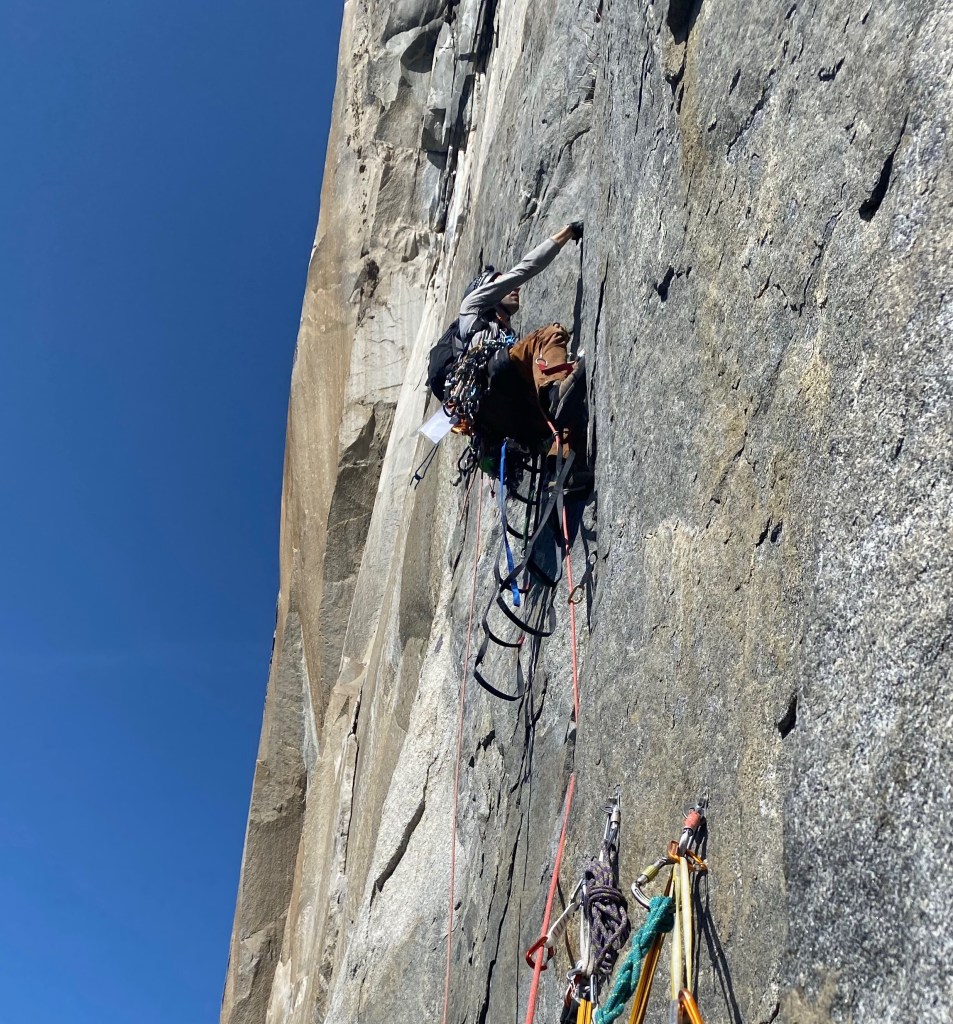
Pitch 12, 13, and 14 belonged to Ben and required several pendulums to the left in a section referred to as the Borderline Traverse. Getting started off Big Sur Ledge required a short section of tricky C2 and then a crack system that led to a bolt ladder (with more bolts than shown in the topo). Ben scoped out the pendulum and then stuck a cam on his aider before he swung over. Right at the climax of his swing to the left, he stuffed the cam in the crack which fit perfectly and prevented him from swinging back to the right.
The next pitch required a trickier pendulum that was quite a bit bigger. One might think they need to find a way to get to the crack system which seems rather improbable. However, there is a bolt that is much more manageable to reach which then allows you to make your way over to the crack system. Ben chose to link pitches 13 and 14 into one mega pitch. While it gets a C2 grade, Ben thought it felt more like C1 with amazing placements the whole way. This also sets you up nicely to not have to lower the bag out much as you wind up not too far left of the belay.
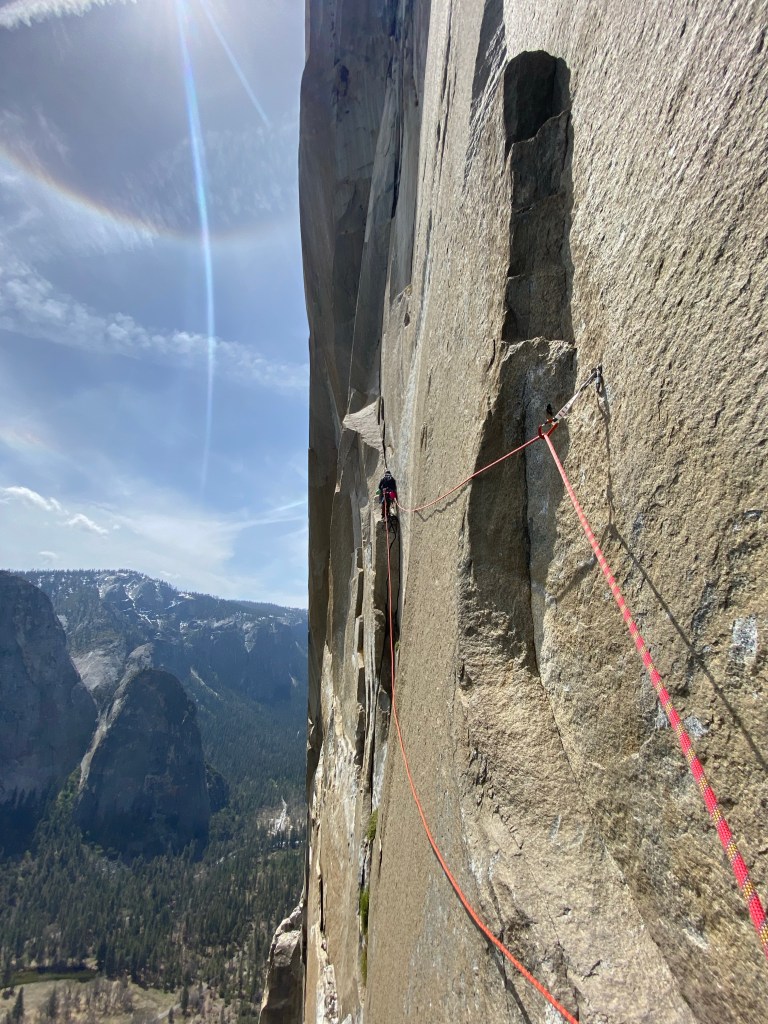
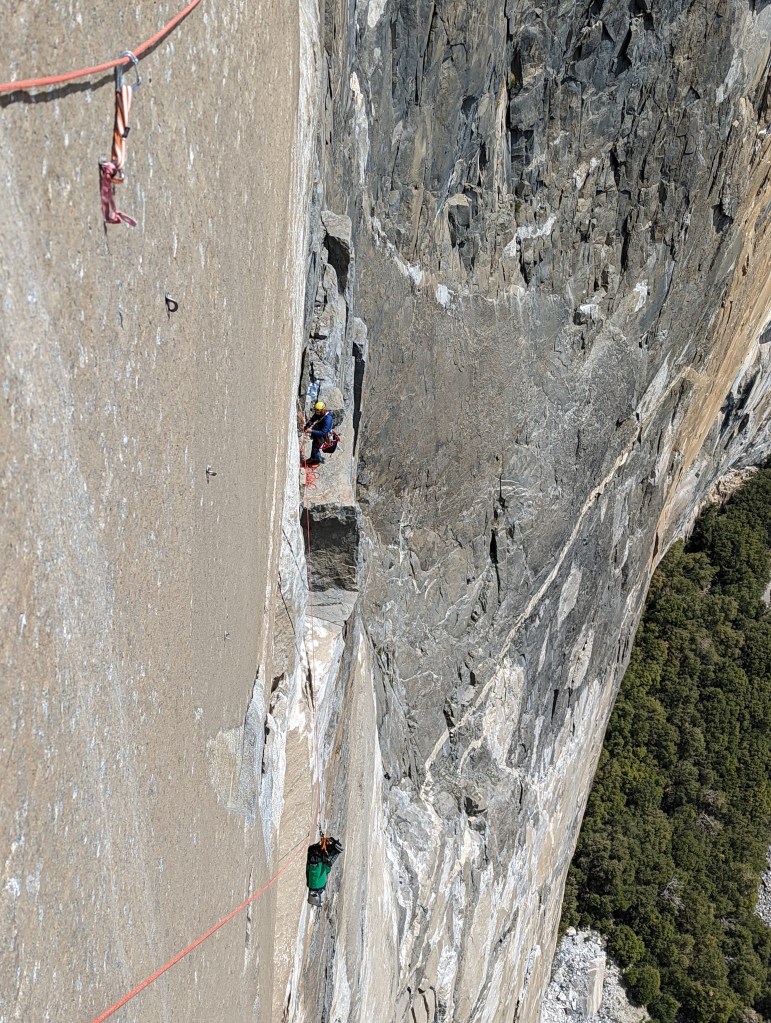
This placed me at the base of the Black Dihedral, a pitch that seemed rather spooky. As I looked up I couldn’t decide if the crack was a traverse, overhanging, or both. I started off slow and steady through some easy placements, back cleaning (removing the protection I had placed) as far as my courage allowed. Once I left my first piece I decided to leave every second piece from there. This ended up working well and made it fairly easy to clean while also leaving me with enough gear to finish the pitch. As I moved along there was black goo oozing all over the crack. When I touched it I expected it to be crusty and hard, but instead it jiggled creepily like a ball of slime. I followed the crack, and just as it seemed to end leaving me with no way to continue, a look to the left showed me perfect edges for hooks. I took this for a bit and ended up back in a usable crack system that allowed me to continue on. By the time I came around the corner, and made my way to the Black Cave, I felt like I had been on a journey through time and space. A truly remarkable pitch.
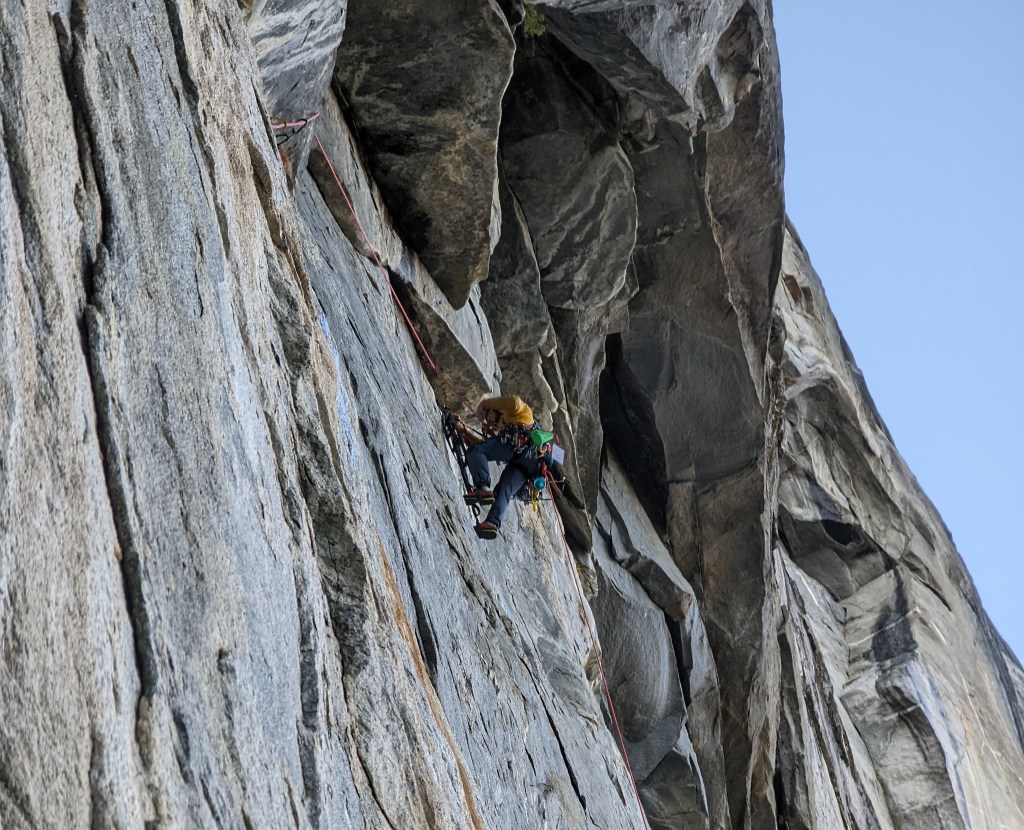
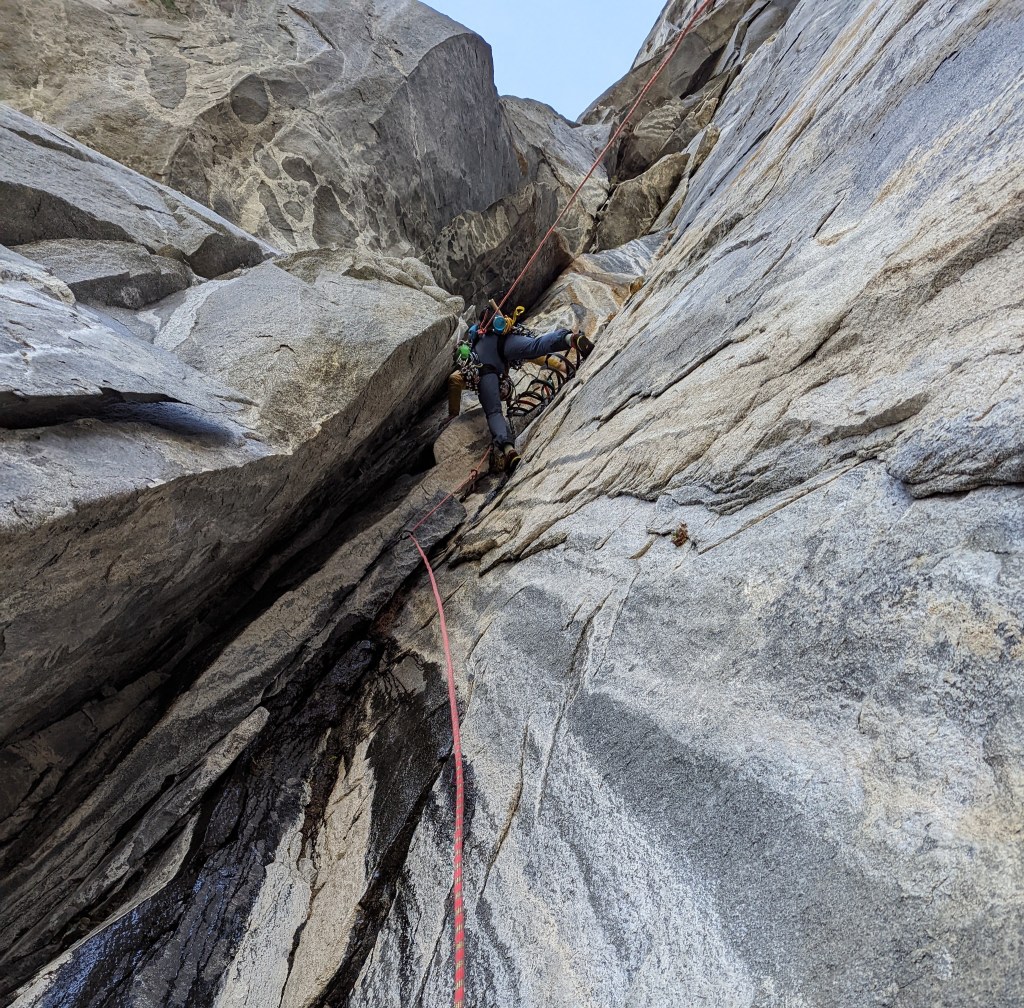
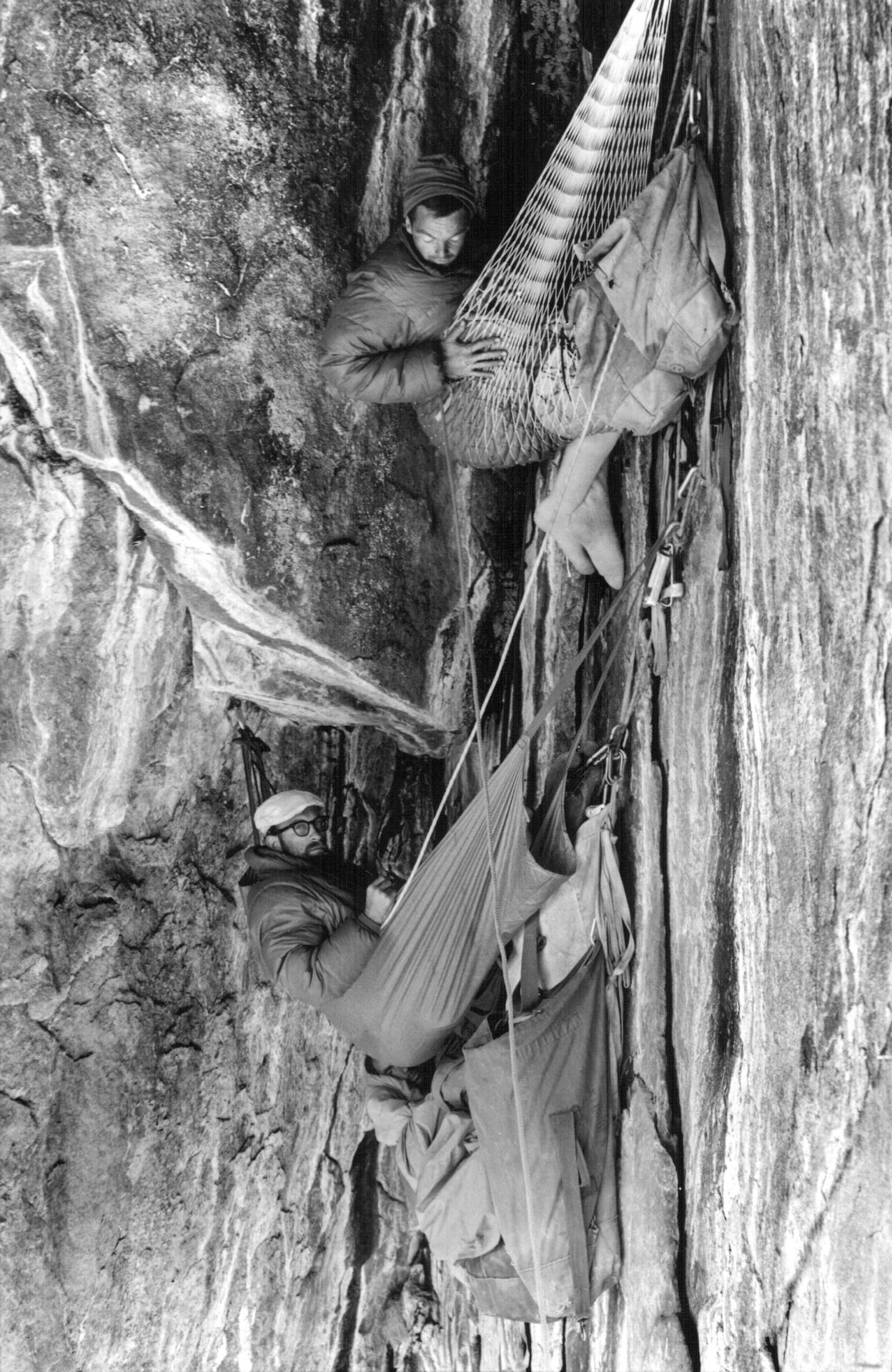
I sat there for a moment just taking it all in. Here I was in the Black Cave, a place I had literally seen in pictures and imagined what it would be like to be there. I was nervous for this pitch at the start of the route, but now after having done the Black Dihedral, I was ready to go, excited to lead this thing. Robbins said it had seemed as if they had climbed into a cul de sac, and I got that feeling as well. It was truly a bottomless cave, with tremendous exposure. I facetimed Maria (my wife) as the sun went down, sharing the moment with her. Ben joined me and asked if this is where we would end the night. It was appealing, bivying in the same place as those 4 legends (royal Robbins, Tom Frost, Chuck Pratt, and Yvon Chouinard) did in 1964. But I was still stoked to climb; I was afraid that if I spent all night thinking about it, that stoke may turn into fear.
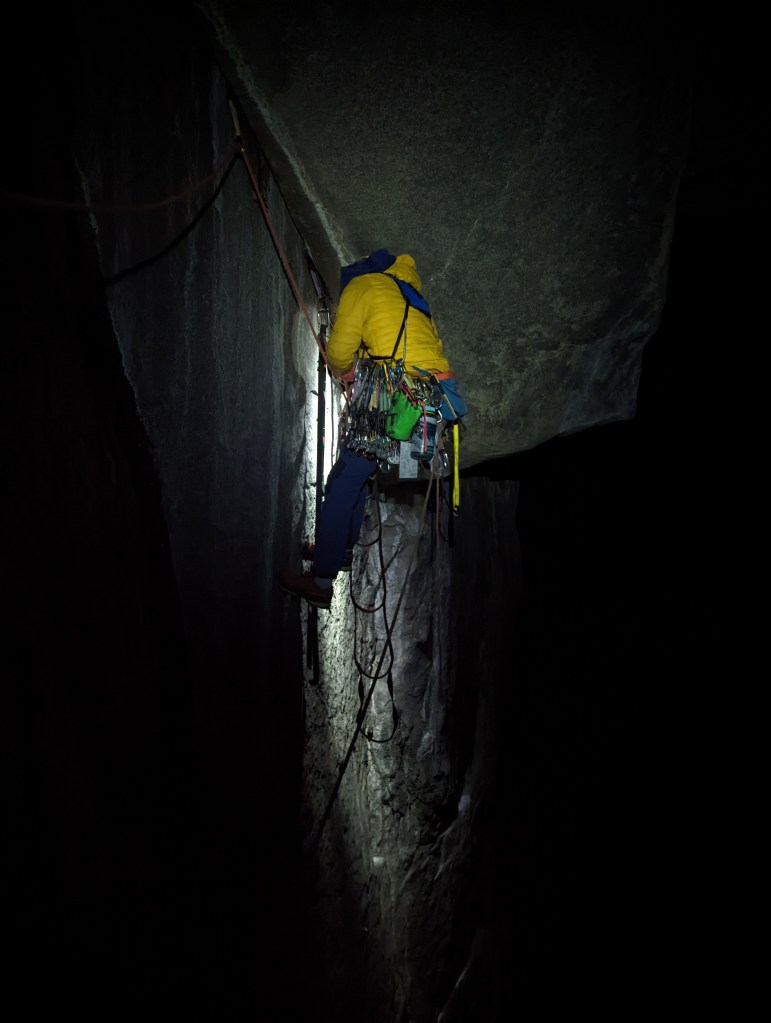
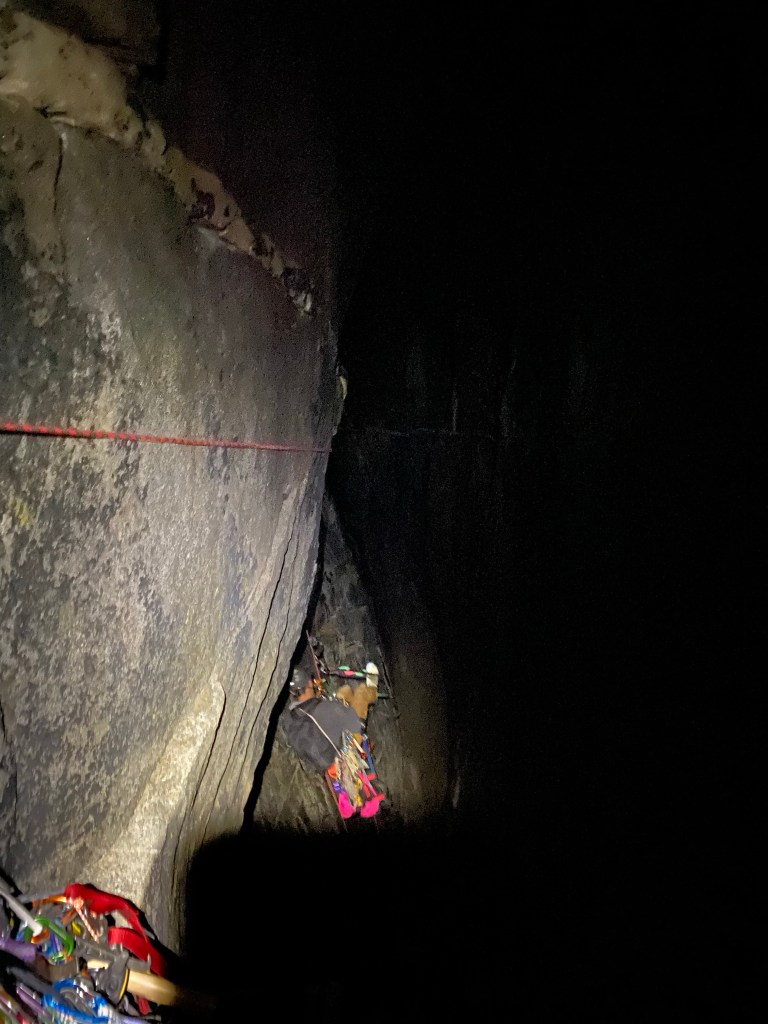
I quested off, climbing down the crack and out of the Cave, by way of headlamp. The sun was gone, and all I could see was the next move. I figured this pitch would be quite short based on the topo. What I didn’t realize is after you climbed down and back out the cave, you then circumnavigated the entire thing. This was probably the scariest pitch of the entire route for me. While mostly easy, with many fixed pitons, there was one move in particular where your only choice of placement was very poor, loose rock. I spent probably 20 minutes trying to find the least likely section of rock to break off. The block I ended up using appeared to be floating in space, attached to the wall by I’m not sure what. I placed my cam horizontally beneath it, hoping that if it did break, the cam would wedge it upwards against the rock above it, and keep it in place long enough for me to get out of the way. I once read an accident report about a party on The Muir Wall who broke a piece of rock when they placed a cam behind it. The rock broke away, cut the leaders rope, and killed him as he fell to the end of his haul line, which was attached to the haul loop on his back. A fate I was hoping to avoid. After carefully weighting the cam I stretched to the next Piton and got off the cam, removing it and leaving the loose rock for the next party, as quickly as possible. It was now nearing midnight and I was exhausted, both mentally and physically. Ben had to do endless lower outs, and in hindsight I should not have clipped as many of the fixed pieces as I did. We did not make 18, which left us at a hanging bivy. We didn’t even take time to eat, simply setting up our G7 pods and going to bed.
Day 3- Pitch 17/18
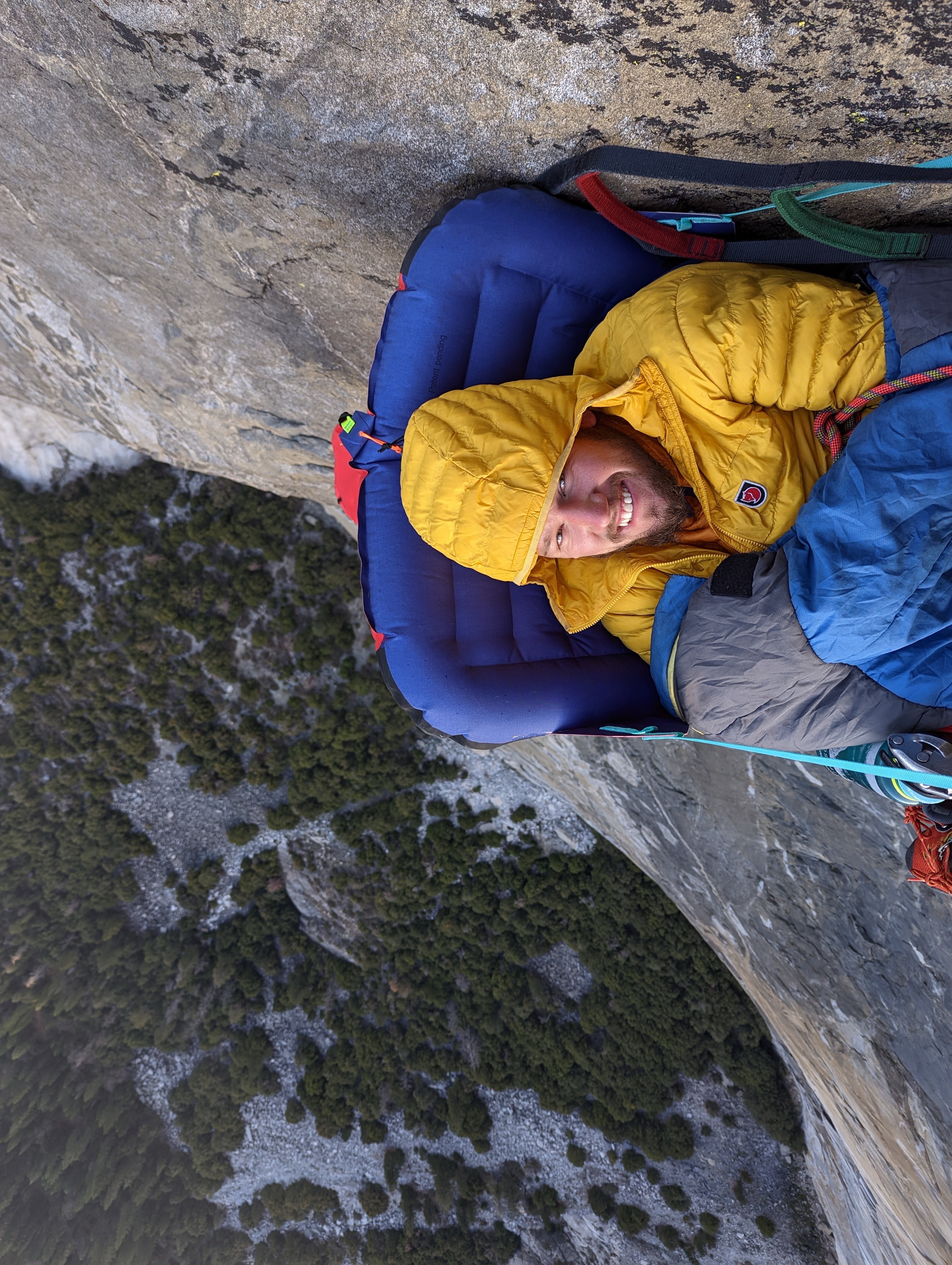
We awoke the next day in a pretty outrageous position that Ben describes as magical. There was a blank face above us and 2000 feet of air below us. It was insane.
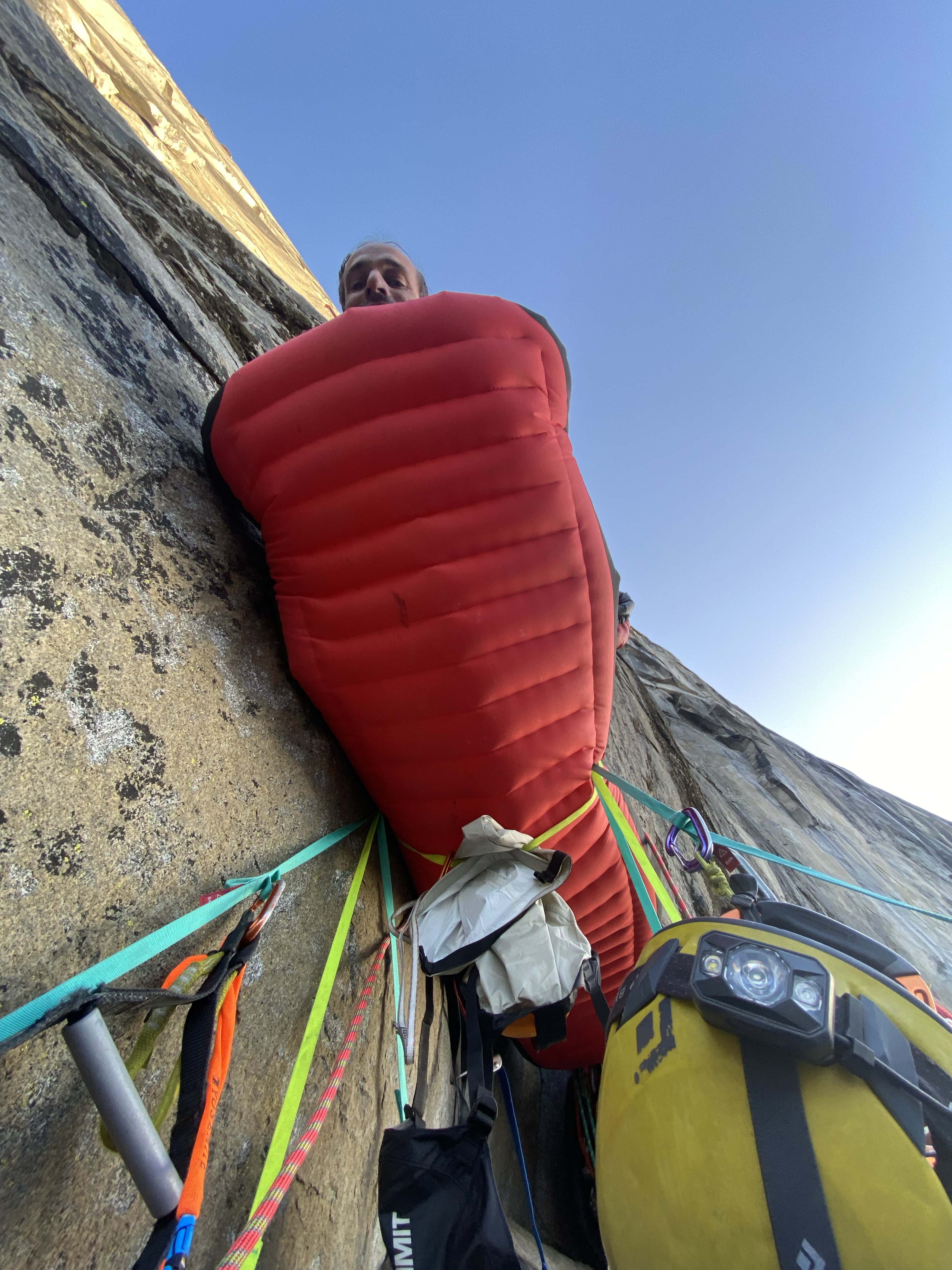
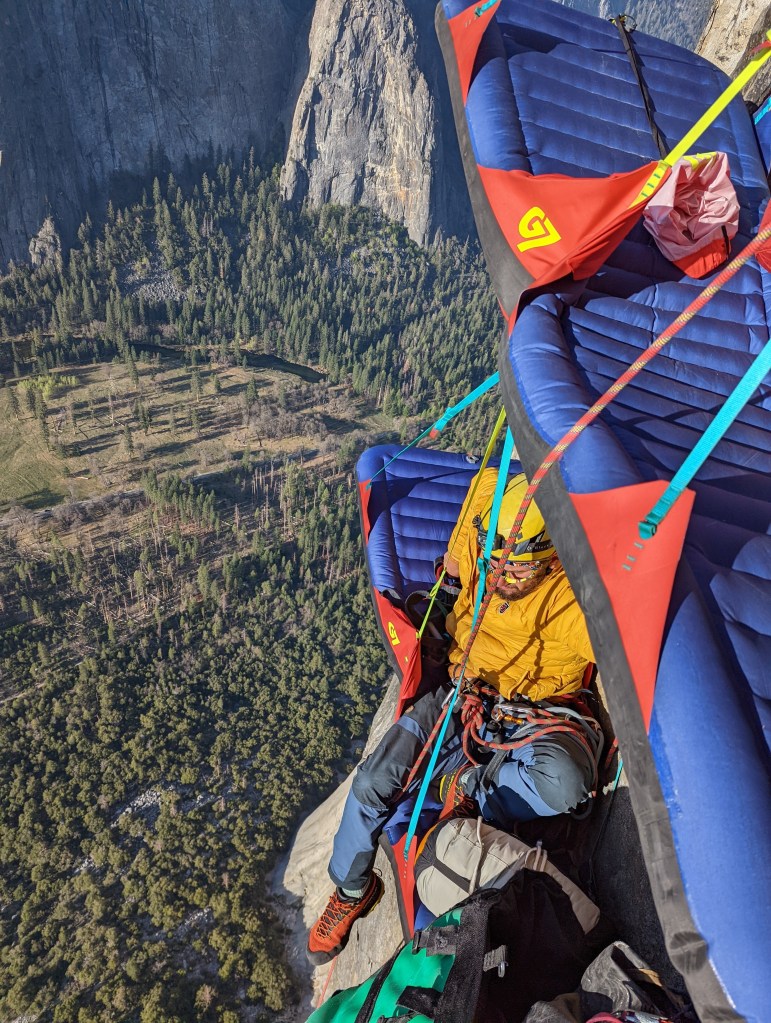
The next two pitches were both C3 and would get us to the ledge beneath the Cyclops Eye. The first pitch involved some tricky climbing left before you make your way back right on a long section of hooks. The climbing here was fun, and not that hard, but the consequences of a mistake were pretty serious. a long pendulum fall into an open book. I back cleaned the whole pitch and Ben had to do two rather long lower outs. First to the left, and then back right. The second one brought him back below where he started at the belay. Again, a testament to the dedication of the first ascent party to drill as few holes as possible. A few bolts straight up would have put them in the same place, but instead they chose to climb a giant 100 foot circle to make 40 feet of upwards progress. Incredible.

Pitch 18 started off very easy, and left Ben at a nice belay stance which was nice. I found my way to a bolt at the start of the C3 section which looked quite blank. As I sat on the bolt I saw what appeared to be a bomber cam hook, but it looked like it would take me getting pretty high in the ladder. Instead, I opted to place a hook on a pretty obvious and worn out hook placement. I was on the hook for maybe 30 seconds as I put the cam hook on my daisy preparing for the next move. I noticed that I was pulling out a little bit on the hook, as the prongs had come out towards me and away from the rock. I quickly sat back on my fifi to ensure I was pulling straight down. Next thing I knew I was upside down and 15 feet lower. I had hit my head hard on the rock and immediately had a ringing headache. I noticed that the rope was not tight, which meant I fell onto my tether attached to the bolt. Typically, once the rope is clipped into the last piece, I immediately remove my tethers, to prevent falling onto them. But I made a mistake, and missed that step this time, resulting in a much harder fall than I would have had with the rope. I reoriented myself and collected my thoughts. I had a minor cut on my finger, and quite a headache, but I still seemed to be intact. I still didn’t know happened. Ben thought I might have dropped something when I fell as well. I pulled myself back up to the bolt and when I looked up, I noticed a brand new rock scar, right where the hook placement had been. The rock I was hooking had broken and came off the wall. This time I got high in the ladders, placed the sinker cam hook, and continued on with the pitch. Should have just done that the first time.
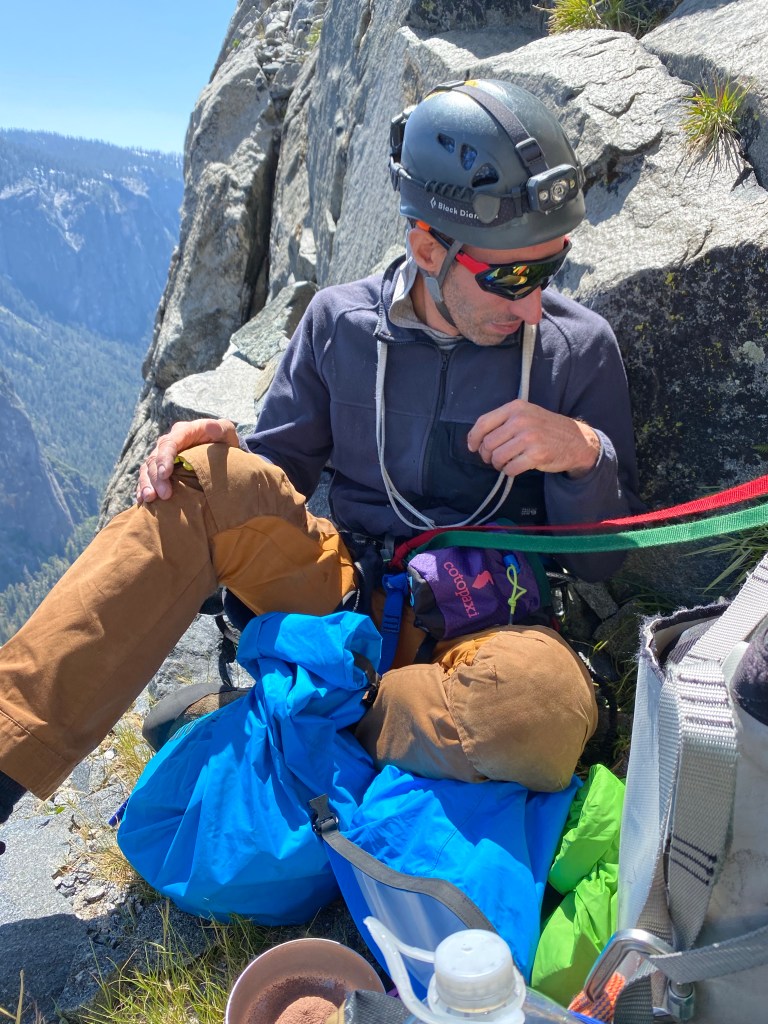
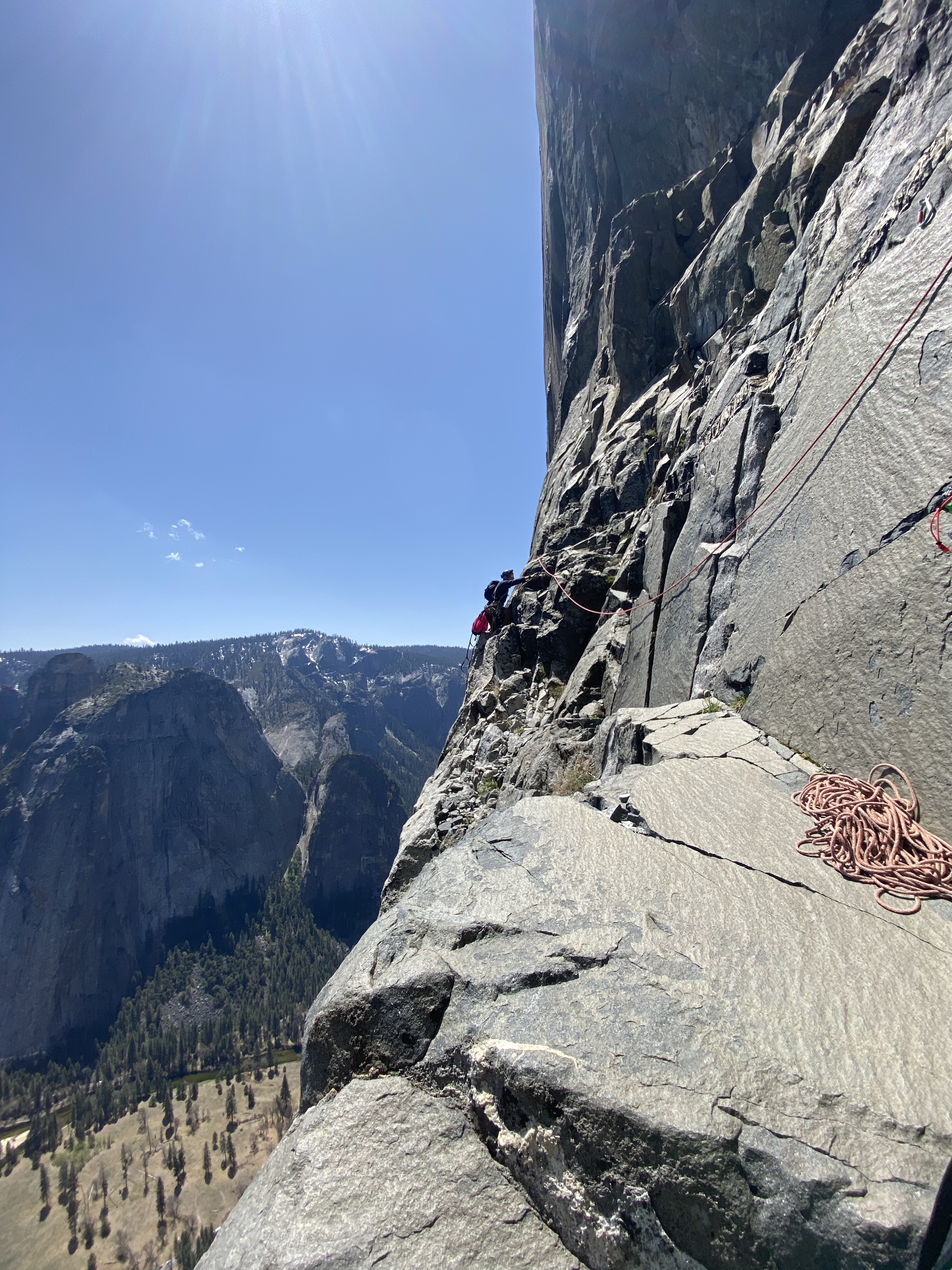
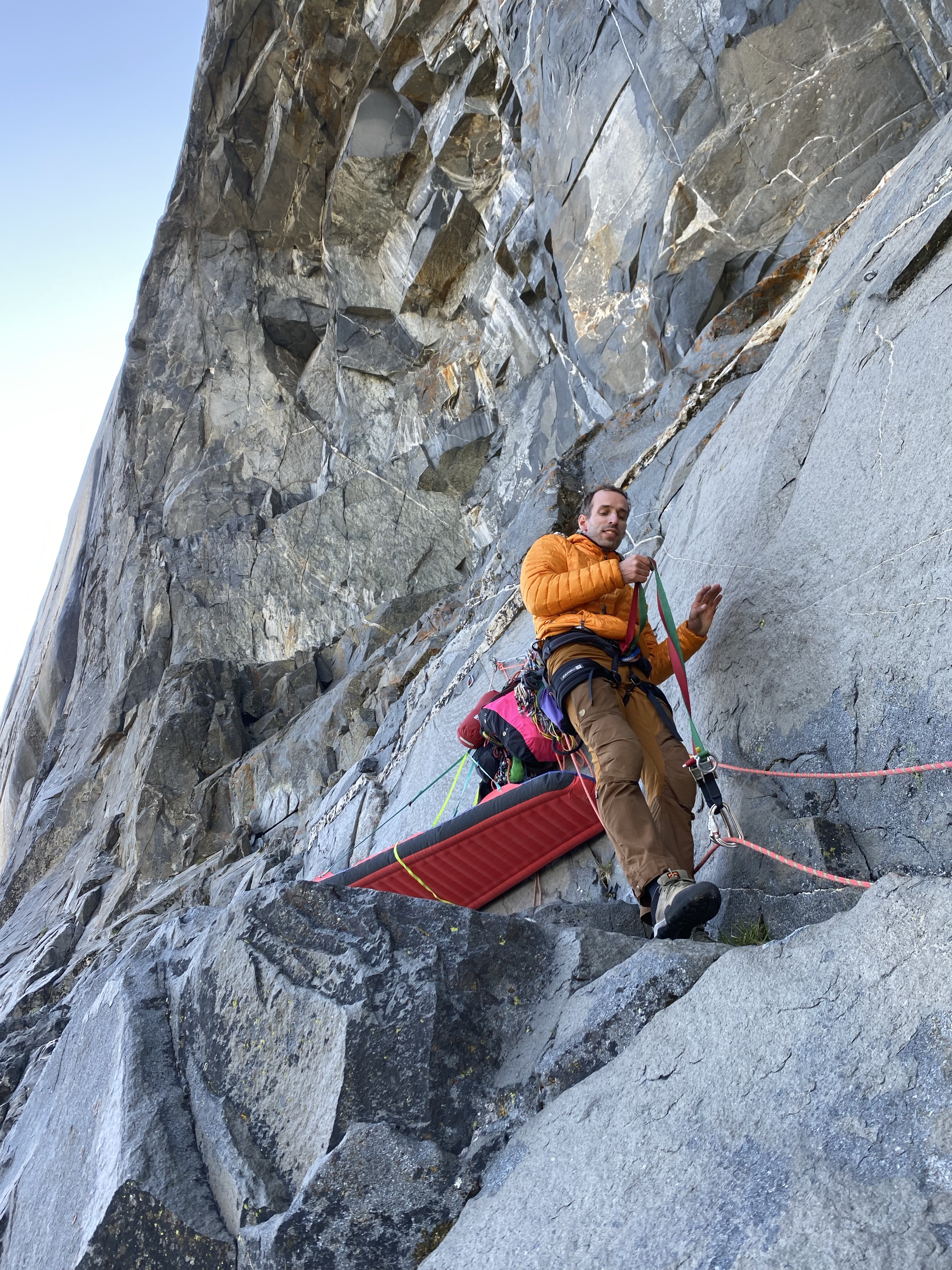
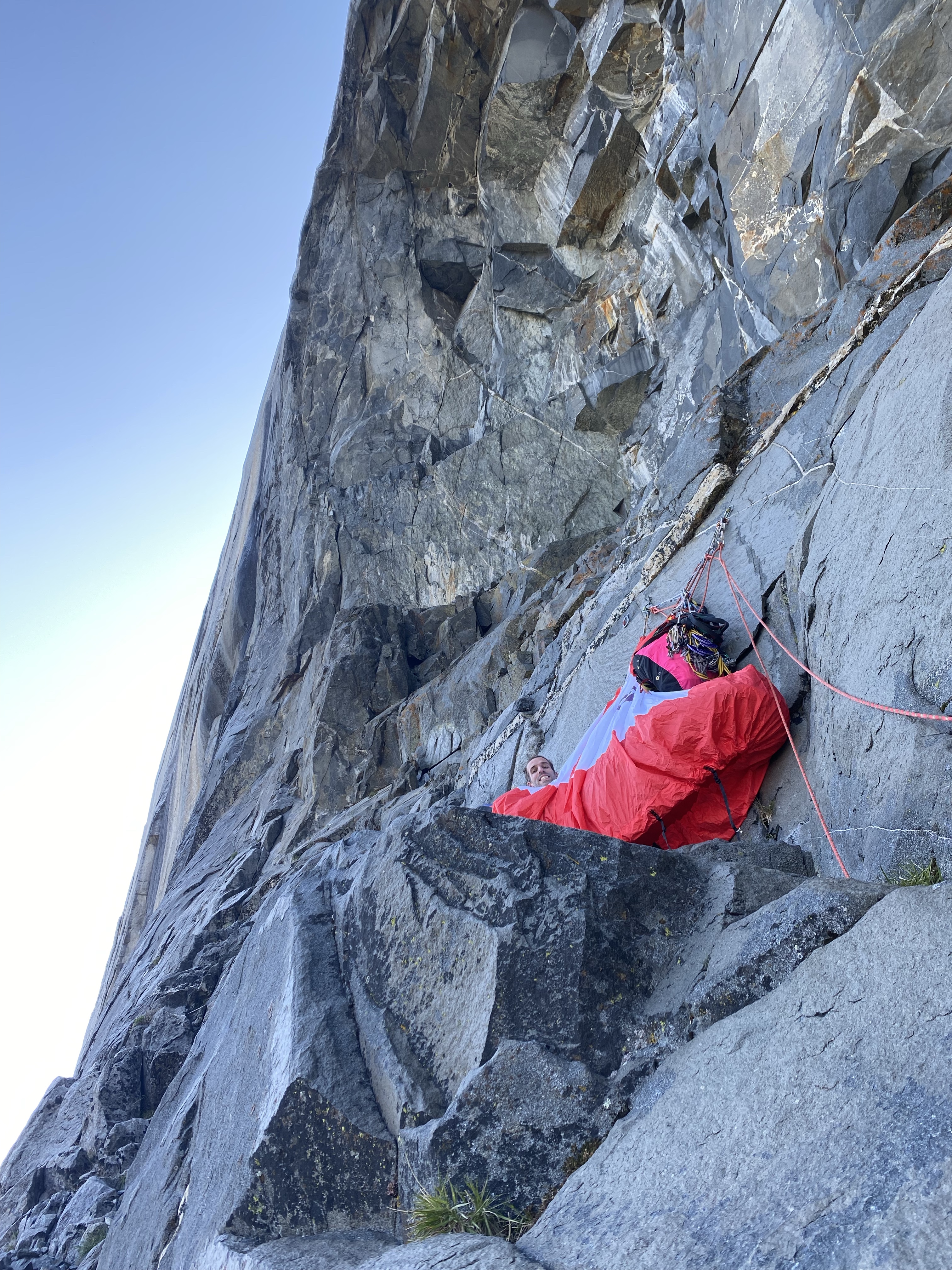
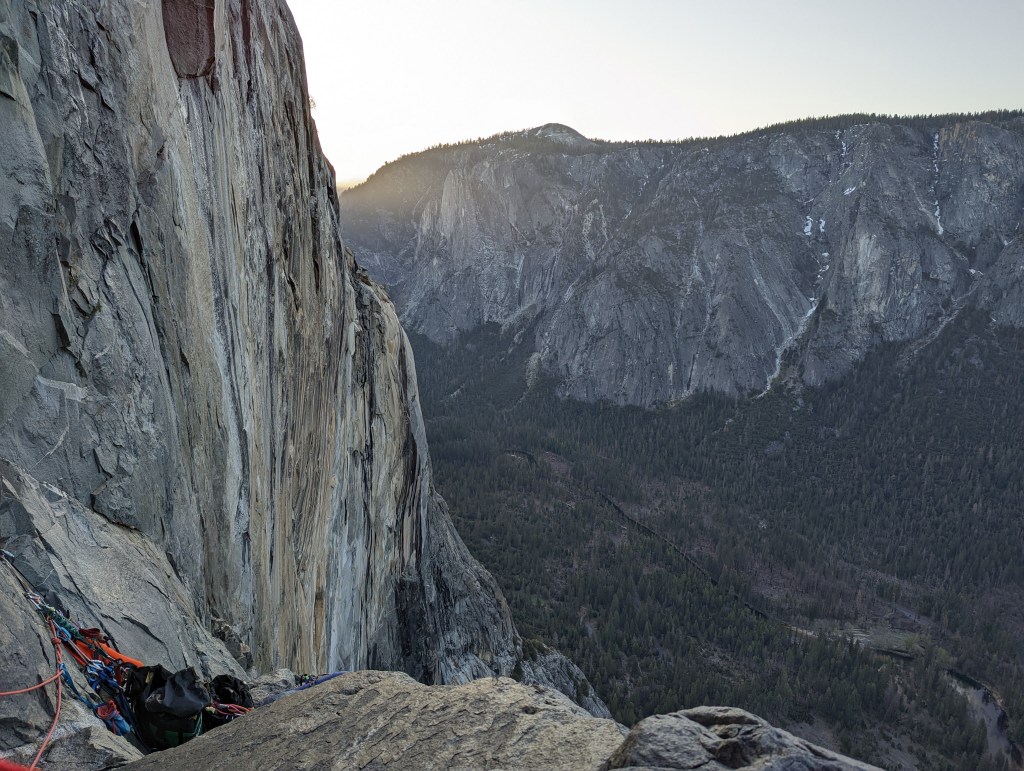
The remainder of the pitch was quite tricky and finicky, and one of the harder pitches of the route. I managed to make my way to the ledge system and spent a fair amount of time looking for the anchors. Eventually I found them, quite a bit farther right than the topo suggested. We took some time to ensure that we weren’t caught on the rope eating flakes and Ben joined me at our sweet ledge system which would be our home for the remainder of the day. It was only noon, and there was plenty of daylight left. But I wasn’t too keen on another hanging bivy, and was actually pretty stoked on just hanging out, eating food, soaking up the sun, and sleeping. I had told Ben about my affinity for sneaking pictures of my partners taking big wall poops, and he managed to snag one of me at a rather inconvenient time. Not my proudest moment. We spent the rest of the day lounging about, trading snacks, drinking hot chocolate, and relaxing. It was a bit boring, but a much needed rest.
Day 4- Pitch 19-23
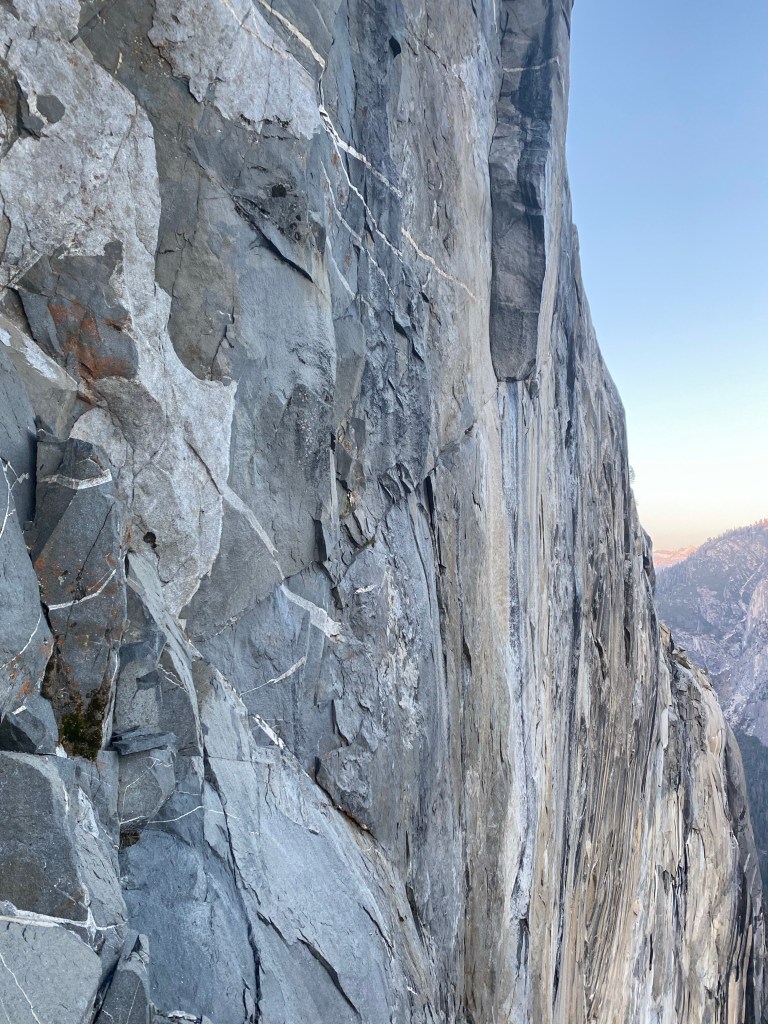
I spent a good part of the prior day staring off in the distance at the upcoming pitch. The hard section looked quite thin. A long rightward traverse across what appeared to be a very thin seam. The pitch started with 5.8R free climbing. This might have been the free climbing crux of the route. It required thoughtful route finding, had loose rock, and was near impossible to protect. Ben ended up having to free climb it with a self belay on a Gri Gri as well. I free climbed all the way to the end of a section labeled as C3 hooks, placed one hook to get prepared to aid climb, and found myself a move away from the seam. I was staring at a perfect number 2 placement behind a flake. The only problem was the flake appeared to be floating in space and would kill anyone and everything in its path if it peeled off the mountain. I had read several mountain project comments about this flake and the consensus was pull down, not out. Quite frankly I was uninterested in pulling on this thing at all. After looking for other options I noticed that the flake seemed to pinch against the wall at the very top. I took a sling, attached a carabiner to it, and began trying to throw the carabiner behind the flake. It took 10-15 attempts as the carabiner kept missing slightly and bouncing off the rock. Eventually the carabiner made it behind the rock, bringing the sling with it. I reached under the flake and pulled the sling through creating a girth hitch around the pinched section of rock. I clipped that, stepped in it, and free climbed past it on more solid rock. I reached back and unclipped my rope, leaving behind the sling and carabiner for future parties to hopefully make that section a tad easier.
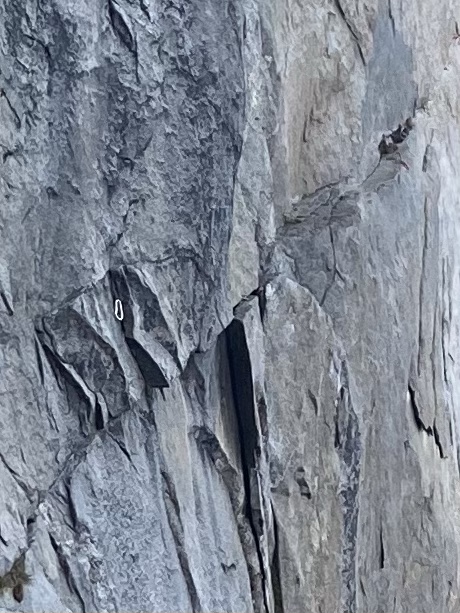
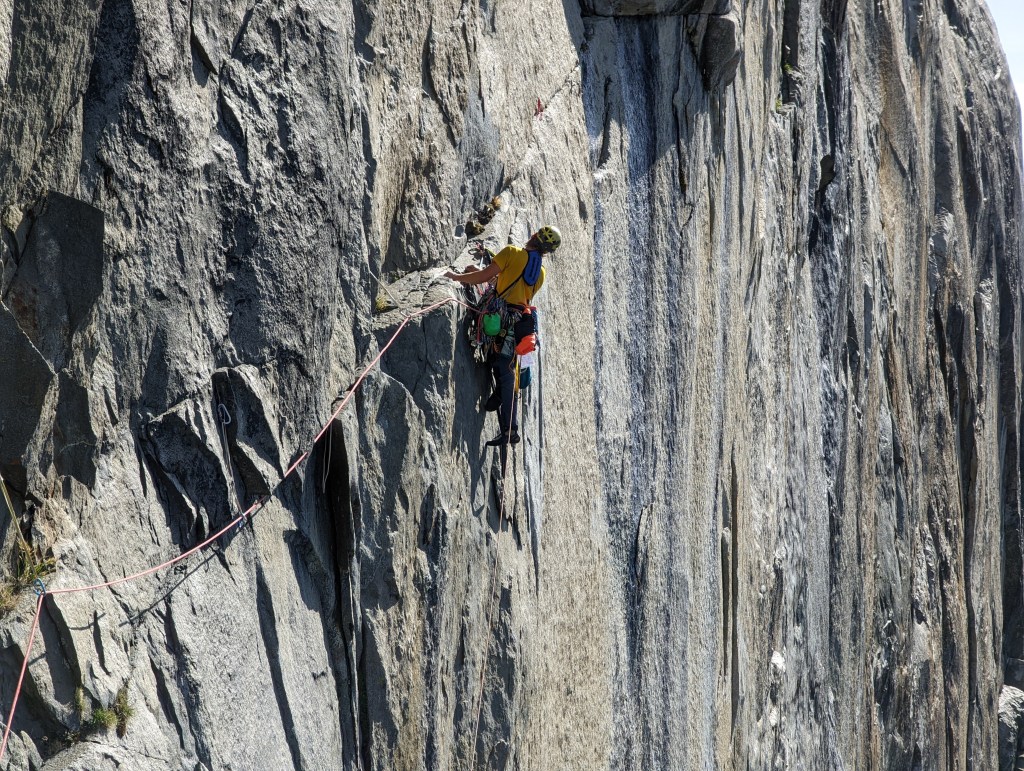
The traverse itself was not as thin as it looked and was quite fun. This led into the next pitch which I linked to the base of a large crack where I built a gear anchor. I wanted to avoid leaving all the pieces of the anchor in the same crack, and didn’t want everything ontop of each other, so I found a small piece of gear out to the right. This would allow my haul point to shift right, and keep it separate from everything else as well. I knew the piece wasn’t wonderful, but I thought it was good enough. After we lowered the bag out (which went for a little ride when we ran out of rope) I began hauling it upwards. After several heaves, the piece on the right exploded out of the rock, leaving me a bit stunned. I had never had a piece from an anchor fail before. There were still 3 more pieces in this anchor, and all were bomb proof, but I was still a bit shocked that it had happened. I put the piece back in and used it to store gear, but adjusted the haul system so it was no longer incorporated in the haul anchor.
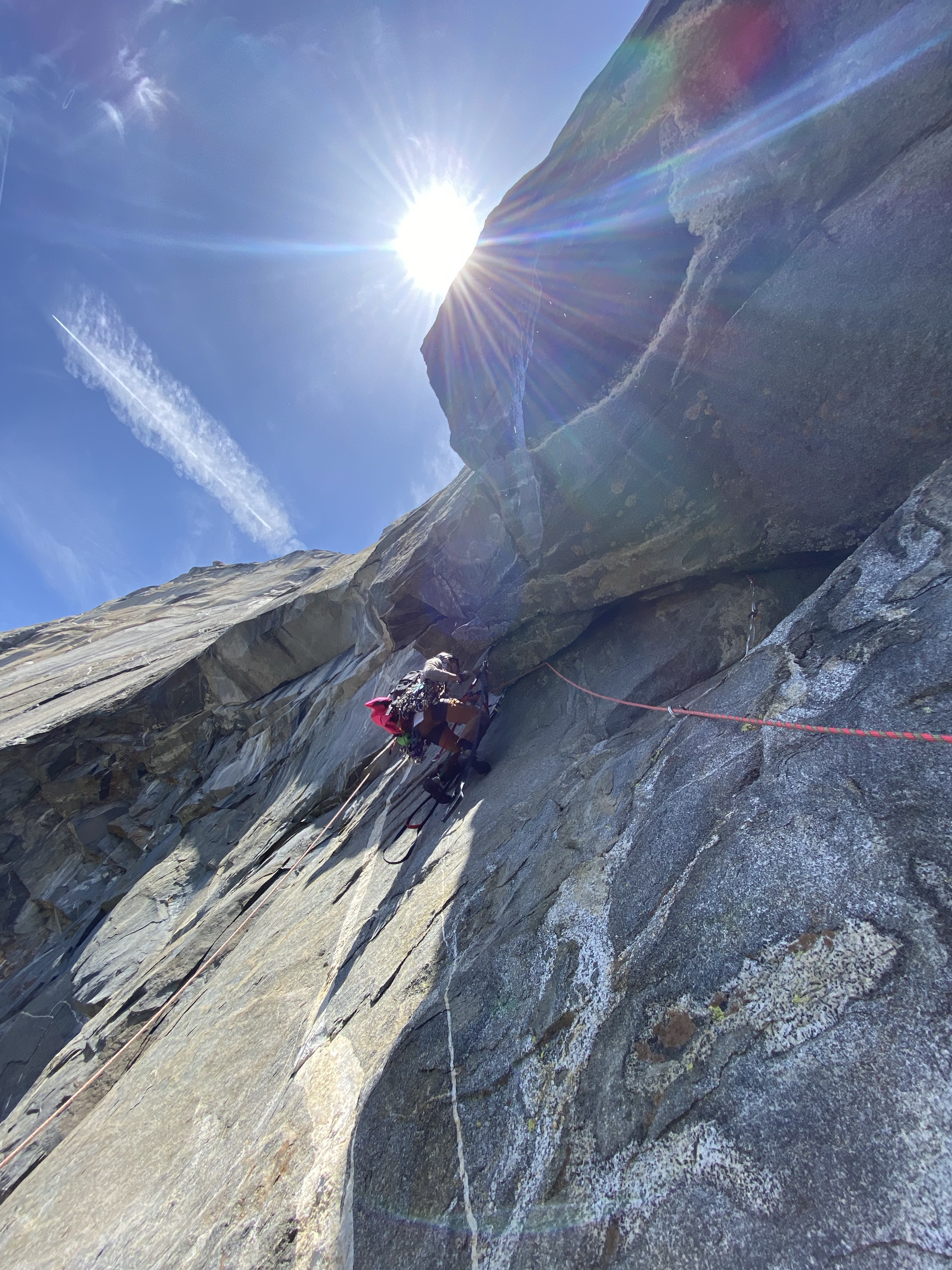
Ben arrived and took back over the lead for the next pitch. This pitch started off very steep, and Ben had to climb out a roof that he quite enjoyed. For most of the route Ben got stuck with most of the challenging follows, but now it was my turn. Ben found the first half quite fun and the second half quite challenging. At one point Ben was on two separate hooks and placed a cam in a blown out pin scar. Because Ben was using both his tethers on the two hooks he was standing in, he transferred his weight over to the the cam he placed, using his fifi hook. The cam failed, and sent Ben falling onto his hooks, which managed to stay in place, on his tethers. I watched as the cam fell past me straight to the ground, well below. Higher on the pitch Ben was transitioning from a nut placement to a rivet of questionable age. Right as Ben placed the rivet hanger over the rivet, the nut blew, sending him falling right onto the rivet, which luckily stayed put. After an eventful pitch, Ben kept it together and found the top.
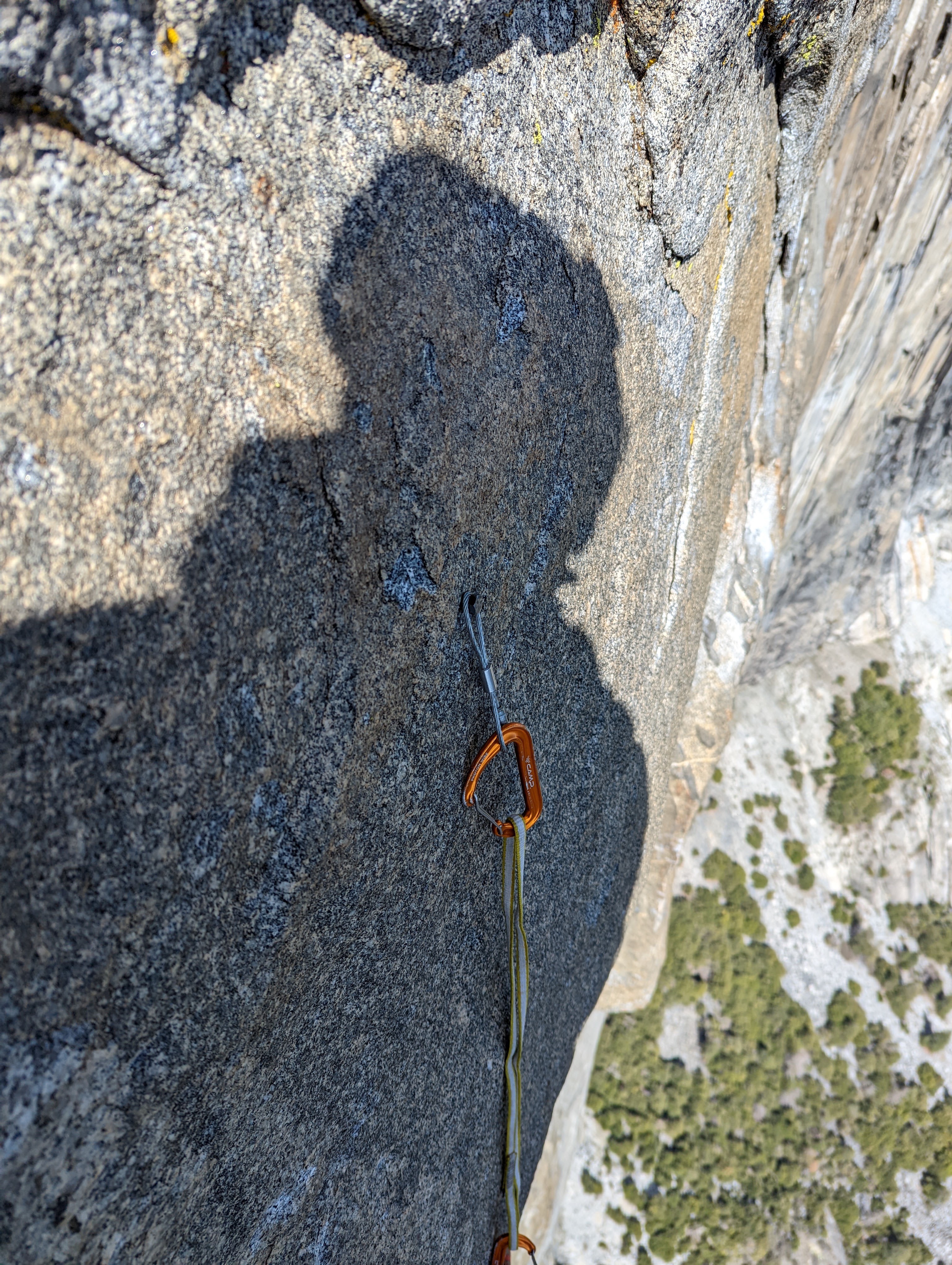
Pitch 22 started off with some spaced out bolts and a very short, but challenging section of C3. I attempted, albeit very briefly, to free climb the 5.7 hand traverse. It was quite pumpy (and sandbagged), and I quickly resorted to aid. I back cleaned the entire traverse and reached a bolt. A short C3 hook section followed and I used my first ever bat hook. This culminated in one rather sketchy hook on a small bump on a sloper of a hold. After contemplating whether I wanted to hook or free climb the last move, I committed to the hook and found the anchor.
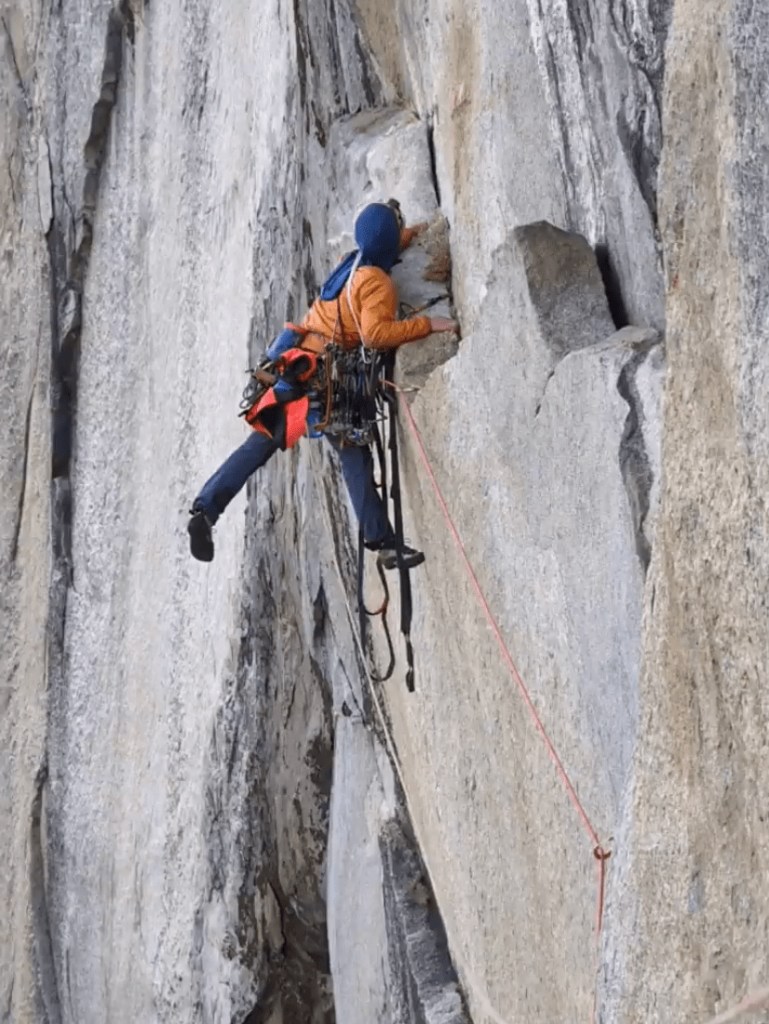
Ben had to do a massive lower out on this pitch since I backcleaned the entirety of the hand traverse. The lower out was so Big Ben found himself hanging in space, back over the lip, and in the gravitational pull of the massive Cyclops Eye. With nothing but air for nearly 3000 feet below him, Ben hung there soaking in the ridiculous exposure.
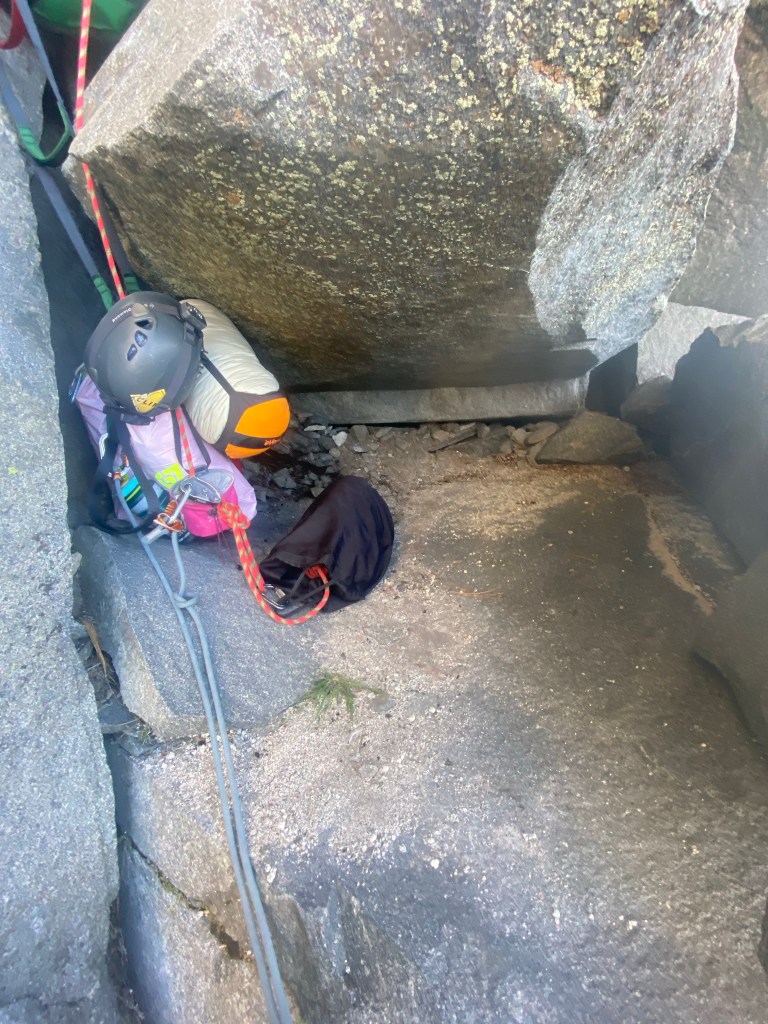
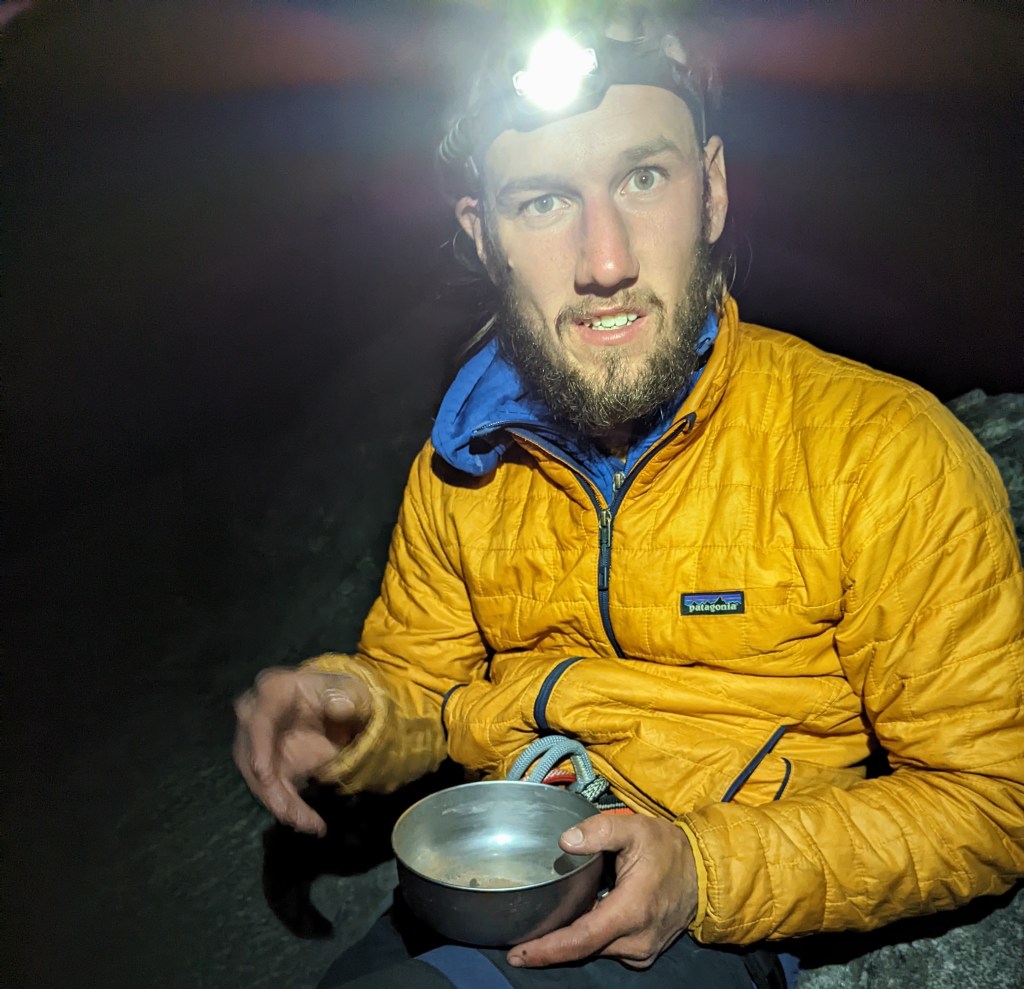
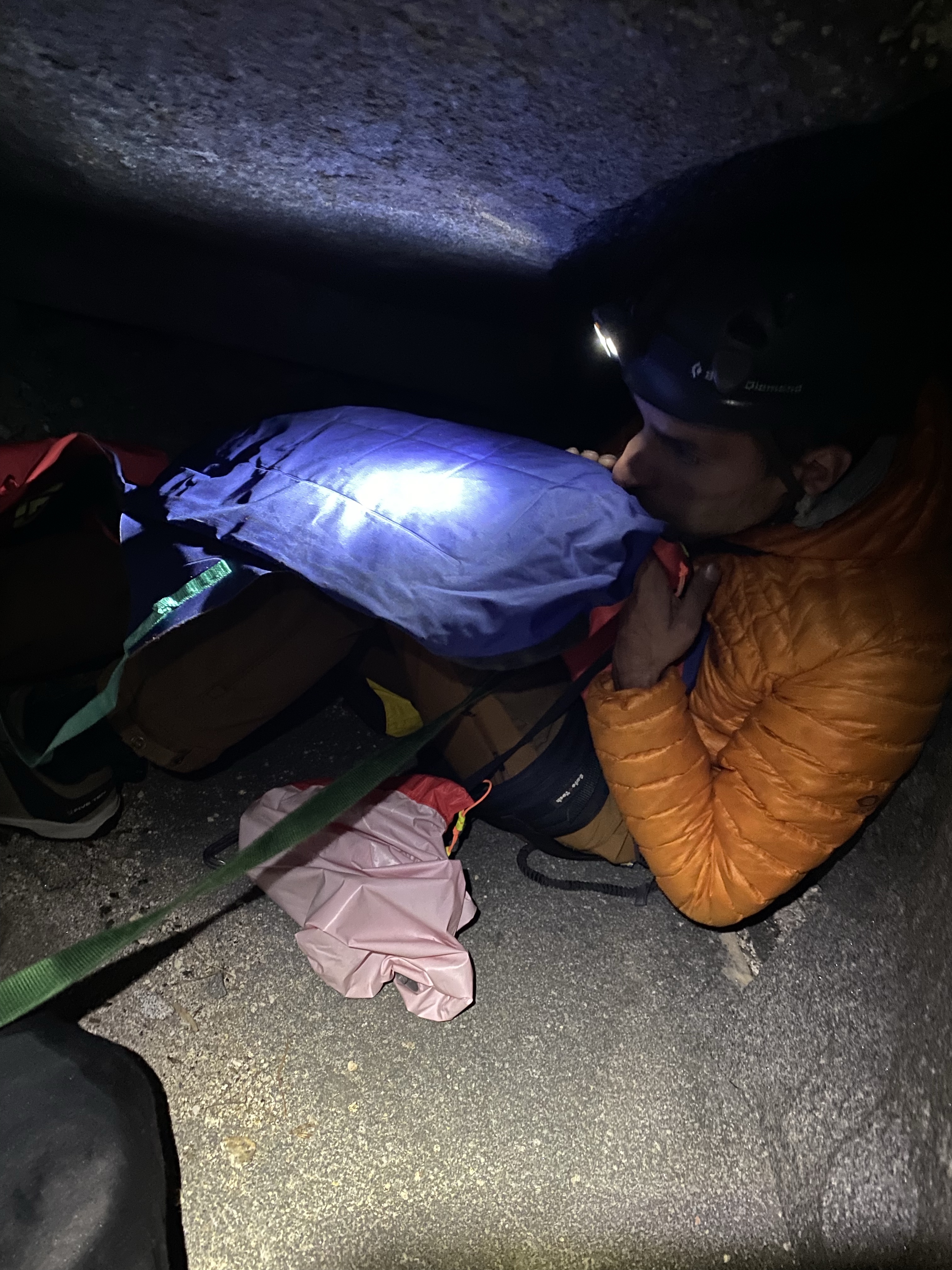
Pitch 23 was a fun romp up a brief chimney that I quickly scooted outside of and made my way to the anchor. This placed us at the Igloo, a bivy I had dreamed about for several years. Such a cool name, and I had always wondered what it looked like. Now I was staring at it and I understood its name. This was the perfect place to cook, bivy, and hang out.
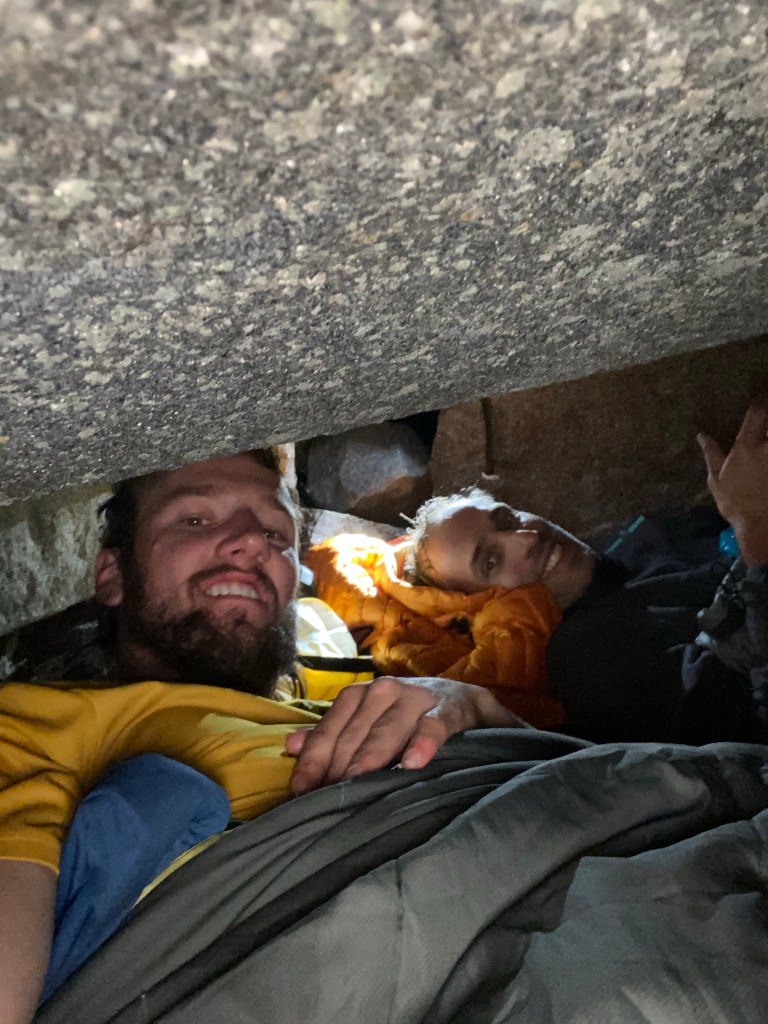
Day 5- Pitch 24-26
Ben started us off with some free climbing that was rather chill, but exposed and with some serious consequences if he were to blow it. Ben found himself in his hero step at one point reaching as high as possible to get a cam stuffed into a horizontal crack. He did some more high stepping as well to avoid a section of loose blocks to get into the roof section at the top of this pitch.
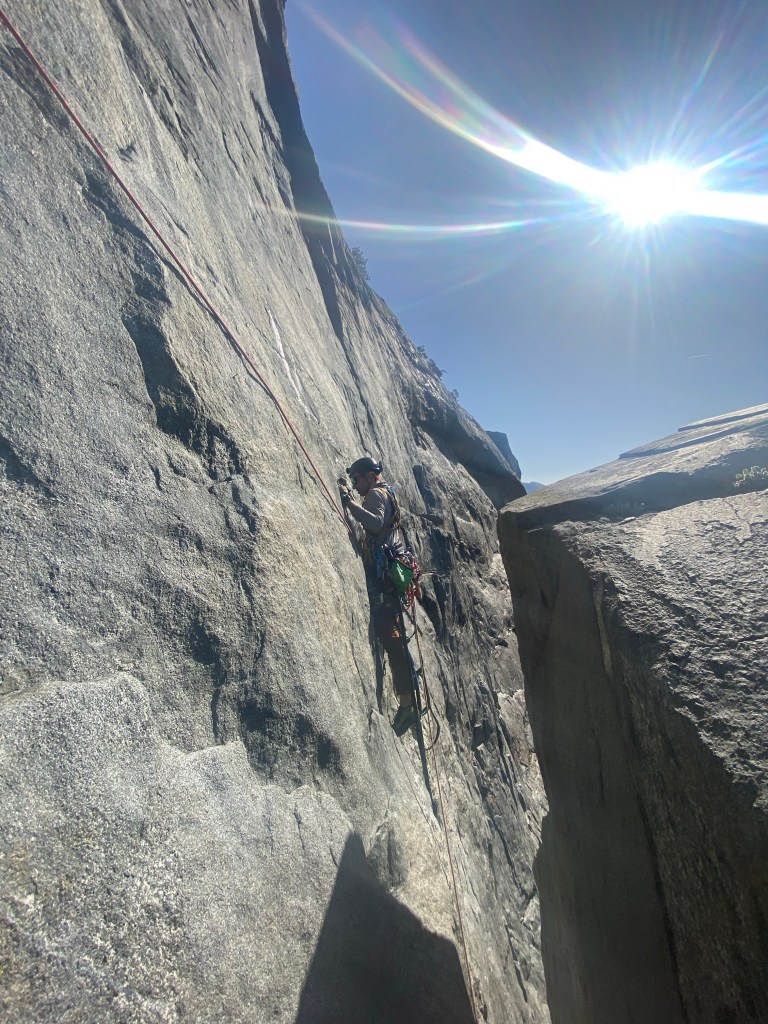
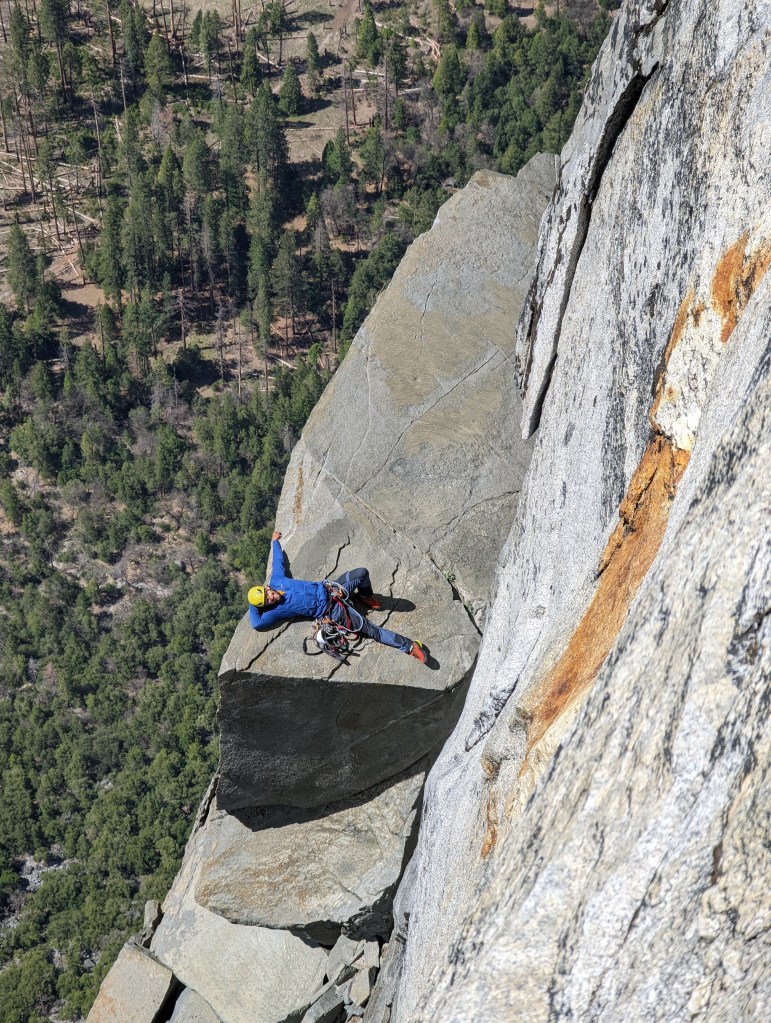
Pitch 25 is graded the hardest of the route (C4) but was really technically easy. It required nothing but cam hooks, above a ledge and the belay, for about 30 feet. I had tried a C4 once before, and came within one move of pulling it off. Eventually, after I couldn’t figure it out, I resorted to hammering a piece in. This time I was determined to not taint the ascent with the hammer, and left it in the bag. I didn’t want to even give myself the opportunity to nail anything in. About halfway up the corner I stopped for 10 minutes or so, trying to find a way to get a piece of gear in a promising pin scar. I couldn’t find anything, and eventually decided I just needed to push on. I don’t know how many cam hooks in a row I did, but I am certain that if I had blown it there was a high probability I would have hit the ledge below me, and the only way off the mountain would have been on a helicopter. Just as the corner ended I managed to get a few small pieces of gear. I did a touch of free climbing and then some more camhooking before the crack finally opened up to start taking cams. I was elated at having not broken my legs. The route was in the bag.
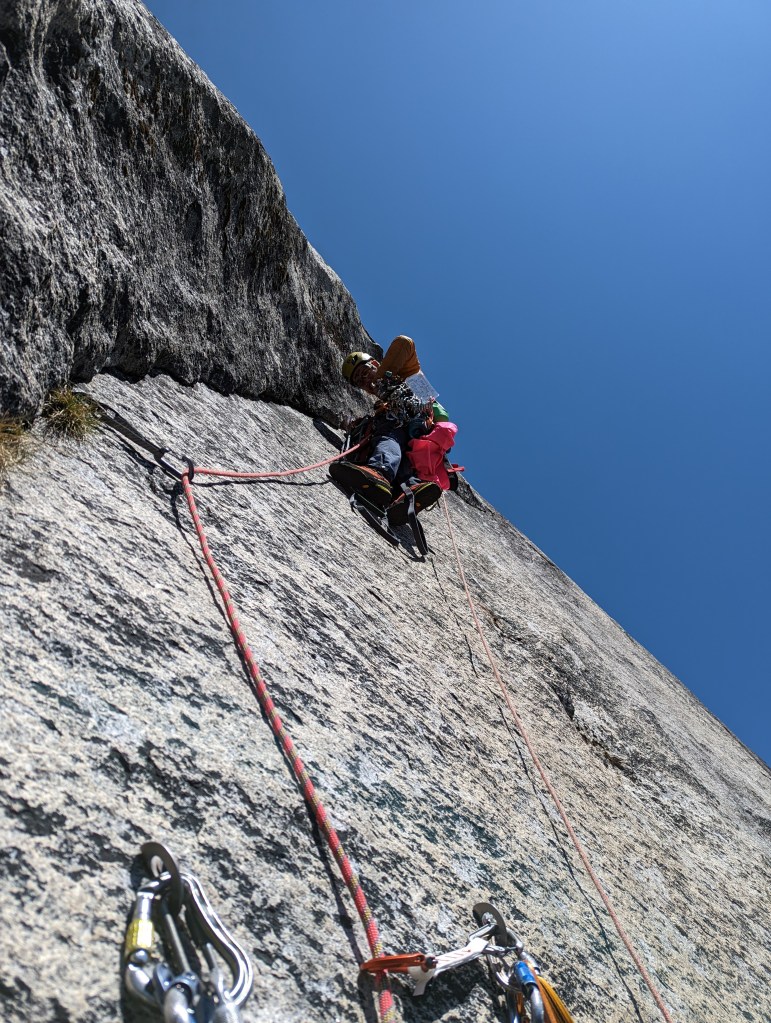
Ben took us home on the final pitch and we topped out The Captain together, mid day, and with enough time to make it back down for dinner at The Lodge. The bags were quite heavy, and and as always the hike down was brutal. I spent the majority of the hike down reflecting on the climb and my trip in general. As I always do when lugging that much weight down The Captain, I thought maybe I could be done with the Big Wall life. But of course once I hit the ground I was already thinking about my next route back up.
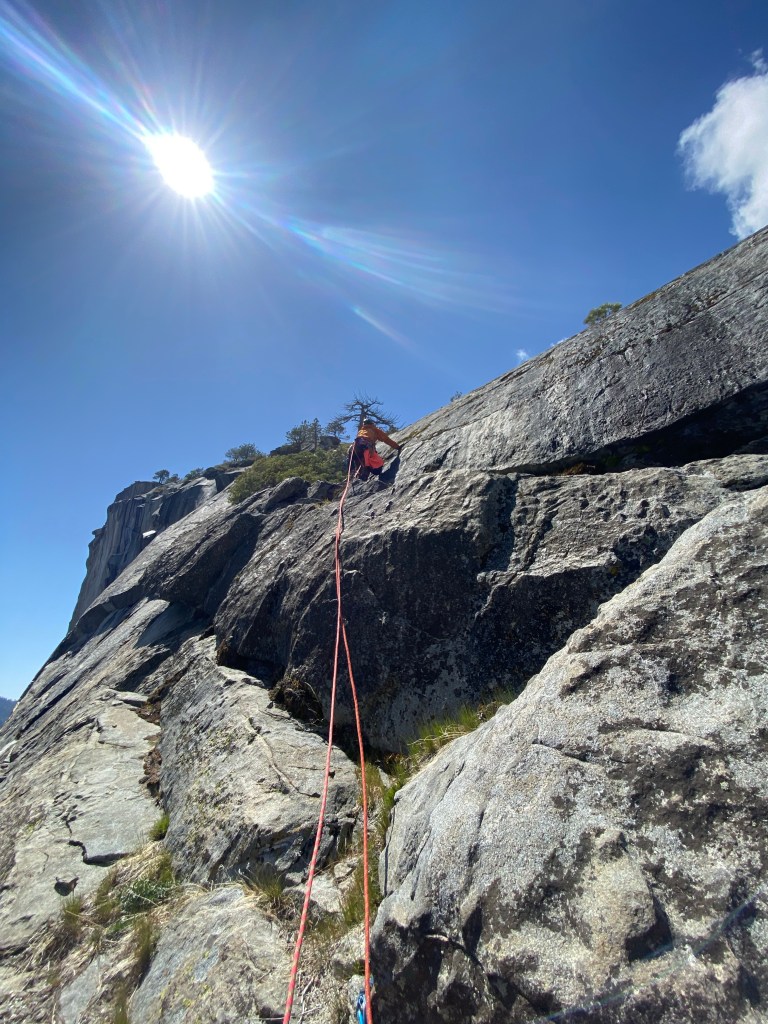
How lucky I had been to score such an awesome partner in Ben. I was so proud of him for even trying this thing as his first wall. And to pull it off in such a clean style. I couldn’t have been happier. Ben ran into one of his climbing idols on the way down (Amity Warme) who had just freed El Corazon with her partner. Though Ben was so exhausted he didn’t realize who it was until later. Amity had been an inspiration to Ben to think about climbing El Capitan in the first place. Talk about full circle.
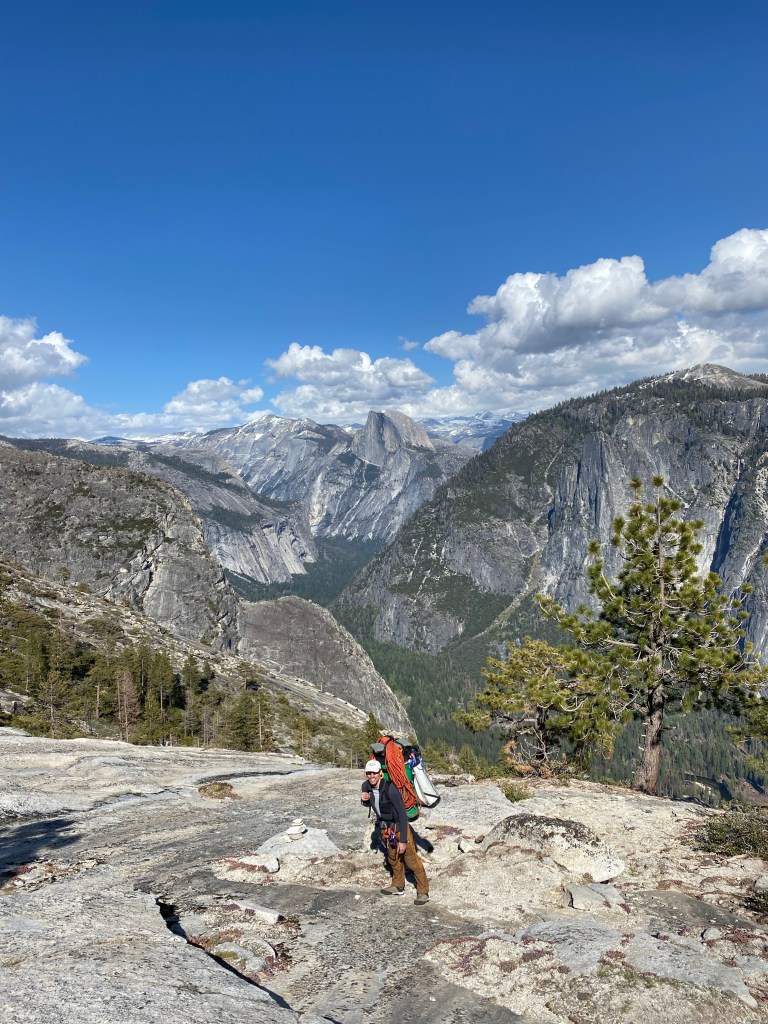
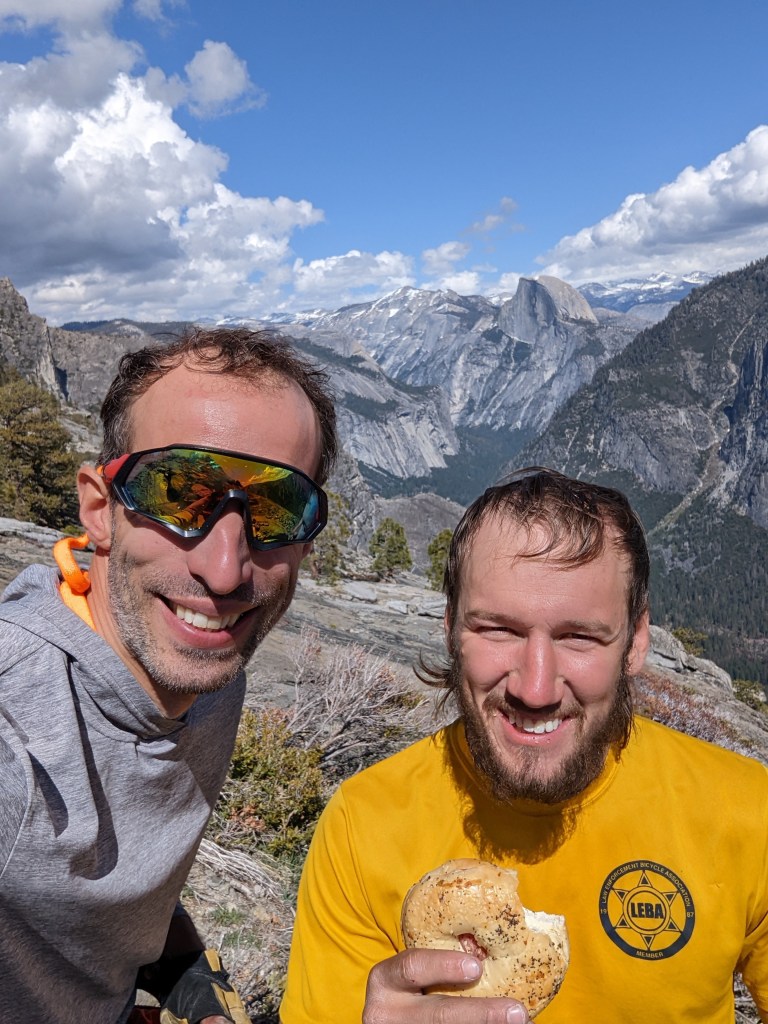
We grabbed food and exchanged gear and said our goodbyes. I crawled into my tent back in camp 4, and Ben drove all the home back to his family in Oakland. I had been looking forward to this route for quite some time but now he moment had come and gone and I had to look forward to something else. At the end of it all, you are left with the memories. The memories of your thoughts and feelings in the moment, the amazing places you visit, and the friendship that will last a lifetime. And Such wonderful memories they are.
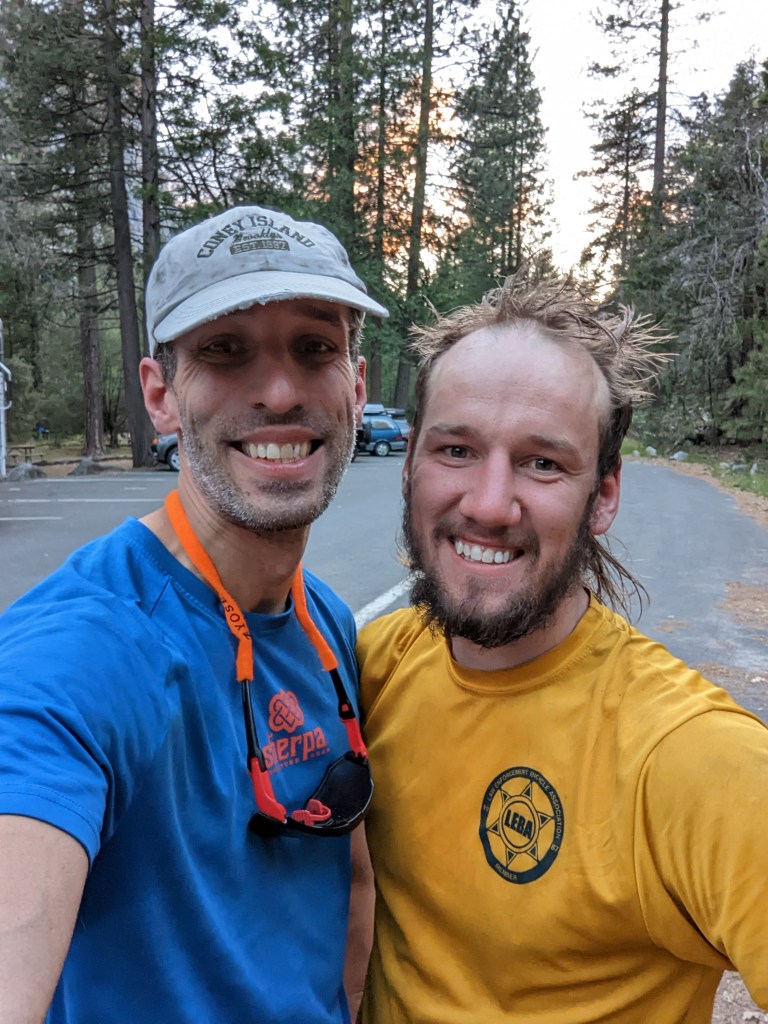

 Big Wall T-Dawg