
Where it all began
This idea started a few years ago, though I’m not sure of the exact moment. I’ve been climbing for 5 years, beginning with my wife Maria on Valentine’s Day 2016, in a gym in Virginia Beach. That quickly evolved to me climbing outside at The New and The Red before I moved to Colorado.
In 2017 I met this 16-year-old kid named Clay, who shared a birthday with me. The bond was tight, and he quickly became my best friend. I watched him grow from a little kid, 5.10 climber, to crushing 5.13’s, on sighting 5.12 C’s, and just being an absolute beast. He was climbing circles around me. Sometime in 2018, he said we should climb El Cap, which was nowhere on my radar. I agreed, but it didn’t seem like much. At some point, it became clear this was a goal of ours, and we started to get serious about it. In spring of 2019 we went out to Yosemite, in absolutely awful conditions, and after a week of watching it drench the rock, there was still nothing but rain in the forecast. Rather than run home with our tails tucked between our legs, we figured we ought to try, and went for it. We “swam” our way up Freerider, soaked to the bone, climbing at night when it wasn’t actively raining, and sleeping, or trying to, during the daytime when it was. We reached the top after just under a week of suffering, but we did it. The hike down sucked, took all day, and I vowed to never climb a big wall again!
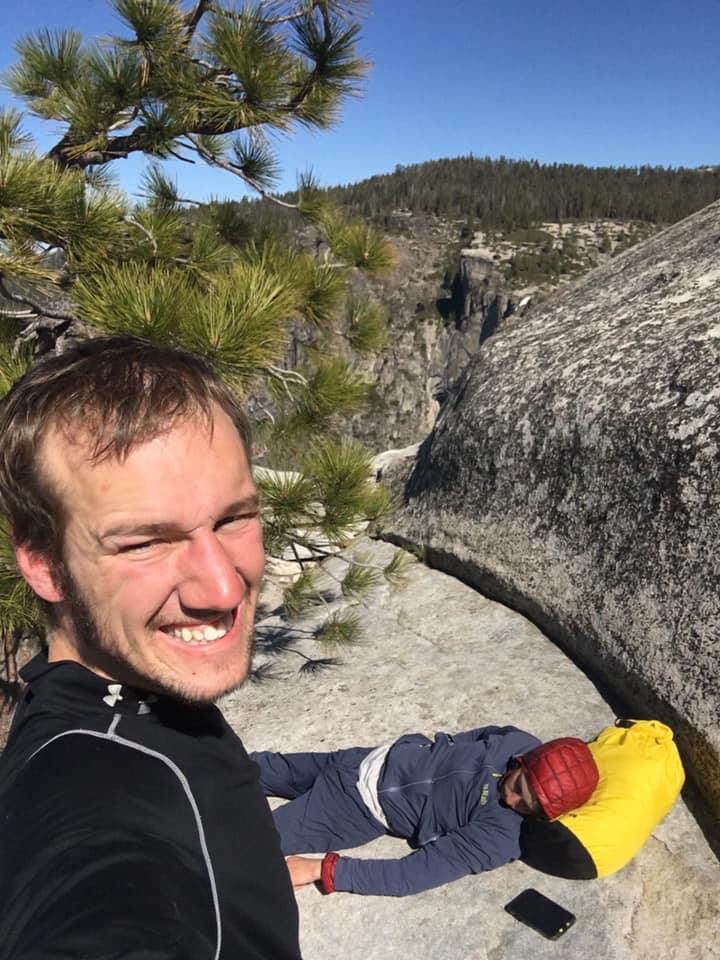
I wrote a trip report on this ascent and a few big names commented on the ascent, both impressed and a bit flabbergasted and what we had done. Mark Hudon wrote this quote “Given your gumption, I suspect you’ll be getting up any El Cap route in any style you choose real soon.” This comment meant the world to me and resulted in a huge boost to my confidence, and likely led to my belief that I could solo this damn thing. I’m not a particularly strong climber, climb slowly, and don’t have a ton of courage. What I do have is the ability to fucking endure. I don’t quit, and I find the ability and strength to push on, one foot in front of the other, rarely bailing, especially when it counts.
Since then I’ve done The Nose, Lurking Fear, Zion: Desert Shield, Space shot (solo, but no hauling), Lunar Ecstasy, Fisher Towers: Finger of Fate, and Black Canyon: Astro Dog (Free climbed). On the vast majority of those climbs though, it seemed that Clay or Jon (One of my other closest friends and partner) always ended up taking the crux pitch for one reason or another. I wasn’t scared of the cruxes, or unable to climb them (maybe I was unable on Astro Dog), but it just usually seemed to work out that way. I wondered to myself if I was capable, or if I was using my partners as a crutch to boost up my resume.
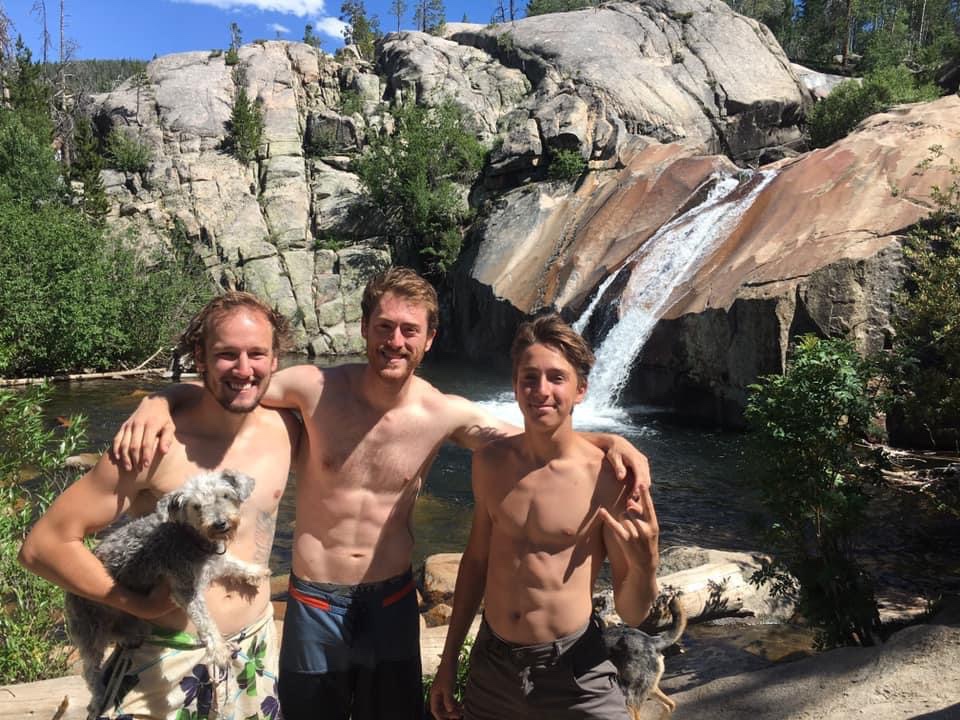
I’ve always been fascinated with solo climbing. I can remember being 18 and dreaming of being the first to solo Denali in January (It’s been done since), doing tons of research while working security on the night shift at an energy plant. At the time I thought I wanted to be a mountaineer and had zero interest in rock climbing. I can remember reading that I should learn how to climb up to 5.9 to make life easier and thinking that sounded hard. I also remember watching Valley Uprising and thinking those guys were fucking insane and I would never do anything like that!
Here we are, 12 years later and the dream is to solo El Cap. The Muir Wall was always the route I wanted to do, but I just didn’t think I had enough time, only having 10 days total to get there, do the route, and get home. Zodiac was the obvious choice. But I was never really happy with that choice, wanting to both climb the heart of the wall and not wanting to do the route that everyone solos. After working my ass off for a few months, and taking my overtime in the form of additional time off, I scrounged up another week of vacation. 3 weeks before takeoff, The Muir Wall was an option again. I began talking with Pete Zabrok and he tried to convince me to do Zodiac or Lurking Fear, suggesting Muir Wall was just too long. This settled it, I would be doing the Muir Wall. Hopefully, I wouldn’t regret this decision. I will say, initially I thought I could do the route in 7 days. After consulting with Pete I opted to go for it in 12, and eventually bumped this up to 14. While I do think I could have done it faster, I don’t think 7 would have happened. And had I had less time, it would have been a lot less fun and a lot more stressful. Thanks, Pete, for helping me to realize that. Pete provided more inspiration with this line “The raddest thing you can do is to climb a wall so low, that is longer and harder than anything you have ever yet done.” The Muir Wall certainly fit the bill. My hardest lead up to this point was C2+ and I had only ever used a hammer one time practicing at a local crag near the ground. This was a huge step up, and I was inspired as Fuck!
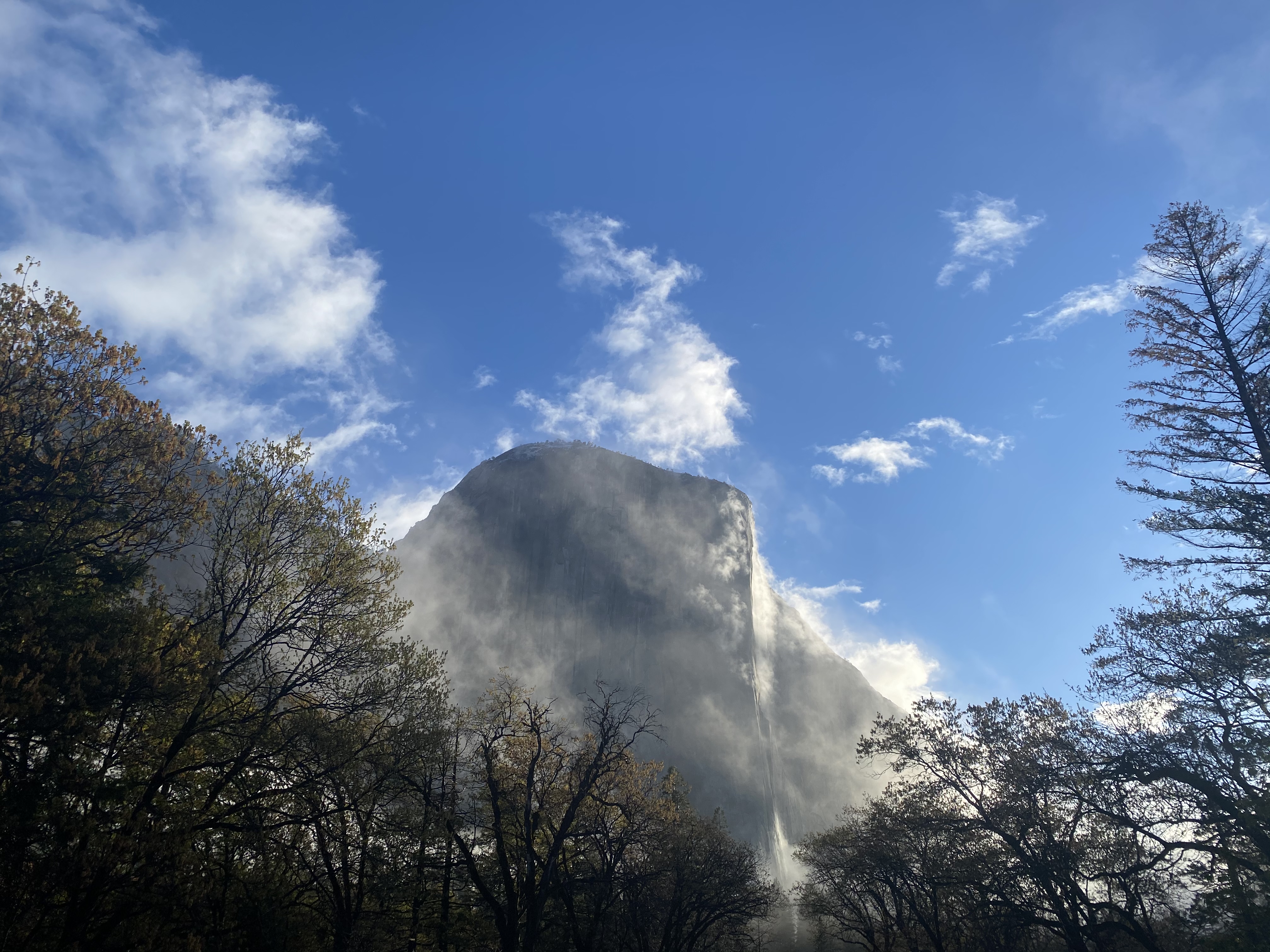
Another reason I wanted to do the Muir was the history! This was the first route ever soloed on The Captain by the late Royal Robbins in 1968. Standing tall on his shoulders, and following somewhat in his footsteps, even if very vaguely, was inspiring to me. Also, Muir Wall was the first route ever done without the use of fixed lines, by Yvon Chouinard and TM Herbert in 1966. What this means is they simply started on the ground and went up, never using ropes to maintain attachment to the ground. Today, the route is typically done using fixed ropes to Hearts Ledge, which means you aren’t committed to the wall until you are more than 1/3rd of the way up it. Some people even skip the first 10 pitches and still claim the ascent of the Muir Wall. I wanted to follow in the style of the first ascent, and only use the two ropes I was bringing to fix to the ground. Once those no longer reached, that meant that I was committed. This would mean the hauling would be harder, the wall would take longer, and I would have to bring more supplies. But trying to somewhat match their style was important to me. Lastly, Chris Mcnamara mentions this may be the longest route on El Capitan, due to its position in the middle of the wall, and its traversing back and forth. This was what I wanted, something that went straight up the gut, and was the whole damn wall!
Anyways, I thought climbing The Muir Wall for my 30th birthday, as sort of an age I’ve been slightly terrified of for a long time seemed right. And I just wanted to see if I had what it took.
Day 1 (Saturday 4/10): pitch 1 (Moby Dick) and 2
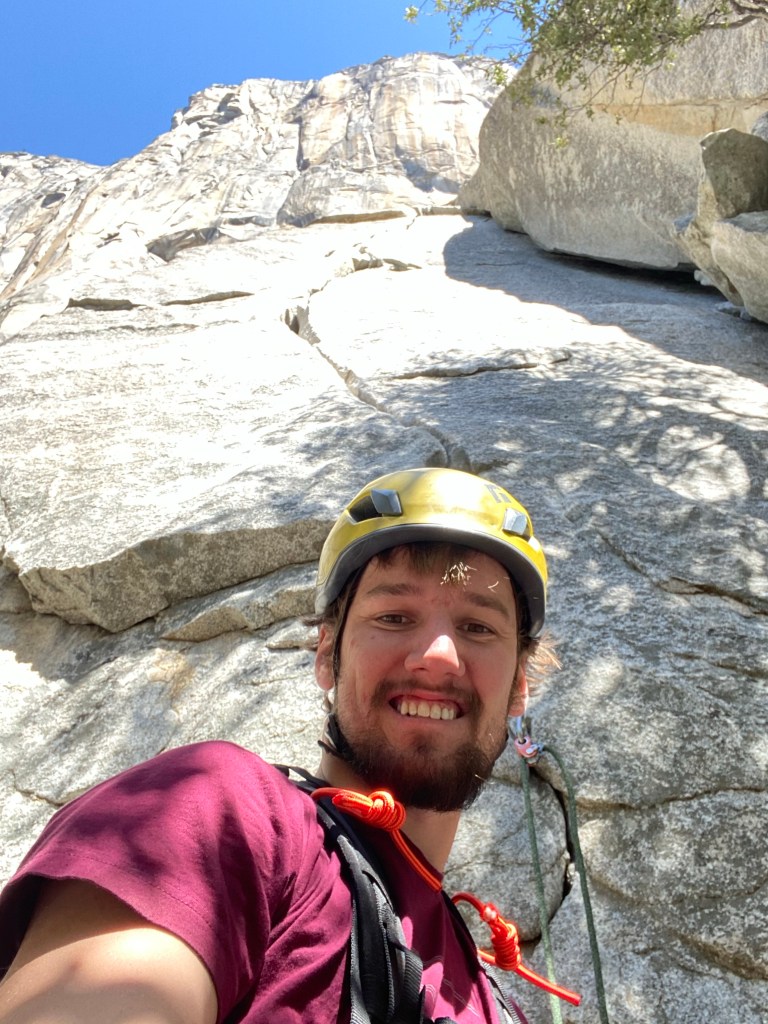
I rolled into the valley around noon and was all set up to get out of the car and go. I had taken the time before leaving to have my rack and rope ready to rock and roll so there would be a minimal delay before I got started. I remember as I was walking up feeling overwhelmed with excitement and anxiousness that this was happening right now. No waiting around, just straight to business.
I walked right up to the route, having a fairly good idea of where it was as it starts just left of The Free Blast which I had done before. The crack was super obvious as it starts as a finger crack and grows to a fist crack which it stays for quite a while. I brought 3 number 4’s for this pitch and wasn’t upset about it. The climbing was very easy, but also quite intimidating. El Capitan is big. I would have loved to free climb this pitch, but it was not something I was going to consider sans belayer. I will come back to it one day.
I did free climb pitch 2 however. The topo says 5.8 but I thought it was mostly 5.6 with maybe a small section of 5.7 or maybe 5.8. I felt very comfortable free climbing in my approach shoes, with the gri-gri belay. When I did get to the short section of steep hand crack, I couldn’t help but smile ear to ear. I was free climbing on the Captain by myself. Pretty cool place to be.
At the top of pitch number 2, there is a fantastic ledge that I spent the night on…..but not before rappelling back down to head into the valley to grab some Pizza. The Valley was super crowded, and I ended up waiting a few hours before I was able to order and put my grubby mitts on the food. But it was worth it. After eating I drove back to the two-way pull-out just past El Cap Bridge and gathered the things I would need to spend the night and sustain myself through the next day of climbing. I then hiked up to the ropes I fixed, jugged up with my bivy kit, and ended my 20’s sleeping 200 feet or so up El Capitan.
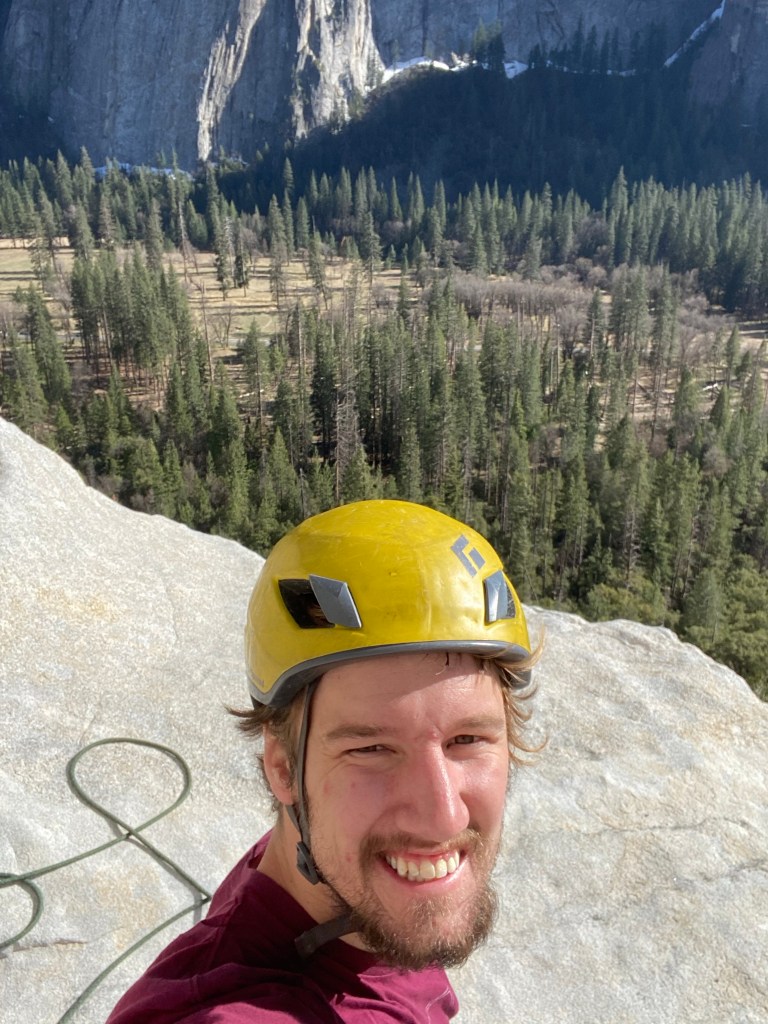
Day 2 (Sunday 4/11): Pitch 3,4,5, and 6 (8a Traverse)
I don’t remember the lower third of the route particularly well. I do remember that it was wide, awkward, and slow going. I woke up on Sunday morning Thirty years old and excited to spend the day climbing. I had brought a backpack, made more for hiking, up to the second pitch with me with the intent of jugging with it when I cleaned each pitch. At some point along the way I decided it was too heavy for me to want to do that anymore, so I began hand hauling it after each pitch which was also less than ideal. By the time I made it to the base of pitch 5 I had to decide if I was going to continue to the end of pitch 6, which would almost assuredly happen in the dark, or if I would stop at the top of four. I did not believe that two ropes would have gotten me to the ground from the top of pitch 5, so once I started 5, mentally I was committing to 6.

I ended up starting 6 around sunset and did finish when it was quite dark. Pitch 6 was one I was worried about from the get-go. Mainly because it went straight sideways which was a huge question mark for me in my soloing. How would I get back to the belay? Would I have to climb the pitch 3 times? I had not done something like this before and had honestly avoided it. Theoretically, I knew that would not be the case, but it was something that made me anxious. The pitch itself was mostly easy until the very end. I believed that when the visible roof traverse ended you would likely just stand up on the last bolt and be at the anchor. This was not so. I had to lower down a little bit and ended up standing high on an ancient piece of fixed gear, in combination with the use of a camhook up and left, to reach up and get myself into another crack system. There were some weird homemade bolt hangers as well that I didn’t really use but that I clipped for protection. I was very nervous using the fixed piece because I didn’t have any pitons to replace it and wasn’t sure how I would do the section without it. I’m sure there was a solution that would have allowed me to skip the piece, but I didn’t see it at the time. I stepped on it very gingerly and thought light thoughts.
Getting back to the belay was a non-issue. I had discussed this briefly with Pete Zabrok before my trip and he told me what to do. It worked like a charm. I used the haul line to pull myself most of the way back over to the belay with the use of an ascender. I lowered myself out at the very end and had to jug up 15-20 feet or so. No big deal.
I ended up leaving a few spare carabiners I had brought along to lower myself out when cleaning this pitch, as well as a few others on the route. Last fall I was cleaning the pitch just below the great roof when a piece of lower out tat broke on me. It sent me skidding sideways across the wall and left me a little banged up. Ever since then I have been a little leery of lowering out on tat that didn’t look relatively new.
Once the pitch was cleaned I fixed a rope to the anchor, left all my gear at the top of 6, and began rappelling down to Little John. I intended to sleep on Little John for the night, to have spent every night on the wall during my ascent, from beginning to end. When I got down to Little John I saw there was already a person sleeping on top of the formation. I would have had to trample over him and his setup to get to the anchor on the left side of the ledge. Instead, I stopped on the right end, tied my two ropes together, and continued to the ground. I looked around for a flat spot to bivy for the night but didn’t see anything that called to me. The only other idea I had was sleeping directly below the Pine Line, at the base of The Nose, which seemed like a pretty bad idea for a multitude of reasons. Instead, I hiked back down to the car, drove out to El Portal, and spent the night in my car. This wasn’t the exact style I was hoping for, but it would have to do.
Day 3 (Monday 4/12): Schlepping Loads and Hauling to the top of Pitch 6
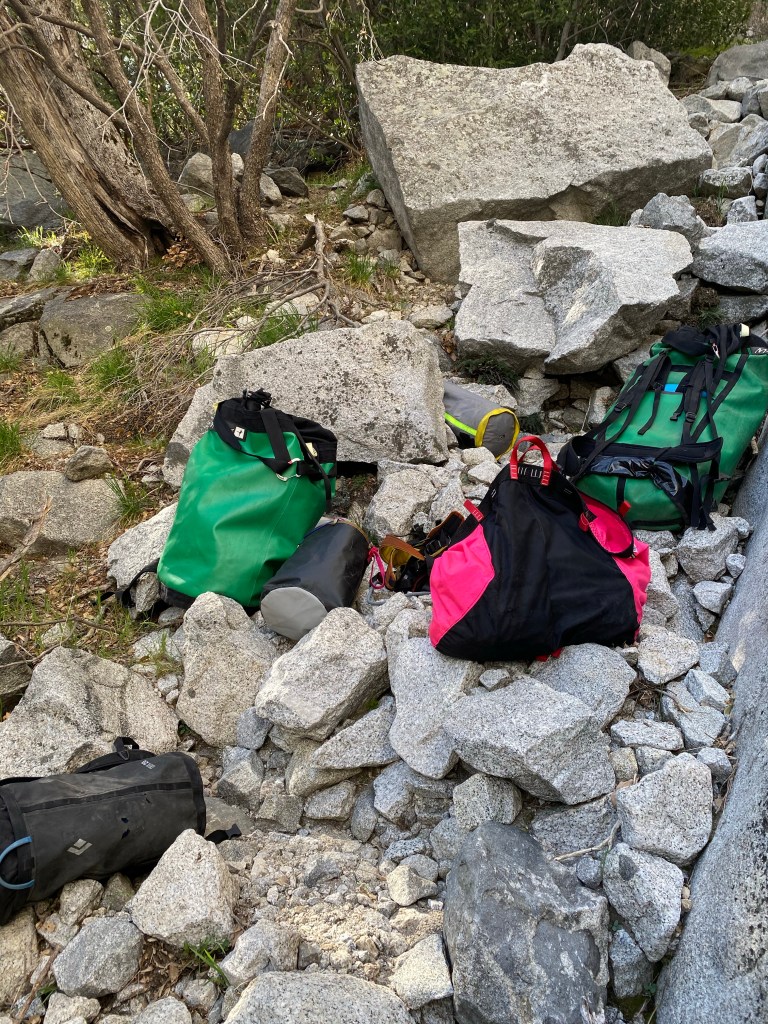
I spent the majority of Monday schlepping load to the base of my ropes, which were just a little down the hill from the Hearts Ledge fixed lines. I ended up walking back and forth a total of 5 times to get all my stuff to the base station of the climb, each round trip taking approximately 50 minutes. While making my way back and forth I met a party (Ari and Pete) who were also hiking loads up intending to do the Triple Direct, which would intersect with my climb in the middle portion. This is the one section I anticipated potentially running into another party. We spoke briefly about timing and where we expected to sleep. I assured them they would be faster than me and I had a ledge so we would work it all out. They told me they anticipated starting the route Wednesday, which is around when I hoped to be making my way to Mammoth Terraces as well, so we would likely intersect. As they continued to the fixed lines, I overheard them have a brief conversation about the required headspace I had to be into solo The Muir Wall. I chewed on this quite a bit because I’ve never thought of myself as a particularly confident climber. I often hold myself back because of a lack of headspace. I get scared to fall, even when I have done so over and over sport/trad free climbing. It’s always fine, nothing bad has ever happened, and yet I have a hard time just going for it when I onsight, needing to work up the courage to give it all I have, usually on a redpoint. I started thinking more about that small comment I heard and thought maybe I am in a pretty good headspace. Not in the way I typically think about it, but I am confident that my systems work and that I can pull this off. I am confident that I will not kill myself, that I can reach the summit, and that I will not end up needing a rescue off this damn mountain. I am confident that I won’t fall, but that if I do, I will be caught by the rope, and everything will be ok. This internal dialogue was a much-needed boost to my confidence.
Once all the loads were at the base of the climb, I took everything out of the bags and meticulously packed each one. I then set up the bags to be hauled and ascended the 400 feet or so back to my highpoint, the base of pitch 7. I then got to hauling, using the 2:1 haul kit that I had only used once or twice before. Should have practiced more! Hauling seemingly took forever, but it was better than 1:1 hauling. I would guess the total weight of my load was north of 200 pounds, probably around 240 if I had to guess. I had 100 lbs of water alone. Once all my stuff was finally at the anchor, I busted out the portaledge (D4 Octapod) and went to bed, fully committed to the wall at this point.
Day 4 (Tuesday 4/13): Pitch 7 and 8
I don’t particularly remember the climbing very well on this day. What I do remember is meeting the Freerider Boys (Sam and Adrian) and wrestling with my Portaledge for quite a while trying to get settled into sleep. Sam and Adrian came through on the Heart fixed lines. This was going to be their first-ever big wall, and they were making a 5-day push with an attempt to send the route. They were hauling to Hearts and had already climbed the Freeblast, which Sam had on sighted. Strong kids.
I stopped slightly early, robbing myself of the opportunity to knock out a third pitch, with the hope to get the ledge put up and squared away before the dark rolled in. This did not work out. It felt like 3 hours I spent wrestling the ledge, but I’m sure it was much less. It did bleed through the sunset and into the darkness, and I ended up settling for an uneven ledge that needed to be adjusted numerous times and required me to not move around too much. I found myself extremely frustrated and nearly in tears as I imagined the onlookers in the meadow watching me and thinking me a buffoon. I’d like to make it clear that my struggles with the ledge were entirely my fault and no fault of the ledge itself. I think the ledge had “Taco’d” and I failed to recognize and fix the issue. Also, I was not very intentional about where and how I set up my sleeping anchors at the beginning of the route, something I would learn to fix later on.
Day 5 (Wednesday 4/14) : Pitch 9 and 10
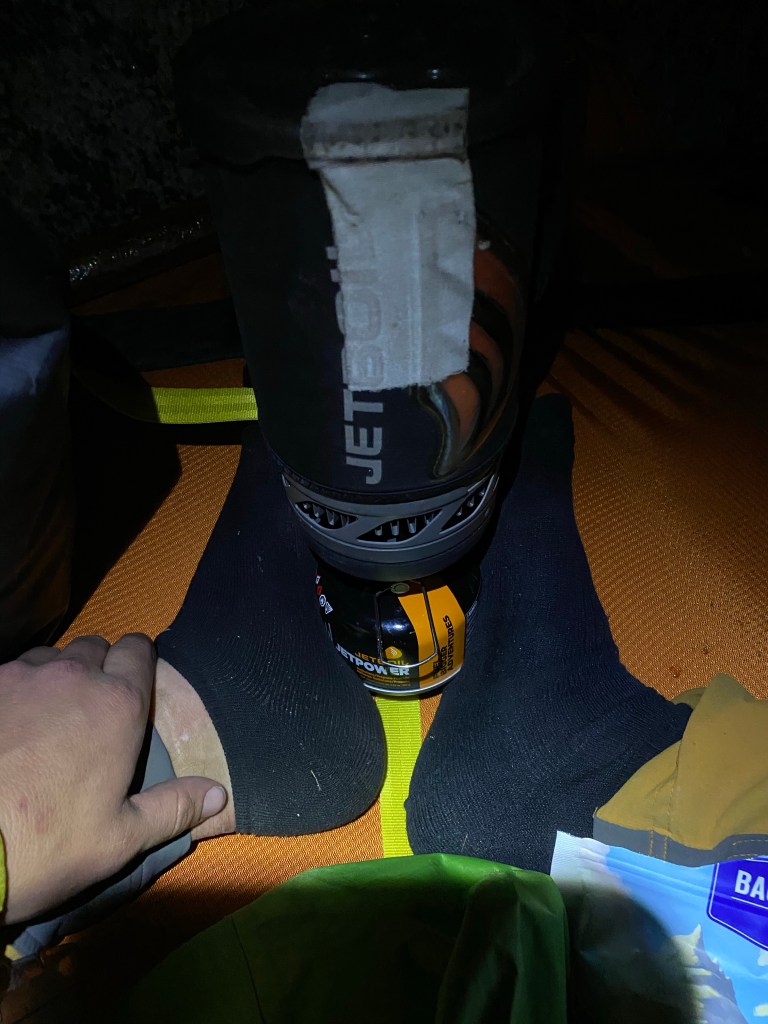
Both the Freerider boys and the Triple Direct team were planning on starting on this day, however, the weather kept them away. It rained overnight, and after I struggled with the ledge, I didn’t even bother busting out the fly. Instead, I stayed in my bivy sack and waited out the weather in the morning which involved a decent amount of rain, sleet, and hail. Once the precipitation stopped, I emerged and saw the skies were still threatening. Without a ton of time to play with, I opted to get up and just start climbing, weather be damned. My first time climbing El Capitan was in the spring of 2019 and the entirety of the mountain was a waterfall. I figured whatever this day threw at me would be minuscule compared to that experience.
It rained on me on and off all day and I just sucked it up and climbed through. I had the kit to weather just about anything thrown at me, and could always change clothing if needed. Towards the end of the last pitch, just before Hearts Ledge, I found a nice little roof where I placed a few cams and hung out for a half-hour or so as I waited for a round of precipitation to stop. It was nice to stop getting spit on for just a little bit. Once it stopped raining and some blue skies emerged the pitch required me to get to a high fixed piece and then tension over to the left and do some “5.8” climbing. I attempted to tension over, but I could not get any purchase on the soaked slabs to navigate the intended 5.8 climbing. I probably should have put my climbing shoes on, but opted to stay in the comfort of my approach shoes. I saw a logical way to climb a little higher from the intended point, but the placement of the fixed piece did not allow me to get to that position to climb. I saw a #1 placement left of the fixed piece and climbed my way a few feet over. I threw in a kneebar and grabbed the #1 and plugged it in, sinking onto my Alfifi. Using a kneebar while solo aid climbing was a bit comical but was also pretty cool. With the pendulum/tension point now several feet to the left, I was able to claw my way over to the more featured section of rock and finish the pitch.
I was a little surprised to find that the anchor was not on Heart’s ledge itself, but about 30 feet down and right. A little scouting showed that about 60 feet straight left, there was a nice flat and level spot, 30 feet below hearts ledge itself. I set up my ropes to ferry gear safely to the left and opted to take the natural bivy over there. The benefit of this was I wouldn’t be in the way or get stepped on by any early morning Hearts Ledge visitors. I left my haul bags at the anchor and walked over my food and bivy equipment to the left, where I spent a very comfortable night, even briefly getting out of my harness while eating dinner and reading my book (short story adventures about John Muir himself).
Day 6 (Thursday 4/15): Pitch 11 and 12
With good weather in the forecast and good natural bivy ledges to come for a few days, I woke up stoked and ready to go on Thursday morning. Looking up, the climb to Mammoth Terraces looked fairly simple, but the hauling looked awful. Pete Zabrok warned me that the climbing up to Mammoth was trickier than it looked, but free climbing the majority of the pitch kept it fairly chill. I did aid a short section both down low and up high, but the terrain was fairly ledgy and simple. I’m not entirely sure if I climbed the intended line or not, climbing well to the right of the fixed rope that goes from Mammoth Terraces to Hearts Ledge. The hauling on the other hand was a huge pain, requiring me to rappel back down to my bag multiple times to help it past obstacles on the way. As I was hauling the Triple Direct team popped up and over from Freeblast. They had already hauled to Mammoth Terraces, so after a short lunch break, they were ready to rock and roll, ensuring neither one of us was held up by the other. It worked out perfectly.
I began shuttling gear from the left anchor on Mammoth Terraces to the right anchor while the Triple Direct team did the next pitch to Pharaoh Ledge. The pitch looked short and quick, and Pharaoh was where I was intending to sleep. Once I completed shuttling my gear the Freerider boys showed up as well, and began their downclimb to Hearts Ledge. They had already done the down climb once and were going to do it again, however, they were staying on a line along the fixed line that goes from Mammoth Terraces to Hearts Ledge.
After a brief lunch break, I started up for Pharaoh Ledge. As I was about to begin, one last party from the Freeblast emerged. I met Dave who said that the Muir Wall was a dream route of his. Once he realized I was soloing it, he called me a rockstar. While this compliment was a bit premature, as I wasn’t even halfway yet, it did make me feel good and was a nice boost to my confidence. I’ve always thought it interesting how sometimes random throwaway comments by random people can unknowingly have a huge impact.
I free climbed the first 30 feet or so before getting into a short corner that I aided to a nice ledge. The pitch then requires you to circuitously rappel back down and right to Pharaoh Ledge. Looking down at Pharaoh Ledge it looked a little bit like a bowl, and not so great for sleeping. Mammoth Terraces themselves had good flat bivy spots that looked comfortable. I opted to fix the pitch, and stay on Mammoth Terraces for the night, waiting until the next morning to haul the pitch to Pharoh Ledge.
As I was wrapping up the night I was invited to come down to Hearts Ledge to hang out with the Freerider boys. Initially, I declined, ready to get to bed. After thinking on it for a minute, I figured it might be my last chance for any kind of social interaction, and rapped down where I hung out for a little bit.
Day 7 (Friday 4/16): Pitch 13 and 14
The day began with jugging and hauling up to Pharaoh Ledge. Pitch 13 was listed as C2 and had the note “many small cams”. Pitch 13 doesn’t particularly stand out to me, however, pitch 14 sure does.
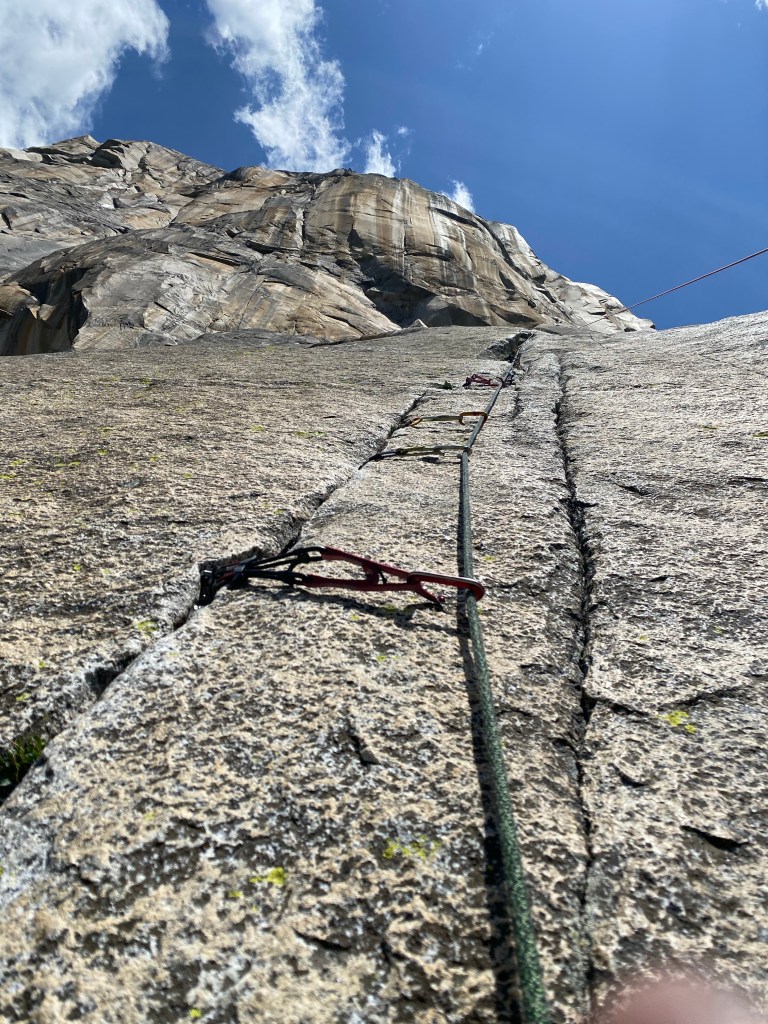
Pitch 14 was the first time I found myself somewhat scared by the climbing itself. Pitch 14 seemed to be nothing but .1/.2 offsets, and I only had 2 on me at the time. I had brought the third set of offsets as a backup set in case I dropped some, but after this pitch, I just started bringing all 3 sets on each pitch. I was using multiple camhook moves between the occasional piece that wasn’t .1/.2’s. This pitch is an inset with both a right and a left side. I started on the right side, and later in the pitch had to transition to the left. But first, a freak rainstorm came in, hard and fast. I was only in my sun hoody at the time. With no weather in the forecast, I had left all my jackets and rain kit down at the belay. With the small gear and camhooks, I was unable to build an anchor I was comfortable with and rappel back to the anchor. The rain/hail was not letting up and I was beginning to shiver uncontrollably, the spiciness of the pitch itself compounding with the weather. I wanted to shut down and stop moving, but the desire to get into some warmer layers forced me to keep moving up. At least if I fell, I could lower back to the belay off whatever caught me and get warm. I borrowed the new BD 00 cam from my friend Perry before I left, and was sure happy to have it numerous times on this route, this pitch included. Eventually, I reached a section in the crack where it finally opened to a much larger size. I threw in three good size pieces, sequentially cloved all 3 with my haul line, and rappelled back the anchor. In the Erik Sloan guidebook, he mentions that the cracks on the Muir turn into a waterfall in a storm, and I got a chance to see this first hand. My hands had numbed out and I was soaked.
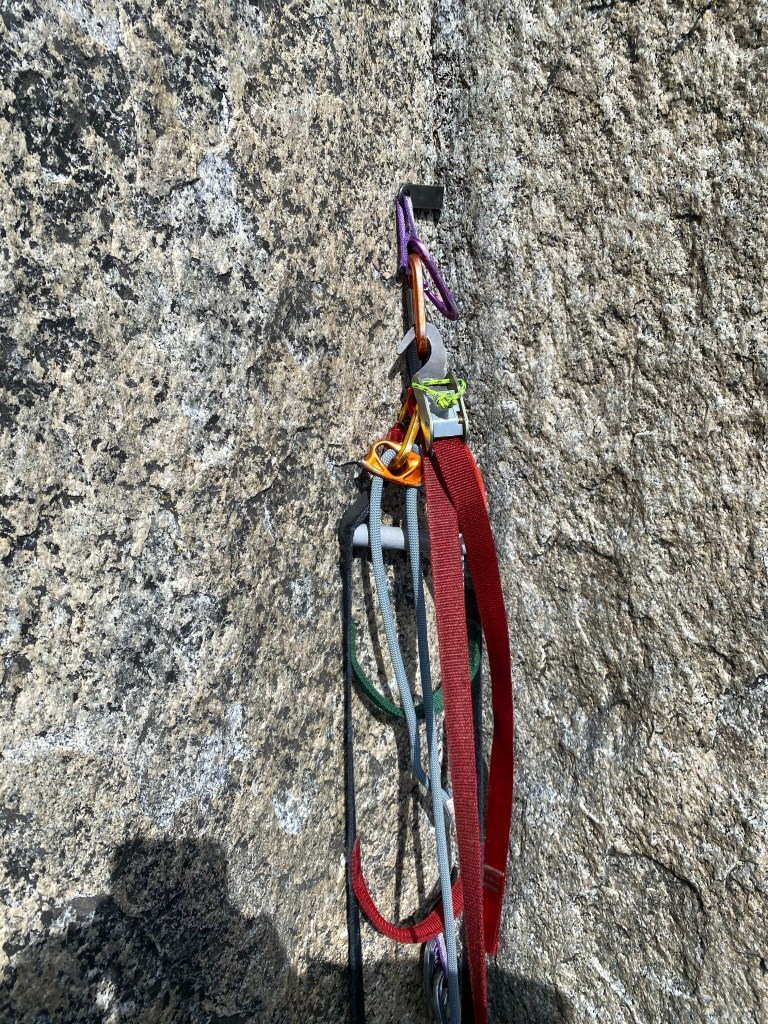
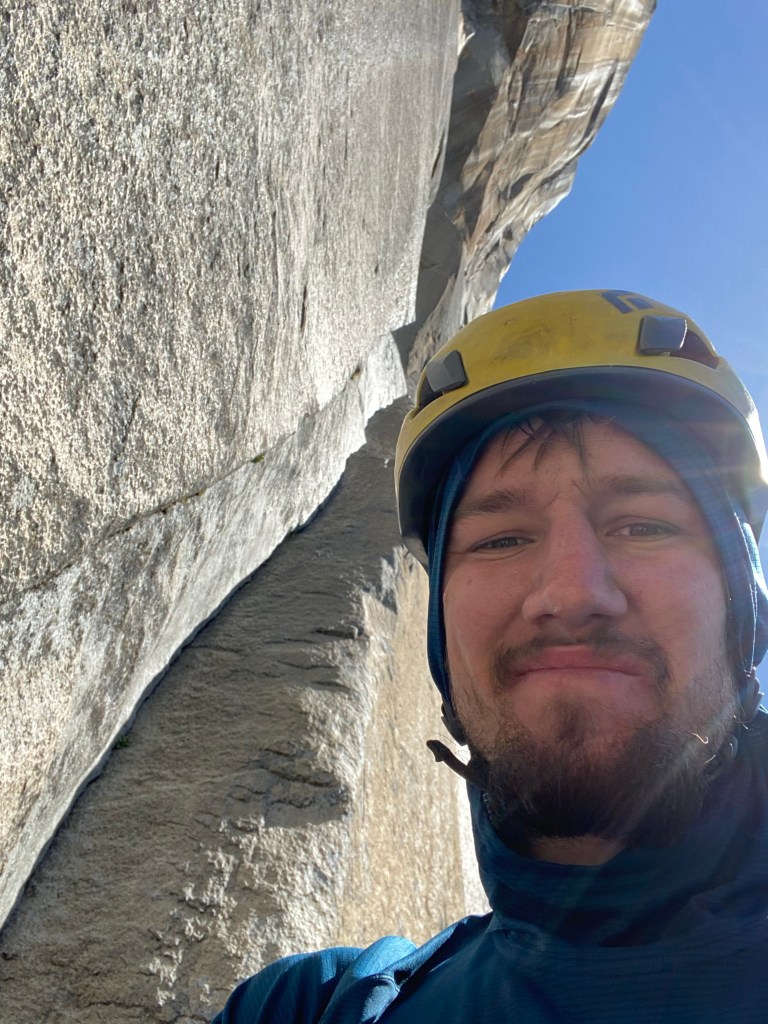
Not long after I got down the rain stopped, the waterfall dissipated, I warmed up, and it was time to continue. I intended to make it to Gray Ledges, the spot I had identified as roughly halfway. I opted to skip the intermediate belay and continue past the anchors into the chimney above. There is a crack in the back of the chimney, but the awkwardness of the chimney makes this pitch a major pain in the ass. Things would have been way easier if I had a belayer and felt comfortable just free climbing the pitch. I eventually found a method that made it not so terrible. Essentially, I chimney climbed with my left side, only using my right aider and the fifi hook to progress upwards. I would alternate from weighting my left side to using the aid equipment on the right and “styled” my way to the top, making Gray Ledges, my halfway point, and an excellent bivy point that I had all to myself.
Looking straight up I could see the classic pitches of The Shield, inspiration for a future ascent. Also looking straight up I could see this incredible-looking corner that was quite intimidating. The Topo showed it as C2 so theoretically it should be fairly easy. But I thought back to the C2 I just climbed below, and this looked just as thin from down here. I was heavily intimidated, but alas these were thoughts for the next day as I had already cleaned and hauled into the night and was exhausted and ready for bed.
Day 8 (Saturday 4/17): Pitch 15 and 16
I woke up just staring up at that second pitch for the day, slightly terrified, but not sure why. The thing was just so damn intimidating looking. I knew it was what I could expect for the entire upper third of the route. Beautiful thin corners were what the Muir Wall was all about. First I had to tackle Pitch 15, a non-descript C1 that looked fairly chill, and it was. Minus a softball-sized rock that broke off inside the crack and tumbled below it was fairly uneventful. I just hoped that rock didn’t hit anybody on the way down. I didn’t hear about any major injuries occurring so I’m going to assume it all ended ok.
As scary as pitch 16 looked, it was pretty easy. Good pin scars and pods made for a fun pitch. It also helped that I was listening to music all day, which just made things more enjoyable. It’s too bad I didn’t have the battery life to listen to music all day every day up there.
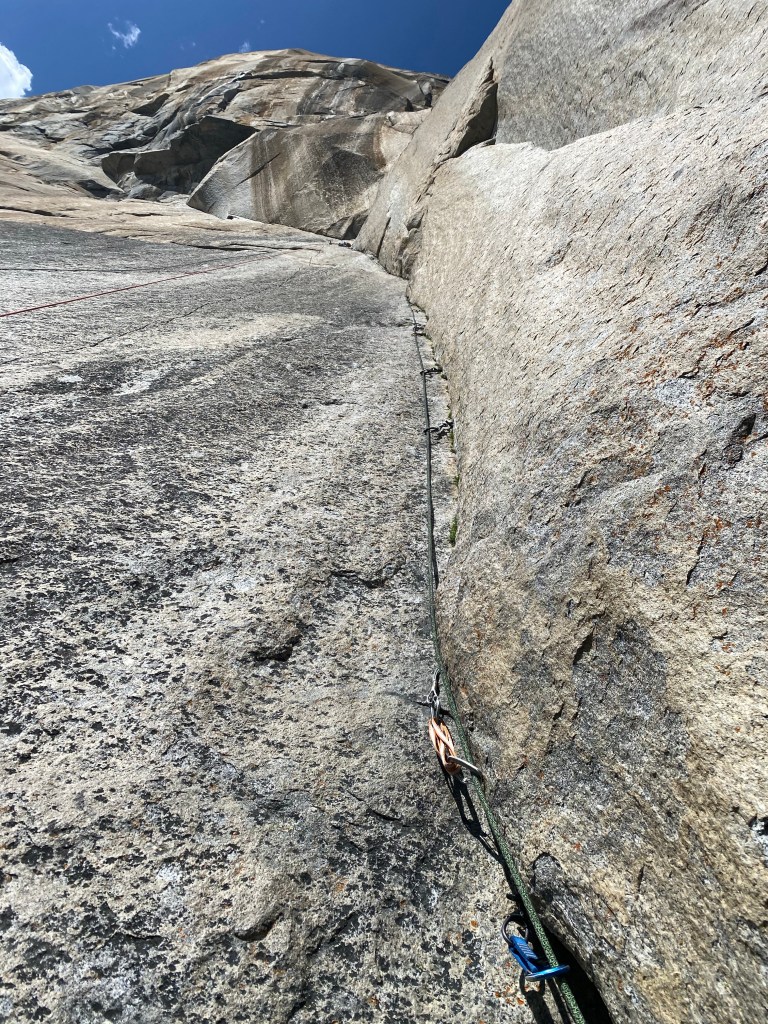

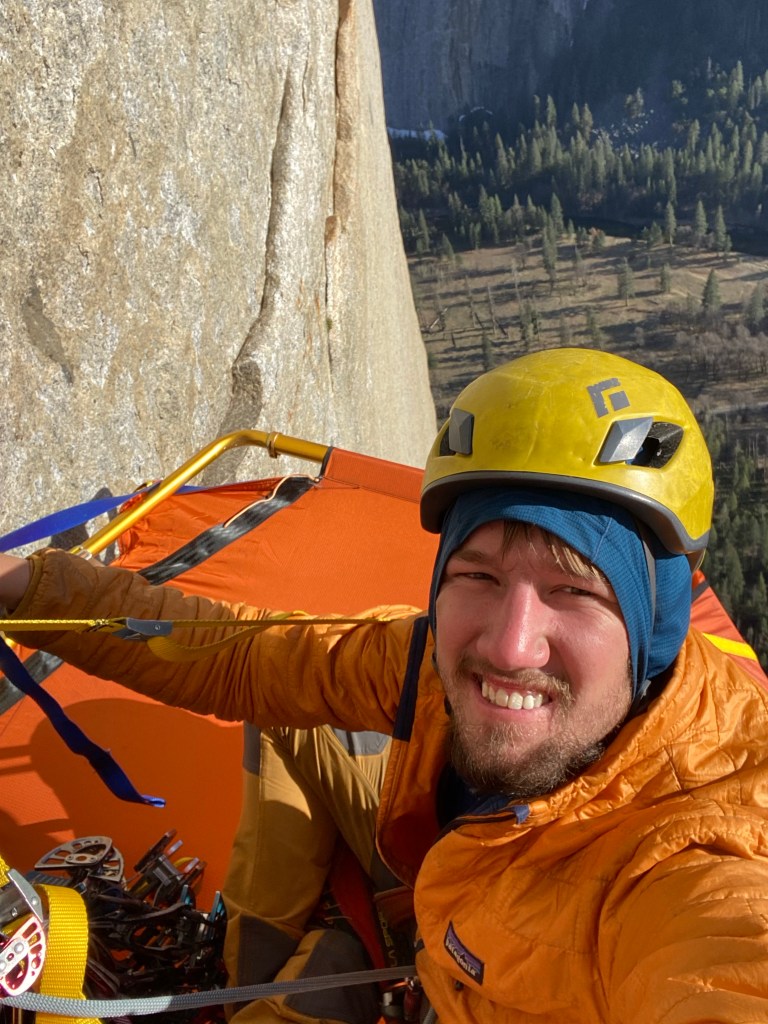
At this point I had pretty much dedicated myself to 2 pitches a day, knowing that was both achievable and would get me off the mountain in time to make it home for work. Assuming there were no delays that popped up that is. The belay at the top of this pitch was a pretty neat place to pitch the ledge, so I opted to stop here. Just below the point where one has to decide if they want to go left to Triple Direct and The Muir Wall or take the left turn to The Shield. I look forward to the day I’m headed left, as that looks like a fine piece of stone. After three consecutive days of natural ledge bivies, I wasn’t super stoked to get back in the ledge and contemplated fixing back down to Gray Ledges and rapping down with my sleeping kit. Ultimately, I decided that wasn’t a very efficient idea and that I needed to bite the bullet and figure out my issues with the ledge. I started to be more purposeful and thoughtful with my bivy belay setup and the ledge situation started to work out for the better.
Day 9 (Sunday 4/18): Pitch 17 and 18

Pitch 17 was the start of the traverse over to where the Triple Direct continued towards the nose, and The Muir Wall got into the business and got properly hard. The first pitch of the day was a bolt traverse that culminated in a short pendulum into an easy crack. The climbing itself was very straightforward, but the traversing nature of the climbing made everything take just a little bit longer. When I lowered out my haul bag, the haul line snagged on the rock along the way, failing to complete its traverse below my anchor. As I began to haul it popped free and came swinging over. All in all, it was less eventful than I thought it was going to be.
Before beginning Pitch 18 the wind picked up significantly. The topo gave this pitch C3 or A2. I knew I could climb C3, but I decided to bust the hammer and some iron out anyhow, just in case. I hoped not to use it however, as I still had hopes of maybe pulling off this wall clean. This was also the last chance I had to bail to something easier. I’d be lying if I said the thought of just continuing to the Triple Direct didn’t cross my mind. It would mean joining the nose, and finishing on easier climbing than I had done, and climbing I had done before. Ultimately, the thought of quitting the Muir, and also of now having the unknown factors of crowds on the nose, kept me true to my course, The Muir Wall.
The pitch began with a pendulum to a thin crack system where the C3/A2 part was. I found there was a pin missing. With a heavy rack, haul line, hammer, and everything else I was carrying I had difficulty swinging over to where I needed to be. There was a fixed piece at the base of the crack, and I needed to swing over there from the anchor alone, no pin along the way to help. After a few tries unsuccessfully, I had to jug back up to the anchor because all of my rope had spilled out of the bag and the wind was making a mess of things. I tried a few more times, without success and I started to get upset, again thinking about all the people in the meadow laughing at me as I bumbled around like a fool front and center in the middle of The Captain. Also, I had to take a poop so anyone who was watching got a nice show. After relieving myself, fixing my ropes, and taking a second to breathe, I lowered back down. This time I placed a number 2 farther down the crack, in place of the missing pin. Instead of penduluming over, I found a way to tension over and snag a crimp that I could yard on. I then fed myself a bunch of slack from my gri-gri, risking a lengthier fall if I blew it, and I free climbed up to the fixed piece. I was quite relieved when I reached that point. I wasn’t even to the hard part yet.
The C3 section was maybe 30-40 feet long and was super fun. A combination of the smallest cams, brass nuts (equalized together), and ball nuts got me up in good style. Another night was spent on the ledge.
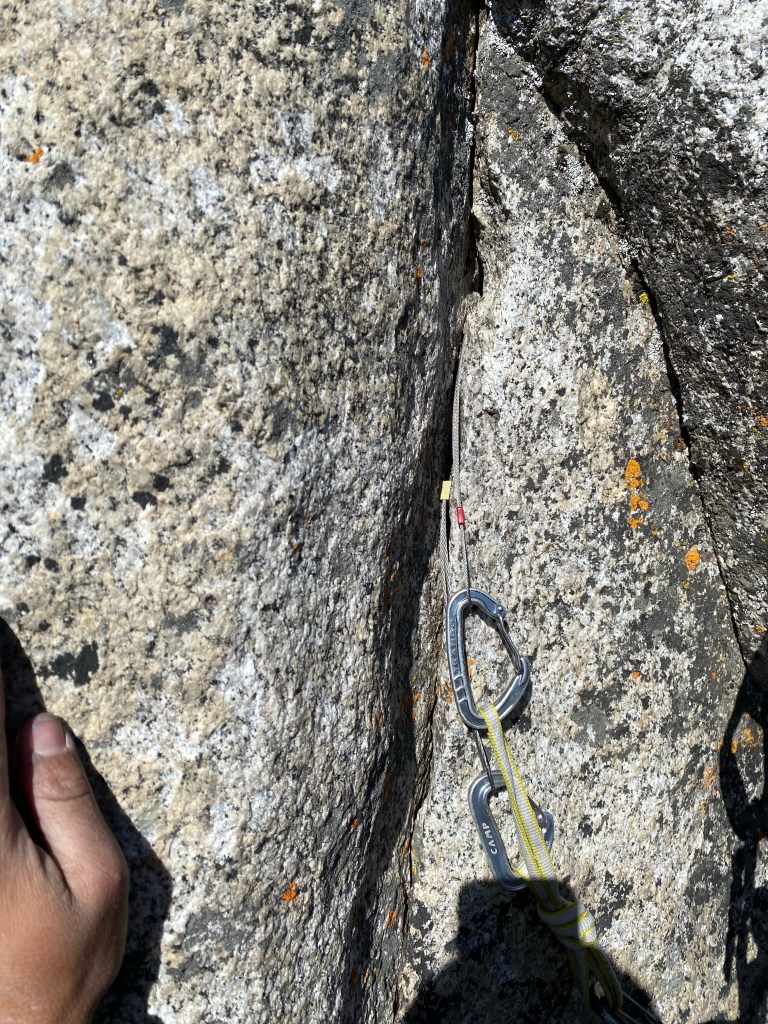
Day 10 (Monday 4/19): Pitch 19, 20, and 21
As the forecast solidified for the upcoming days it became clear that Wednesday was going to have me dealing with thunderstorms at some point. Climbing in the rain and being wet is annoying, but climbing in legit thunderstorms is downright scary. I’ve had several close calls with lightning, feeling the electricity flow through and sting my head and face on multiple occasions. Twice I have been convinced I was seconds away from getting struck on the summit of a mountain. Depending on when the storms were going to show up Wednesday, I was at risk of losing at least part of the day, and maybe the whole thing if I wanted to ensure I didn’t get stuck out in the weather. This meant that I was going to have to find a way to make up those 2 pitches before and/or after Wednesday to ensure I could still get down and back to work on time. At this point, I knew I had plenty of water and food to make it to the top. Which pretty much meant the only way I was coming off the mountain was by summitting, getting rescued off, or dying. Bailing down was never a thought I had, but now it was no longer an option. Not missing any work would have been nice too.
The first pitch of the day started very easy, with free climbing to a bolt, and then a short 20-foot section of aid climbing. This went very quickly and ended the majority of the traversing of the climb. Things were now more or less a straight shot to the top. As I lowered my bag out towards the anchor, once again it got snagged along the way. I should have pulled the bag back and attempted to lower it past the obstacle a second time, but after being able to easily haul it past the previous day, I just let it be. As I passed the bag while cleaning I did attempt to knock it loose, but in hindsight, I could have tried a lot harder. I continued up to the belay where I began hauling the bag and hauled it tight to the rock where it was stuck. I continued trying to haul but the bag was pretty well stuck, and at a 45-degree angle down and to the left. I lowered the bag and attempted again with similar results. I tried multiple strategies to try and get the bag to pop free, but nothing was working. I thought about rappelling down to the bag, which was going to take a little work because of how far to the side it was, but I was concerned about being in its path when it finally came loose and ultimately went flying across the wall.
When I bought Pete Zabrok’s Hooking up, he had mentioned I was free to message him on Facebook if I had any questions, and I had been keeping in touch with him throughout the climb anyhow, updating him with my progress. I pulled out my phone and shot him a message, figuring he may have some solution that didn’t require me to go back down to the bag. While waiting for his response I continued to dick around trying everything to get the bags to pop free, but without success. Pete responded with an excellent method, but it still required me to go down to the bags, which is what I was hoping I could avoid. Before going down I noticed there was a small ledge several feet below the bags. I lowered them down to the ledge, which partially took their weight. I then rappelled down and found a way to free climb up and over to right above where the issue was, self-belaying with the gri -gri. Once I got above the bags I realized my rope was in a position where if the bags popped loose, which is what I needed to happen, they would likely rip me off the rock and across with them. I was on a good ledge where I felt comfortable so I quickly removed my rope and flipped it under the haul line to ensure the haul line would not take me with it. I was then able to easily manipulate the haul line because it was not fully tensioned, because the bags were partially on the ledge I had lowered them onto. I got the rope off the obstruction and then kicked the bags until they cut loose and went flying across the rock face, coming to rest directly below my haul point. This entire process cost me an hour or two, mainly because I tried so long to avoid doing the inevitable and rappelling back down to the bags. Once the bags were fixed I jugged back up and over to the anchor and finished the pitch up.
The next pitch was similar to the chimney of Pitch 18 and required a similar method of aiding with my right side and free-climbing with my left. It was just as heinous and no fun.
At this point in the day, I was below the infamous 1″ pitch that goes on forever. I remember reading Royal Robbin’s account of this pitch and it sounded terrifying and very difficult. I looked up and it just looked fun and easy. Modern cams will do that for you I guess. I had already done my 2 pitches for the day, but I had to make up a pitch or two for Wednesday somehow. I figured I could snag one pitch right here and now.
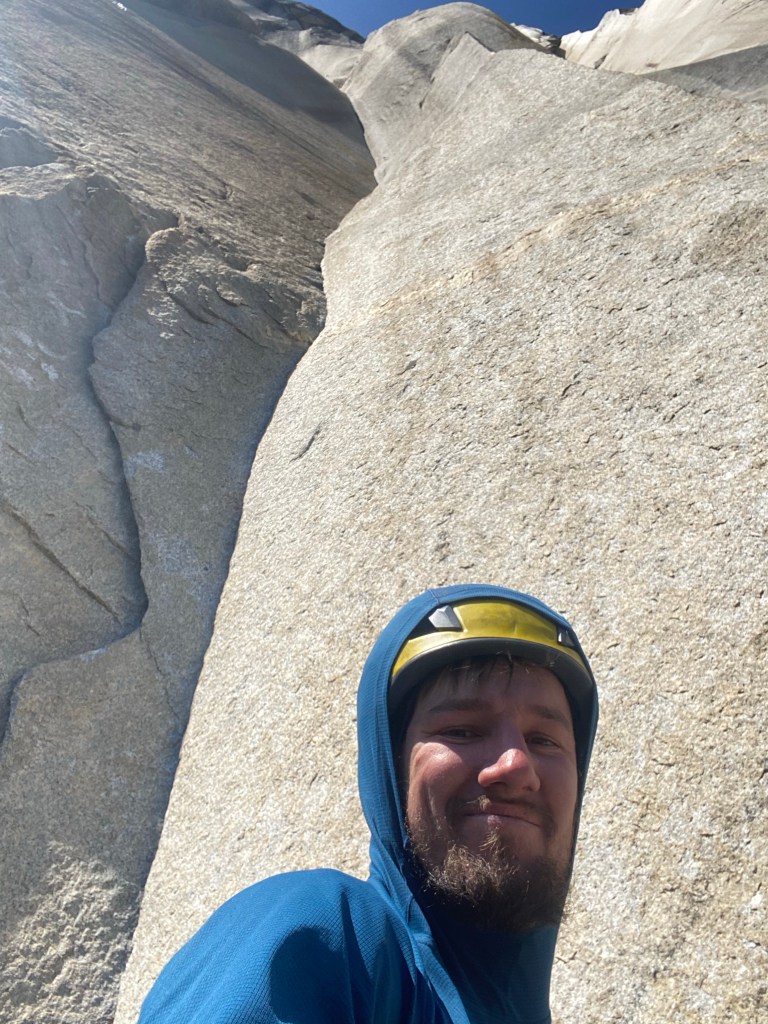
I started up the pitch and was immediately a little off-put by the hollow flake inside the crack in the first 15 feet. I tried to think light thoughts as I aided up and past it, hoping to not somehow break whatever connection it had, dropping the flake into the crack, and opening up the crack to where it would be wider than the cams that were protecting me. Of course, hundreds of people had climbed this section before, and hundreds more will likely climb it again, and that flake will remain. Nonetheless, it spooked me a bit. At the top of the flake, there were giant jugs which I reached up and grabbed to better facilitate getting higher in my aiders. Only to realize that it was essentially a bowl, full of bird shit, that I had just stuck my hand right in it. Later in the pitch, I would get to feel the feathers of the swift as I freaked it out and it emerged from the crack, brushing my hand as he flew off behind me.
The pitch started with a smaller cam, black totem size, but quickly opened up to .5 size, which it stayed for nearly 100 feet. I grabbed two purple totems, threw one on each aider, and cam jugged up the crack. Upon reaching the top of the pitch, I Fixed the ropes with the intent to rappel back down and bivy in my ledge, which I had already set up just below the pitch when I heard a noise. It was the call of fellow monkeys down in the meadow. “HOO HOO!” I didn’t know if the was for me or not, but I was so happy and enjoying myself that I decided to call back “HOO HOO!” I heard cheering back and then people screaming my name! “Yeah Tony!” my face lit up with joy and felt like I was on top of the world, even though I was still 1000 feet below it. I didn’t know for sure who it was, but I assumed that the Free Rider Boys had made it back to the meadow! What a fantastic way to finish the day! And now I was a pitch ahead of schedule, setting myself up to be ok if I missed Wednesday due to the weather. Great success!
Day 11 (Tuesday 4/20): Pitch 22 and 23
I woke up directly below the 1″ crack, having bivied in my ledge in another fantastically exposed section of the route. On top of that, I had finally gotten to a point where I was getting the ledge set up effectively in a way that allowed me to sleep well and not have to fuck around with the ledge once it was set up. Today was going to be a real test, giving me both a C4/A2 and a C3 pitch to see if I could handle the harder climbing.
Once I jugged up and cleaned the 1″ pitch I got my first look at the C4 section. It involved a fairly easy section of aid up and left, that then required you to clip into a fixed piece and pendulum back down and right, directly above where the belay was, and ascend a very thin seam. Once again, I struggled slightly with the pendulum. I got it by having a camhook ready to go, swinging over, inserting my fingers into one cam hook slot, pulling hard while I inserted my camhook into the higher slot, and quickly sinking into my fifi hook. I failed once or twice and ended up swinging back over. Once I finally got myself settled in I had my first close-up look at what was to come. It looked harder than anything I had yet climbed before. I was armed with my hammer, some beaks, arrows, and a bunch of clean gear. I hoped to do the pitch without putting the hammer or iron to use.
I carefully and cautiously made my way up the seam, back cleaning all of my gear until I was above my pendulum point. If I had fallen in the beginning I simply would have swung back over, having the pendulum point essentially giving me a top rope. However the higher I climbed, the scarier the prospect of falling became. Because there is no rope drag when soloing, theoretically I could have left gear below the pendulum point without any real consequences. For some reason I opted not to do that, back cleaning everything until being above the pendulum point. I was camhooking liberally anyways, which typically means no pro will be left anyhow. Once I started leaving gear I used the majority of my brass nuts. There came a point where nothing would fit aside from Beaks, which I had only ever placed one of before, while practicing at a local roadside crag for this trip. I busted out the biggest beak and slotted it into what I thought looked like a good beak placement. I lightly transferred my weight onto it, and it held. Eventually, I worked up the nerve to give it a light bounce and it was holding up. As my confidence grew, I figured I ought to bounce on it harder. Since I was hoping to avoid using the hammer I figured I ought to use my bounce test to try and set it in the rock as hard as I could. Once I had jumped on it with all my life I moved on and just assumed it was a bolt, continuing upwards. I then hand placed a second beak, back cleaning the first, and using a similar strategy of bounce testing to set the beak in the rock. I continued placing camhoooks, brass nuts, a ball nut, and even a DMM Peenut (which I hate) that moved on me when I weighed it but stayed in the rock.

I reached a place where I thought I was going to need another beak (a medium-sized one this time) and once again I hand placed it. As I went to weight the beak it ripped out of the rock and hit me right on top of my helmet, causing me to sink back on my fifi hook and the tiny piece it was attached to. I continued trying to hand place it several more times but was unable to get it to stick, continually ripping it out of the rock and weighting my fifi hook on the piece below. I looked up and thought I saw a bigger placement not far away, but just couldn’t get to it. In hindsight, I could have fashioned a cheat stick with my hammer and tape and made that placement, however, I didn’t think of it at the time and I opted to give the beak a few taps with my hammer, eliminating my opportunity to climb this wall free. I stood up and the beak held like a champ, allowing me to reach up and place a bomber gold DMM Offset that I would trust my life to. From that placement on the crack remained slightly challenging, but the real difficulties were over. I ended up falling one placement short of pulling off the pitch clean, but I had fun and I learned a lot.
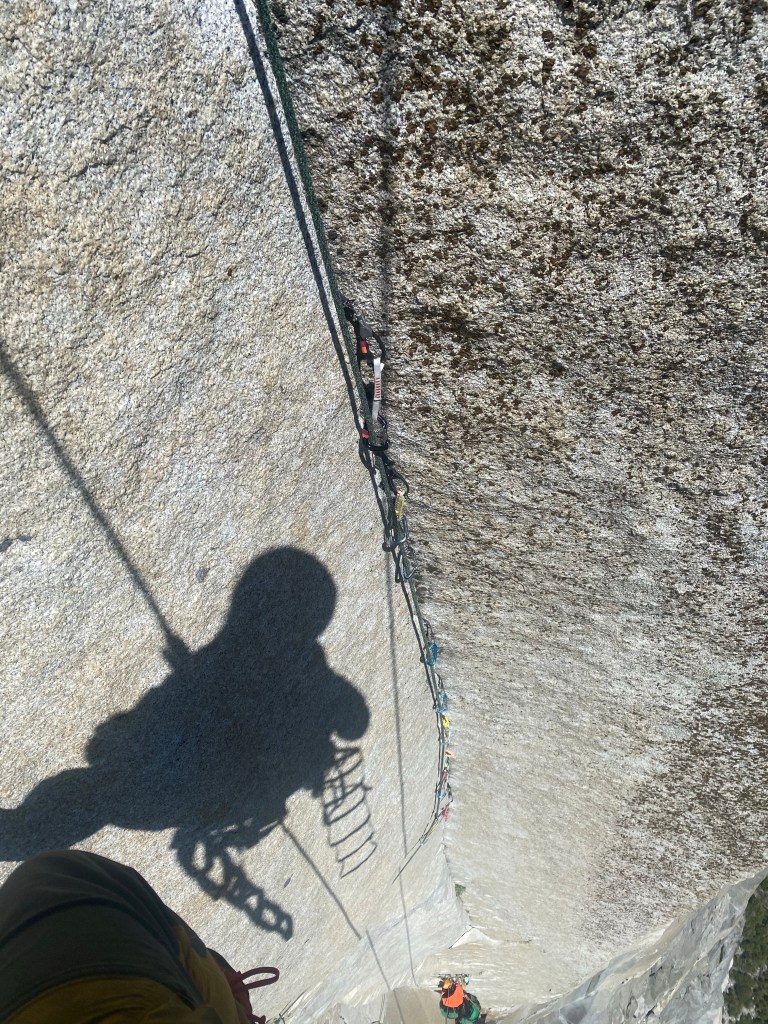
The next pitch was the Dreaded Dihedral that Pete Zabrok kept telling me to nail in. I thoroughly contemplated not climbing it that day, justifying the thought of being one pitch ahead. Ultimately I knew if I didn’t climb it I would end up psyching myself out more and more the more I thought about it, which could end up being an entire day with the weather coming in! It started with a brief slab that I found kind of challenging and mentally exhausting, perhaps because the last pitch had me mentally fucked up. Once I reached the dihedral proper I remember reading about the poor fellow who had soloed this far just to blow it while trying to climb the pitch clean, landed on the slab, and broke his ankle, being rescued off the next day. I climbed up several placements, surprised that I was struggling to find good bomber camhook placements, and hammered in a Lost Arrow. I had never used one of these, but I figured since I already nailed once, I might as well make sure I didn’t wind up getting flown off the rock and to “just nail the dihedral” as Pete repeatedly told me to do. I didn’t know how to nail in the arrow until Pete gave me a quick rundown. I also didn’t know how to clean the damn thing but another friend I made (Matt Lambert) told me how to do that as well. After having placed my first angle I used a combination of the smallest cams, the occasional cam hook, and small nuts before I nailed one more. Now that I was adequately off the deck I figured I’d be alright and I slowly made my way up using clean methods. After 80 feet or so the angle tips back, but the placements get much bigger, making the climbing easier.
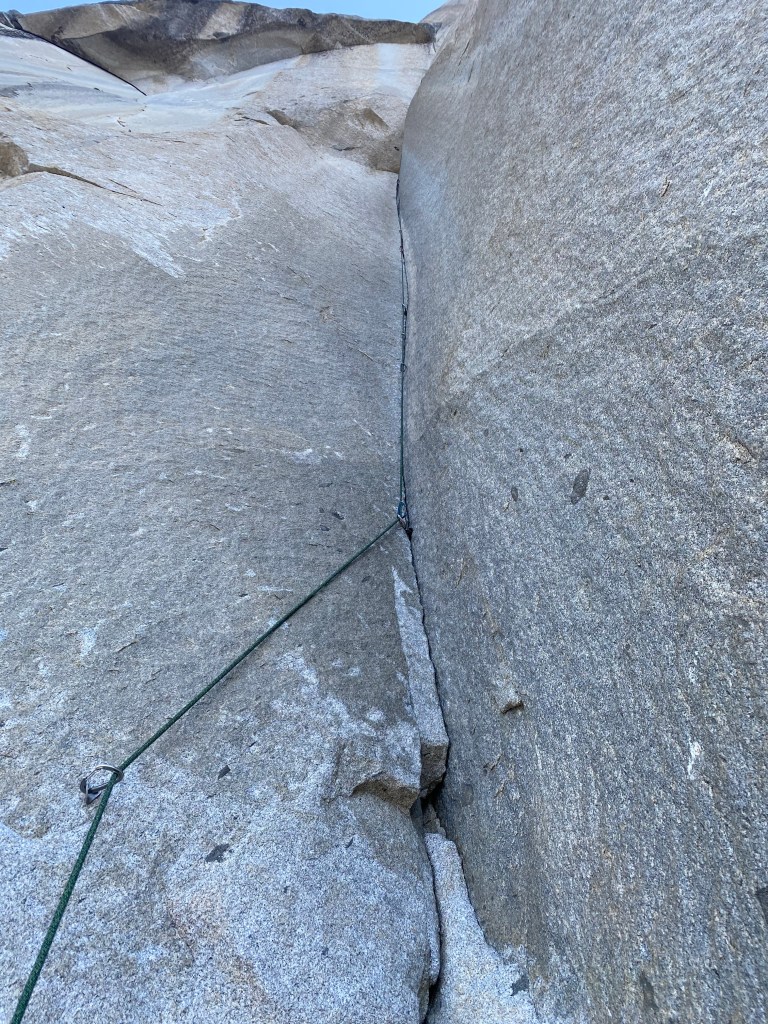
Darkness came upon me and I continued climbing through it, wanting to stay ahead of schedule as the weather continued to look bad the next day. The last stretch of climbing requires you to climb on the side of this barely attached flake for several moves. When I placed a piece of gear behind it I could hear it scream and moan, begging to be released from its position and fall to the valley floor. This piece of rock probably scared me more than anything else on this entire route. I had read an accident report of a team climbing the Muir who dislodged a loose piece of rock, cutting the lead climbers rope, sending him falling to his death. As I cautiously placed a cam behind this flake I kept imagining this piece of rock doing the same. It looked like the kind of rock that would cut my rope right from my waste, leaving me to fall over 2000 feet straight down. I made sure to stand tall in my aiders, to minimize the number of placements I made and get off this death block as soon as possible. This thing looked to only be attached by a small section at the bottom, and maybe a bit at the top, being the inverse shape of an hourglass. I finally made it past the flake, leaving zero gear in it, and continuing to the anchor.
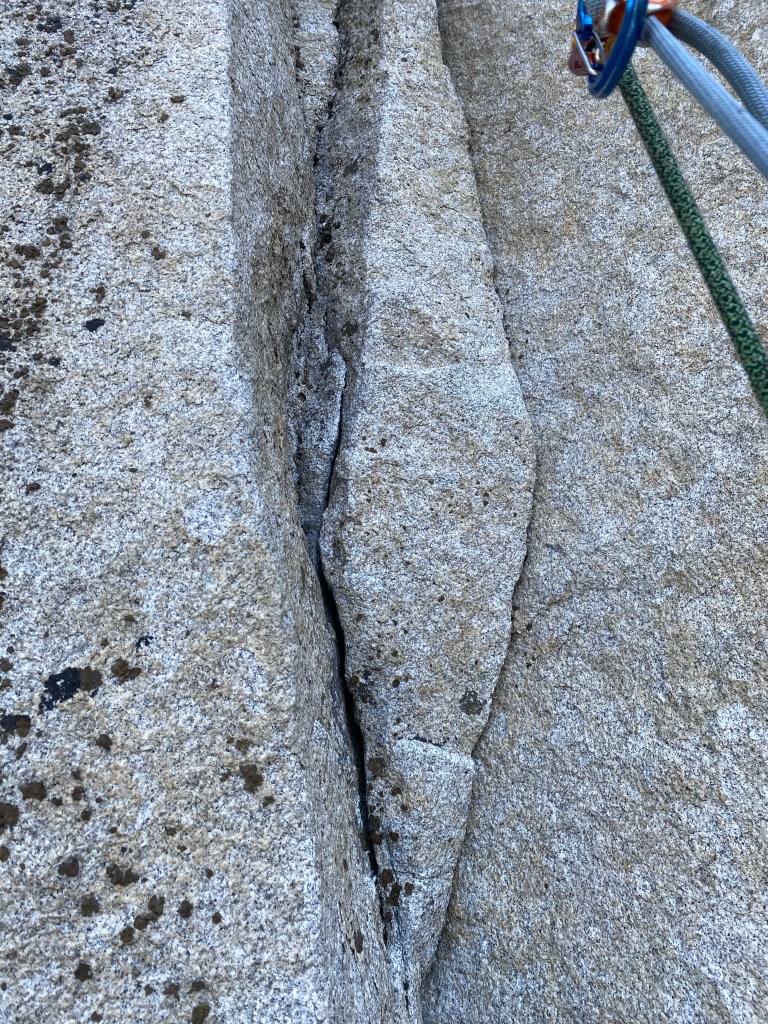
I rappelled back down and went to sleep on my ledge at the intermediate belay just below the slab of the dihedral pitch. This ended up being a great bivy and a good place to hang out.
Day 12 (Wednesday 4/21): Rest Day
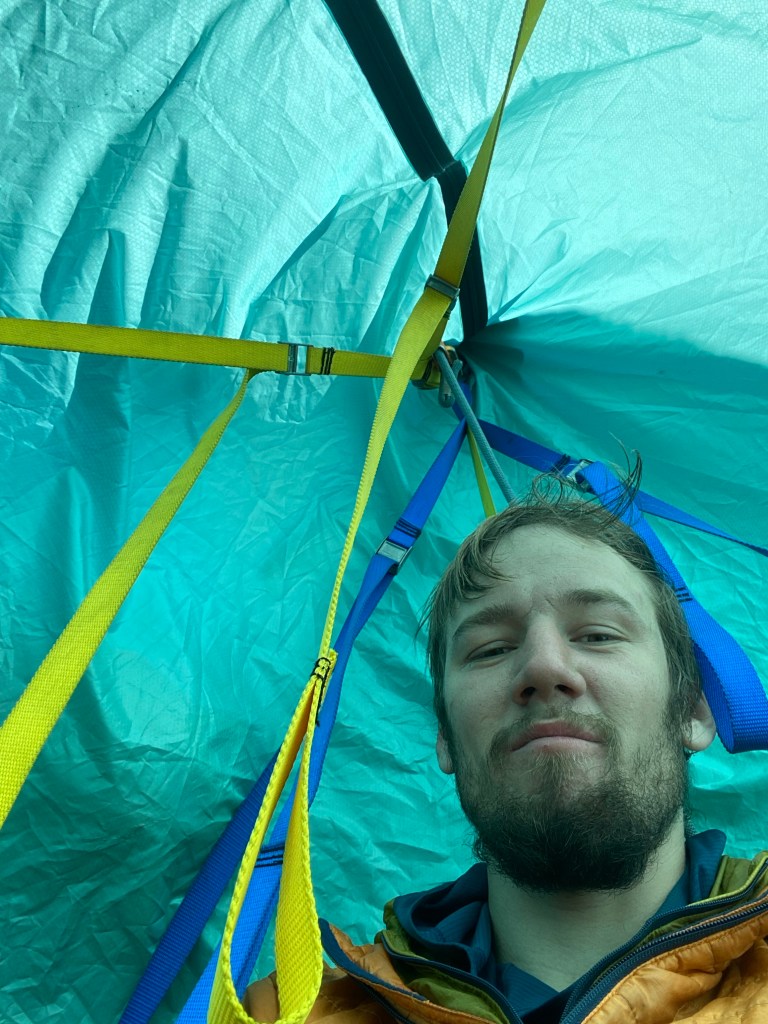
I woke up once in the middle of the night to light rain, closing up my bivy sack as I had not set up my rain fly yet. The rain was brief, but I figured it just an omen for what was to come later in the day. The forecast had the storms coming between 1 and 5. While I figured if I got up early I could knock out a pitch, I would first have to clean the pitch from the night before and move base camp, which I wasn’t super keen on doing. I didn’t want the storms to come early and leave me hosed trying to set up a ledge while getting crushed by the weather. I opted to sleep in a take my morning fairly lazy. So lazy I considered leaving the rain fly off and just going to the bivy sack. I knew the rain fly would be better, but if I’m being honest I was just scared because I had never set it up in a real on the rock situation before and I didn’t want to deal with it. In the end, I opted to set it up and it was totally fine. I did notice I have quite a few holes in it, which is a bummer considering I’ve never used it. I need to repair those and stop leaving them in the ledge haul bag and transition it to the inside of the actual haul bag I guess. I got myself prepared for the big storm, reading my book, spending far too much time on my phone, and generally being very bored. I watched as the sky came and went constantly threatening, but ultimately never doing anything. An entire day wasted! but I likely needed the rest and my hands and feet were grateful for the break. I got to read all about John Muirs various adventures and connected deeper with the route’s namesake. Also, my phone battery started becoming an issue, and if I wanted to be able to talk to anyone on the summit, I needed to start rationing my use of it at this point. Videos and pictures almost ceased at this point.
Day 13 (Thursday 4/22): Pitch 24, 25, and 26
Going from a pitch ahead to a pitch behind meant I had to find somewhere in the next 3 days to make up that one pitch, also knowing I hoped to combine the last two pitches would allow me to get off the mountain Saturday evening. This was non-negotiable as now not only did I have to get to work, but there was also an all-day rainstorm coming that was supposed to last through all of Sunday and most of Monday. Additionally, the temperature was going to drop so low that it was threatening to snow!
After cleaning the dihedral pitch, I got started on pitch 24, perhaps my favorite of the route. This pitch is graded C3F or A2, but honestly, I just found it to be C3 fun. This pitch was two straight in cracks that allowed me to get high in my aiders on every move and felt more like climbing in zion but on granite. I do remember there being a short section at the top that was moderately challenging, but with an entire pitch of bomber gear below you, it didn’t feel very intimidating. I loved every second of this pitch. Looking back, perhaps my body was just feeling rested after the day off and everything didn’t hurt as much. Whatever it was, I had a blast.
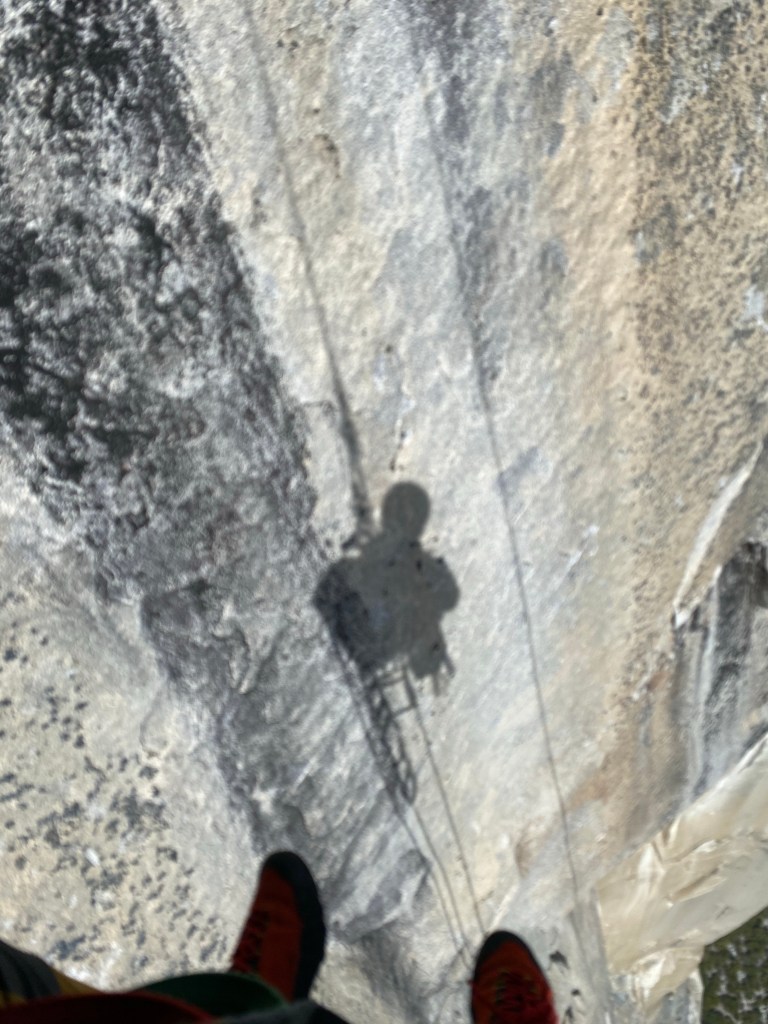
The next pitch was short and easy. The fixed heads listed on the topo were there, so I didn’t need mine, though I did bring them. Also, I’m 99% sure I could have easily gotten around the fixed heads with very little trouble. This pitch also had a fun hook move at the end that I thoroughly enjoyed, and ended at my favorite bivy of the entire route, a 3×6′ ledge that was great for one person.
After loving the first 2 pitches, and having a C1 pitch above me, I charged on into the night, climbing a third pitch to get back on schedule to finish on Tuesday. This was the beginning of a very long corner that would take up the next 3 pitches. It ended at a nice ledge stance and anchor that I fixed at and rapped back down to my bivy. This was probably my favorite day on the route and was so much fun.
Day 14 (Friday 4/23): Pitch 27 and 28
After cleaning the pitch I did on the previous night, I had a long C2 corner that looked similar to the first corner that I got intimidated by, but slightly longer. This time I was not nervous or concerned, the experience of my previous harder pitches giving me the confidence to charge on. That being said, I’m surprised the pitch didn’t get a mention for being black totems for days, similar to the 1″ pitch. I felt like all I used was black totems until mid-pitch things suddenly got very wide and I used a couple of #5’s to get through to a fixed nut with a chain attached to it….very odd. After this pitch, I got to lay my eyes on the crux of the route C4/A2+. Looking up it looked short but very thin, and jungly.
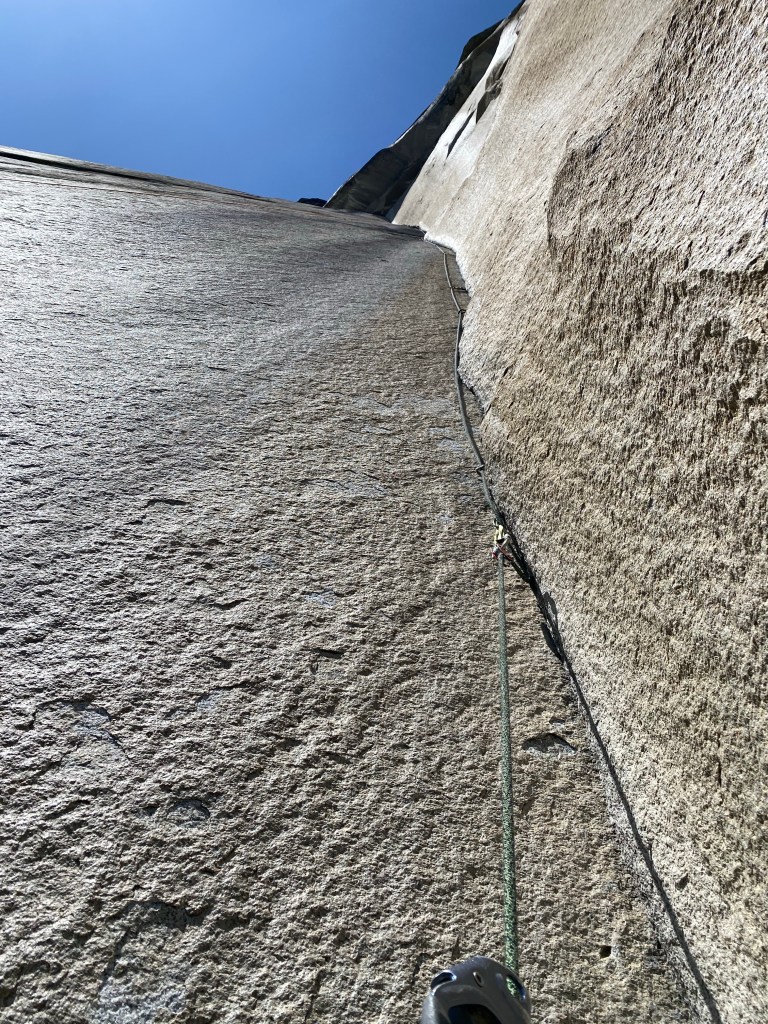
The first 2 placements off the belay were bomber, key for keeping a factor 2 out of the question. Additionally, I could look up and see there were a few fixed pieces that would help, but I couldn’t see how to possibly get to them. Having already nailed several times I made a few small placements then got a lost arrow in, removing any temptation I had to get the pitch clean. Then I simply couldn’t see anything within reach. I began pulling at grass, flowers, and weeds, ripping them out of the crack, looking for places I could put gear. The vegetation was growing right out of pin scars, and as I gardened the crack, their juices ran down my arm. Eventually, I learned to use my nut tool to assist in this endeavor, cleaning 3-foot sections at a time looking for places to put my gear. I slowly and methodically worked my way up the pitch, nailing 2 more beaks (one medium, one large). Along the way, I also saw a fixed head that was simply slotted in the crack like a nut, but not nailed at all. This pitch was mentally draining, and unlike the first potential C4, I don’t think I would have been able to do this one clean. I reached the first belay which had a smattering of bolts and opted to finish up to the belay to just below the roof. Upon reaching the end of the pitch it was obvious the lower belay was much better for setting up a ledge. After all the lessons I learned over the previous two weeks, I was getting pickier about where and how I set up my Octapod. While I was tempted to tie my ropes together and go all the way back down to the awesome bivy at the base of the corner, instead I fixed my lead line to the upper anchor, rapped down, and used the intermediate belay, setting up my ledge and having an awesome last night on the face of The Big Stone!
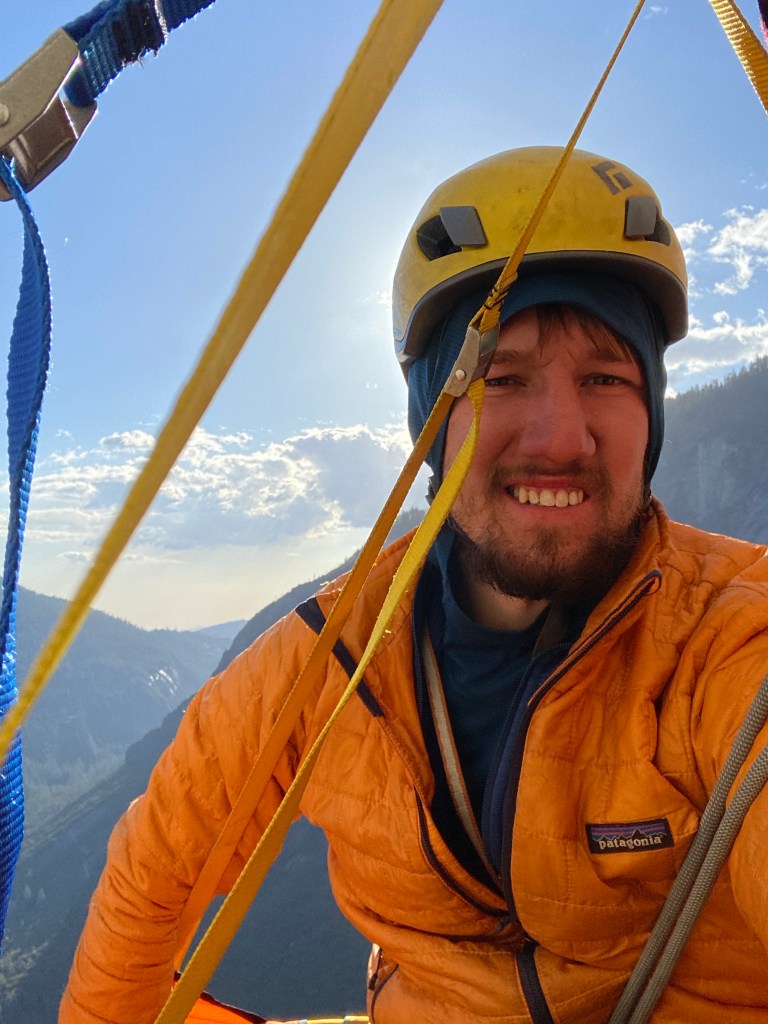
Day 15 (Saturday 4/24): Pitch 29 and 30. Beginning of descent
When I awoke I had maybe 30 feet to jug up to the belay for the pitch. The last pitch looked fairly intimidating, being directly under a roof and traversing straight left. From below the climbing was inobvious, but once I was at the base of the climbing it showed itself. I jugged up the 30 feet, leaving my bag below, haul line attached to the lower anchor, and bringing the lead line with me. I intended to link the last two pitches, since there is no rope drag when you solo, and so I wanted as much lead line as I could get. I started up this pitch and with the assistance of what was probably the only mandatory hook move on the route (loved it!) made my way outright, where I climbed up to a penji point. The climbing then led me down and left, to an obvious hand crack that I free climbed most of. Once the climbing got a little harder and more flared, I threw in some of my bigger totems and made a few free moves to a fixed piton. Leaving no gear below me, I knew that if this Piton blew I was going to take a monster swing back right towards my first penji point. I weighted the piton and after several moments of it holding, took a deep breath and began to tension hard left, also scraping against the rock trying to work my way to a ledge 20 feet left using the combination of rope tension and climbing. I had difficulty, once again, and opted to throw in a small piece to assist me. Luckily, after I made my way to the ledge, I was able to reach back and clean the piece.
I walked across the ledge looking for an anchor so that I could reset myself for the next pitch, and there was a lone piton. After looking for a while for the next pitch, I saw it on top of a block that the topo doesn’t mention. I couldn’t find an easy way on top of the block until I walked behind it and found a squeeze chimney in its back. Having not mentally prepared for this I wasn’t super stoked and took a few minutes to mentally convince myself this was what I had to do. Once I committed, the climbing was easy and I was on top of the block easy enough. I then scampered up the easy climbing to a final mantle move, where I was able to place 2 black totems and stand tall in my aiders to avoid having to do any difficult free climbing.
I was now on third-class terrain and began walking straight right to where the anchor was. I got within 10 feet when my lead rope, which was zigzagging through all the gear below, ended just short of where I needed to go. DOH! I walked back and found a big crack to build an anchor to jug up the rope on. I then untied from the lead rope, flipped my haul line around so that it was dropping straight down, and carefully walked across the rock to the anchor. I set up my haul line to haul and rappelled back to the initial anchor, which was straight below me. Convenient! As I was rapping down I noticed an issue though. Because I didn’t leave the lead rope attached to the anchor where my haul bag was, I wouldn’t be able to go down there and release the haul bag. If I did that, I would wind up stranded with no rope, the lead line above me, and the haul line behind me and to the left. I was going to have to clean the pitch, then rappel back down to the haul bag with the lead line, then do a free-hanging rappel back up to the anchor on the lead line, and then haul the pitch. Annoying, but not the end of the world. I had been climbing for nearly 2 weeks and I waited until the very last pitch to make a major mistake!
As I began cleaning my pitch I also realized I did not leave myself any spare rope for lower outs, of which there were 3 on this pitch, including the one in the very beginning. I didn’t have enough rope for the first lower out, and so I took a short swing in the roof section. I wasn’t thrilled about it, but it was not a big deal, very safe. The second lower out was much longer and again I was short on the rope. I was short enough that no only was I going to swing sideways, but I was also going to fall and probably hit the corner on the way down. I began to get very nervous, until I remembered that I had the haul line, unweighted, above me. I attached myself to that, lowered myself off the lead line, and then safely swung over. My mistake had paid off! The last lower out also ended up with me being a bit short on the rope, but the first was not a big deal. I jugged back to the anchor, set the lead line up to drop straight down, and started rapping down.
During all my cleaning shenanigans the haul line had wrapped itself around a flake way to the left. I tried to pull it over without success and was also not able to flick it out of the flake. I continued to work on it without any luck, resorting to having to pull myself over, across the majority of the pitch. I was hoping that I could get myself to the flake, steady myself, release the haul line, and then find a way to control my return. But of course, I got within 5 feet of the flake, and the haul line finally released, sending me flying back to the right. The swing was outrageous, probably in the ballpark of 100 feet, and slingshotted me back to my anchor, which I was able to grab to prevent the backswing. My heart was in my throat during this, and while I knew it was safe (nothing but air), it still scared the shit out of me!
I then did the long free-hanging jug back to the anchor and hauled the last pitch, completing the route, but not the adventure. I finished hauling the pitch around 430 on Saturday afternoon, leaving 3 hours of sunlight to get packed up and moving down the mountain. With a lot of weather coming, I was hoping to get down with one load, but that was a pipe dream. As I began packing my bags it became obvious that was impossible, both because of the weight of my gear and the volume it took up. I began packing two bags, kicking and cursing the whole time know there was no way I was going to avoid getting very wet the next day.
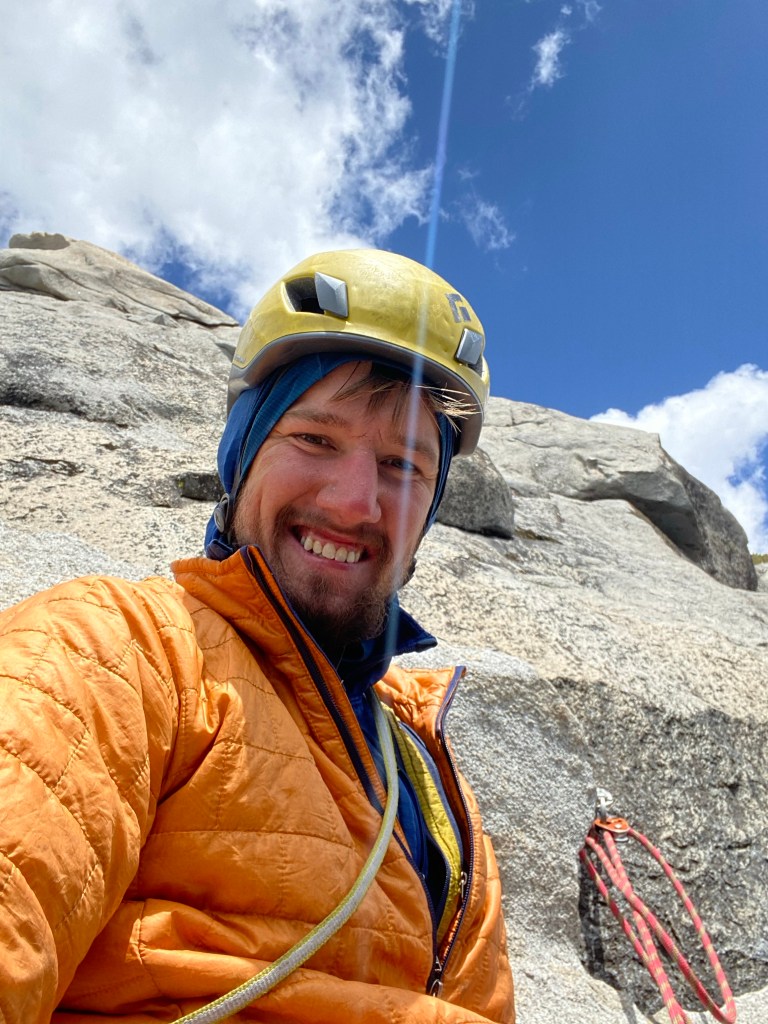
Once I had both bags packed, one very heavy, the other moderately so, I walked one bag to a landmark near the top of the nose, and then went back for the other. This was a great idea I picked up from Pete, having initially planned to walk one bag down, and then walk back up to get a second bag. Instead, I walked the bags from landmark to landmark, all the way down the slabs to the base of the creek that leads to the waterfall. Benighted, tired, and hungry I stopped there to eat dinner, my last dehydrated meal! Following dinner, I was much too tired to continue and opted to go to sleep right there, putting my gear below a big boulder, and getting in my bivy sack, sleeping to the sound of the water rushing towards the waterfall. Before falling asleep two lost climbers found me topping out East Buttress and looking for a way to hike off. After some brief confusion where I tried to lead them to the rappels, which they were thoroughly against, I gave them general guidance towards the nose. I don’t know if they ever found the hikers trail, but the thought of it sounded downright awful. Fuck that.
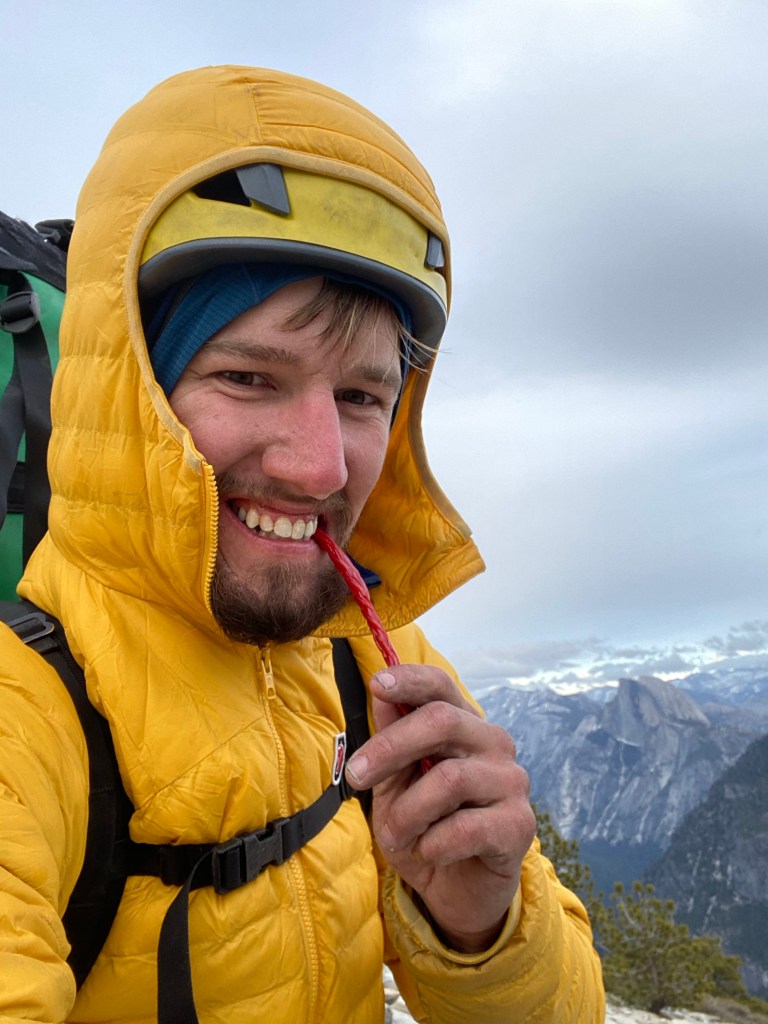
Day 16 (Sunday 4/25): Finished descent
I woke up in the morning to the pouring rain that I was expecting. No such luck as last Wednesday where the weather never came. I laid in bed for a long time, begrudgingly wishing that I was anywhere else, and wouldn’t have to do what I was going to have to do. My phone was dead so I had no idea what time it was, but just laid there pouting for several hours. Finally, I got out of bed, threw on my rain gear, grabbed a bag, and marched on. I went all the way to the top of the rappels before I turned back and walked back to the waterfall. I then grabbed my other bag and brought that to the top of the rappels.
After struggling with the bags for quite some time, trying to unload my gri gri and load the lower out cord on the first rappel, while getting hailed on, I got started on the rappels. The GriGri 1 was buried in the bottom of one of the bags, and so were my prussics, so I used my GriGri + on the first fixed-line. This sucked big time and took forever to get down the rope. It was just too fat, and being soaking wet didn’t help. After that, I pulled out one of my ropes and fixed that which got me to the last rappel. I then opted to jug back up and grab the rope. I was briefly tempted to simply leave it, but it’s still in pretty good shape. I finished up the rappels and was so close to being finished for the day. It didn’t look like it was anywhere near sunset either but I couldn’t see the sun to tell for sure, as it was hidden behind all the rain clouds.
I grabbed the lighter of the two bags and marched down the final hike to the car. The entire climb I had been concerned that my car was going to have been towed. One because I was on the wall for so long, and two because I thought I might have forgotten a burrito in my center console, and was worried a bear probably ravaged my vehicle which I’m sure the park service would have towed away. As I finished the hike to my car I started clicking my lock button, hoping and praying to hear the horn on my car. The last thing I wanted to do was try and find a ranger to figure out where my car was and how to get it back. Luckily, once I hit the bridge, I saw the car’s lights flash up. The burrito was in there (whoops!) but the car was just how I left it. And it was only 4:30!!! I had plenty of time to head to Degnan’s and grab some grub!
Day 17 (Monday 4/26): Retrieved last load
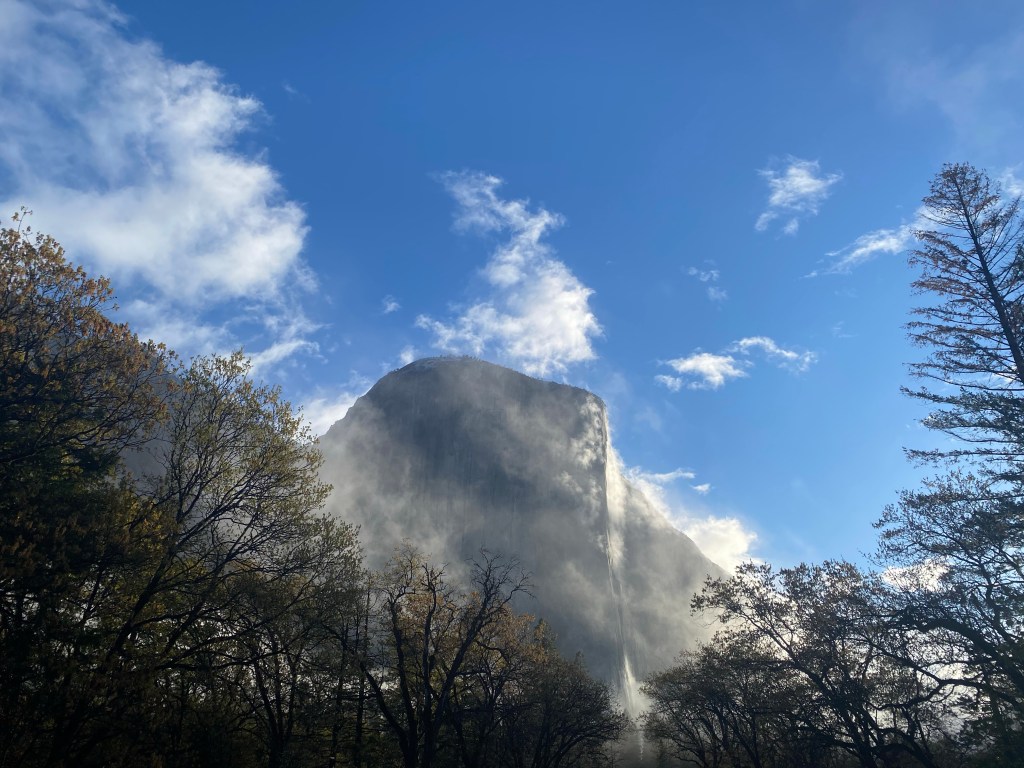
After spending the night in El Portal, thinking about what I just pulled off, and reading stories from Pete Zabrok’s Hooking Up, I drove back in to hike up and get my last load. On the drive in the tops of the mountains were covered in snow. So glad I wasn’t still up there. I hate snow! The hike up to get my load was peaceful, and the bag wasn’t as heavy as I remembered, as it had sat in the sun all morning. I got my last bag to the car and drove out of the valley, heading straight to work, without even stopping at home before I got there. I did grab a hotel in vegas so I could sleep in a nice bed and get a warm shower which was much needed.
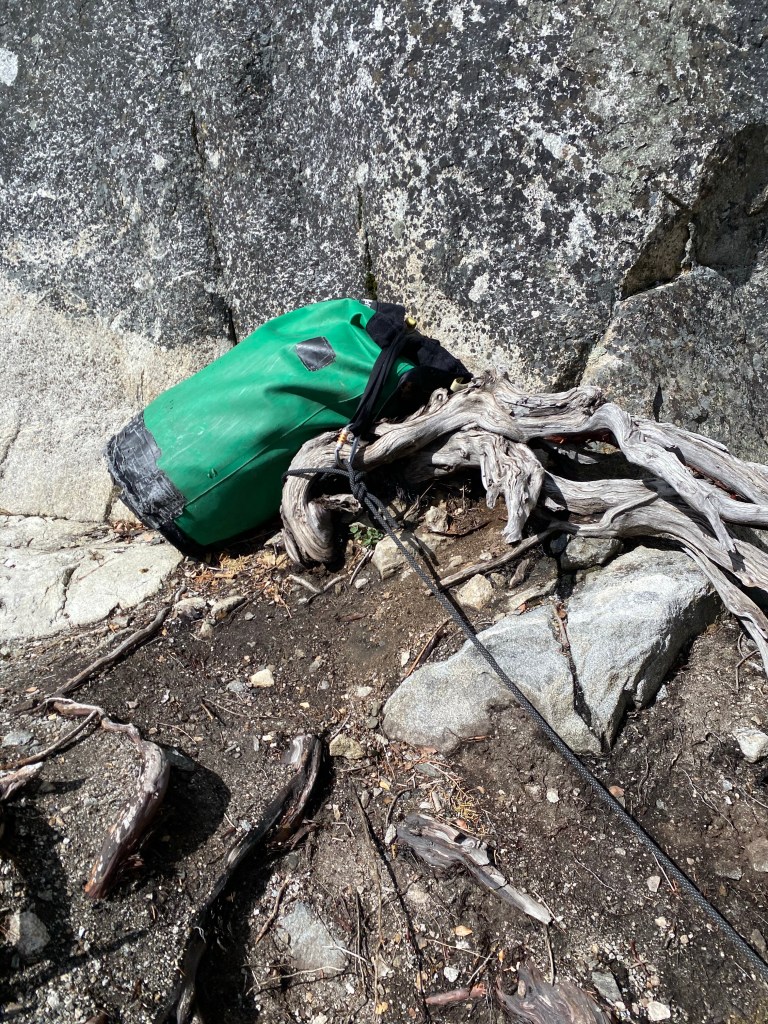
My system used was a GriGri+ with an Edelrid Swift Pro (8.9) rope and a dynamic 10.0 Beal Tiger for the Haul line, with the ability to switch to that rope and a GriGri 1 if needed. Zabrok thinks the 8.9 is too thin, but I thought the system worked great. I didn’t fall though on the route so who knows! Maybe I was dangerously close to disaster the whole time. For a rack, I brought 4 lost arrows (nailed 3 on the route), 7 beaks (nailed 3 on the route), 3 sets of offset cams, 2 sets of offset nuts, a set of ball nuts, a set of RP’s and a set of peenuts, 3x all cams .1-#4, 2 #5’s, 1 #6 (not needed after first 10 pitches, and probably not needed on first 10 pitches, but very nice to have). I also brought 1 cam smaller than a .1. I brought 2 hooks but only used 1, made 3 hook moves the whole route, probably only 1 of which was mandatory. I also brought a set of heads which were completely unnecessary.
I brought 12 gallons of water and dumped out 6 on the summit. I would have left them for future parties, but they were in MSR bags, not gallon jugs, sorry. I brought too much food and probably hiked down 15 lbs worth at the end. I also brought too much backup gear, wanting to make sure no single mistake could totally fuck me. That being said, I only dropped 1 carabiner on the route and fixed no gear.
This was a grand adventure, certainly the most outrageous of my life……so far!

 Big Wall T-Dawg
Fantastic accomplishment and a great trip report. Thanks!
LikeLiked by 1 person
Dank climb! I did Royal Arches while you were up there and I thought that was tough.
This is an awesome write up and I’m sure it will help future generations of big wall climbers (i.e., not me).
This actually made me tired reading it, lol.
LikeLiked by 1 person
What an adventure. Thanks for being so frank about your fears and providing such a wealth of detail about the route. I’ve been fantasizing about soloing the Muir for years; maybe this will actually kick me into action. Nicely written too…keep it up!
LikeLiked by 1 person
This is a really excellent trip report. It is a great reflection of your thoughtful and humble nature. Kia kaha from your friends in New Zealand!
LikeLiked by 1 person
EXCELLENT trip report, Tony! I’m looking forward to being up there soon as well! Thanks for one of the best trip reports I’ve seen.
LikeLike
TM would be stoked to see this. I’ll show him the article the next time I see him.
LikeLike
Great synopsis of a ballsy solo. I’ll try to get in enough time (and “shape”!) to join you again the next time I make it out to CO. Here now, but it looks like the schedule is full – and I’m way outa shape.
LikeLike